Conferences Are Important for High School Studentsโ€”Youth Apprentices and STEM Professional Development

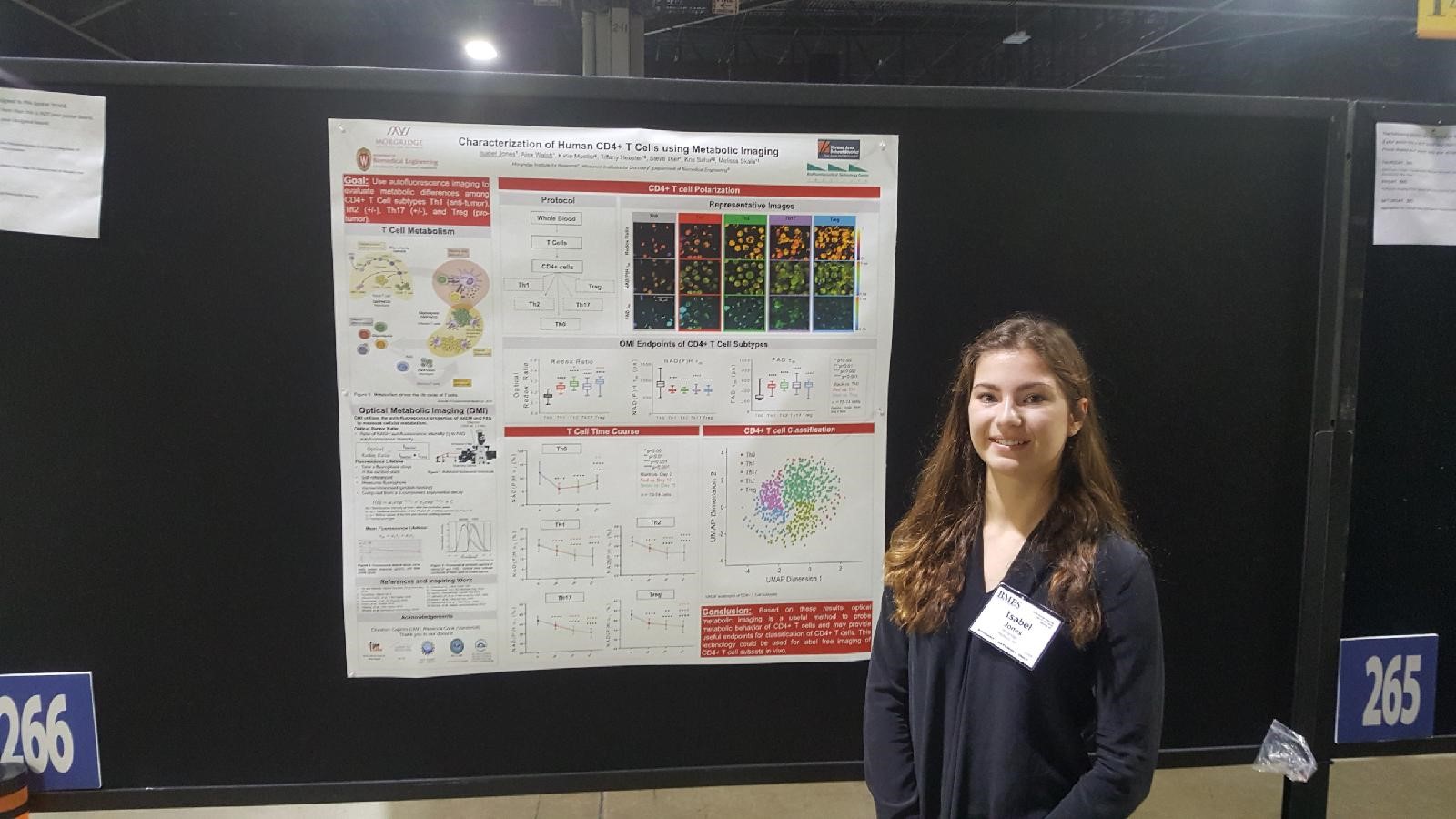
Isabel Jones presenting her research at the BMES Conference in Atlanta, October 2018.

As adults, we can all attest to the benefits of attending professional conferences. Conferences provide us with opportunities to present and share with others, network, and renew and refresh in our field. For some of us, that first conference, at the college or early employment level, may have contributed significantly to a sense of ourselves as professionals.  But what does it mean to someone younger?

Recently, three high school students enrolled in the Dane County Biotechnology Youth Apprentice (YA) Program were able to attend conferences related to their interest in pursuing Science, Technology, Engineering and Math (STEM) careers.ย  Hereโ€™s what they discovered.

Continue reading “Conferences Are Important for High School Studentsโ€”Youth Apprentices and STEM Professional Development”

Fun with Science for the Holidays: An “Actor’s” Perspective

This past weekend, I had the opportunity to be a part of “Once Upon a Christmas Cheery in the Lab of Shakhashiri”. Bassam Z. Shakhashiri is a professor of chemistry at the University of Wisconsinโ€“Madison who is well-known for his fun science demonstrations and a fervent dedication to public science communication. Once Upon a Christmas Cheery started in 1970 as an end-of-semester treat for Dr. Shakhashiriโ€™s freshman chemistry class; by 1973, the Christmas lecture had become so popular that Wisconsin Public Television offered to broadcast it during Christmas week, and this collaboration has continued uninterrupted ever since.

Thatโ€™s 49 years of Christmas lectures, commemorated by making indium, the 49th element, the Sesame Street-esque โ€œsponsorโ€ of the show. It helps that indium burns bright violet, the name of Dr. Shakhashiriโ€™s granddaughter and hence his favorite color. The color purple made a firm foundation for many aspects of the show: The chrysanthemums frozen in liquid nitrogen were purple, as was the balloon I inflated during my spiel on air movement. Most of the set was various shades of purple, too.

Bassam Shakhashiri and J. Nepper on the set of Once Upon a Christmas Cheery
The set was whimsical and very purple. Photo by Eric Baillies.
Continue reading “Fun with Science for the Holidays: An “Actor’s” Perspective”

How To Make Medicine on Mars

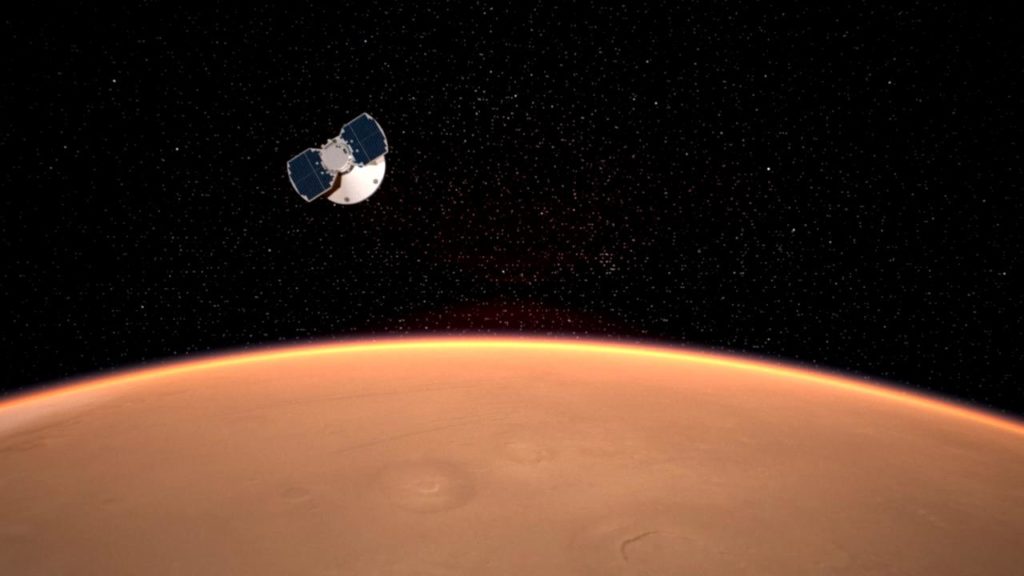
Today NASAโ€™s InSight lander will touch down on Mars. InSight, which launched on May 5, is NASAโ€™s first Mars landing since the Curiosity rover in 2012. The lander will begin a two-year mission to study Marsโ€™ deep interior, gathering data that will help scientists understand the formation of rocky planets, including Earth.

NASA's InSight lander approaching Mars.
Image credit: NASA/JPL-Caltech

While every spacecraft that reaches Mars offers more knowledge of the Red Planet, a lot of the excitement is fueled by hopes that someday these missions will bring humans to Mars and enable us to start colonies there. While this goal seems very distant, tremendous progress is being made. Scientists around the globe are making incremental discoveries that will lead to the advances necessary to make colonization of Mars a reality.

I had the pleasure of meeting one team of scientists doing just thisโ€”eight high school students from iGEM Team Navarra BG. I met the team and their advisors at the 2018 iGEM Giant Jamboree, where they presented their synthetic biology project, BioGalaxy, as part of the iGEM competition. The problem they aimed to solve is key to helping humans stay on Mars for an extended period of timeโ€”how do you take everything you need when there isnโ€™t enough room on the spacecraft? Continue reading “How To Make Medicine on Mars”

Dear Tech Serv, Thank You!

Itโ€™s that time of year again. Time to be thankful and show gratitude for those special people in your life. The undergrad who does the dishes, the labmate who shares their buffers when yours runs out, the collaborator that sends you data on a Saturdayโ€ฆ Take a moment this week to say thank you, or send them an email to show your appreciation.

Today, we want to thank our Technical Services team. They work hard to help researchers choose the right assay for their needs, understand results and troubleshoot technical problems. They strive to provide the best service for those in need. Many on the receiving end have sent thankful messages:

โ€œI deeply appreciate the help you have been and the email you just sent. I think with the information here, I may have sorted out an issue that has plagued our lab for the past few months.โ€

โ€œCannot tell you how grateful I amโ€“you’ve been a tremendous help.โ€

โ€œYou are super sharp and caught critical errors in my protocol (the calculation andย dilution errors you referenced below). While few of my colleagues run kinase assays, I did consult 6 of them, and none caught the errors you did. You’re clearly an expert and I truly appreciate how you’ve tailored everything for my ‘beginner’ level.โ€

โ€œWow, I cannot thank you enough! You have NO idea how helpful this is! You guys are absolutely great.โ€

Hereโ€™s one heart-warming story we had to share in which Tech Serv helped a group of students turn frowns into smiles.

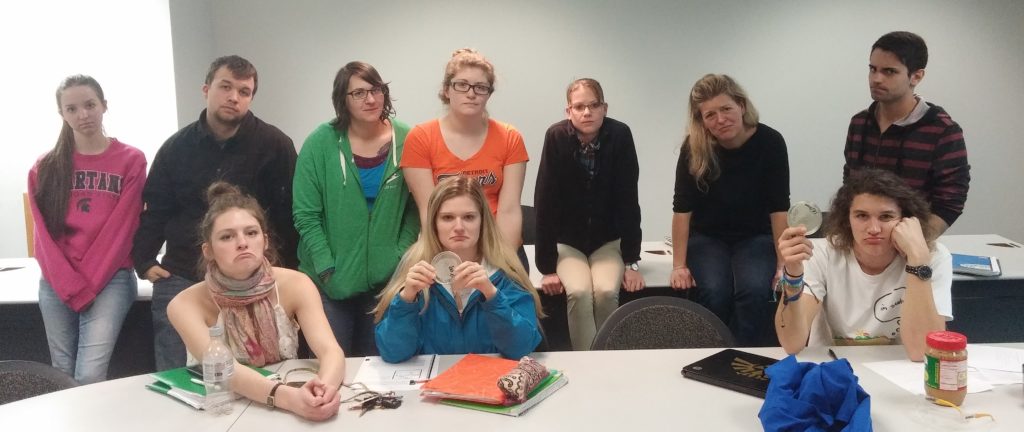
In April, Tech Serv received a message from a professor from a university in Michigan regarding an issue with the pGEM Vector System. He was teaching a cell and molecular biology course and his students were unable to generate any colonies. โ€œI have a very disappointed group of seniors on my hands. Please see the photo attached. All those sad faces trying to exude how hard they’ve worked with nothing to show for it. Any insight would be greatly appreciated,โ€ he wrote.

โ€œI understand the frustation of a kit that is not working, the students look so sad!โ€ replied the Tech Serv team. Turns out, the cells may have been past expiration or subjected to repeated freeze thaws that caused the cells to lose competence. Tech Serv sent them a replacement kit with a photo of the team for encouragement.
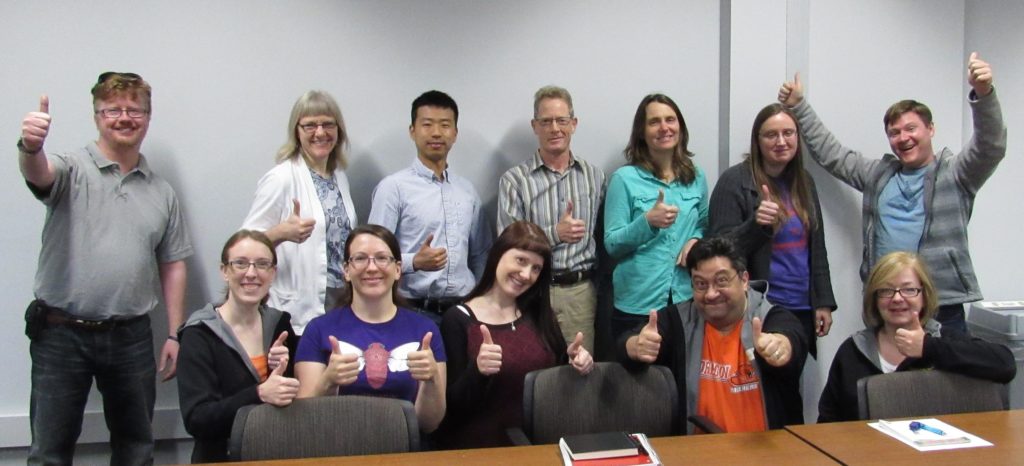
โ€œWe greatly appreciate you replacing what we have and aim to turn those frowns into happy faces before graduation,โ€ the professor replied.

Two weeks later, they got their colonies and wrote back: โ€œIt worked very well! We were able to make the most of this and they experienced a very good exercise in troubleshooting. I would say the group would view all that happened as a success. Thank you, we will continue to order from Promega as you’ve always proven to be a very client-friendly company!โ€

Nothing brings more happiness to the Tech Serv team than your success, so donโ€™t hesitate to contact them with any questions you may have. Theyโ€™re here to help.

Thanks, Tech Serv!

The Five Steps to miRNA Profiling

MicroRNAs (miRNAs) are small, non-coding RNAs that play a role in regulating cancer by acting as both tumor suppressors and oncogenes. Ranging in size from 18โ€“25 nucleotides, miRNAs function in feedback mechanisms to regulate many cellular processes including cell proliferation, apoptosis, cell signaling and tumorigenesis (1).

Not surprisingly, dysregulation of miRNA expression can have serious repercussions. For example, miRNAs are dysregulated in almost all human cancersย (1). Because of the potential to influence cancer growth and development, there is growing interest in miRNA profiling to identify possible biomarkers for cancer diagnosis or prognosis, as well as potential therapeutic targets (1).

Growing interest in miRNAs as both biomarkers of disease and therapeutic targets drives the need for fast and effective methods for miRNA profiling. Profiling miRNA targets follows a relatively simple workflow: sample selection, RNA extraction, RNA QC and quantitation, RNA profiling and data analysis (2,3). So what happens at each step?

Five steps of miRNA profiling
The Five Steps of miRNA Profiling

Continue reading “The Five Steps to miRNA Profiling”

Virtual Reality Is Changing How We Experience Science

The South Pole was exactly as I expectedโ€”snowy and barren, apart from the giant research station in front of me. Suddenly, I got a notification in my communication system that there was a strong signal coming from the sky. I looked up and changed the visual display settings of my goggles to find stunning views of the Solar System, all the way past Pluto. My heads-up display told me that Iโ€™ve discovered a subatomic particle, called a neutrino, that flies through the fabric of space at nearly the speed of light. I wanted to find the source of this neutrino, so I switched my display to X-ray vision. The signal brightened, and the source was revealedโ€”a massive black hole. I captured as much data as possible so I could report back to the lead scientist on the project. What an exciting afternoon of research!

Okay, Iโ€™ve never actually been to the South Pole, but I experienced this event in virtual reality at a conference expo booth for the National Science Foundation. This experience put me in the shoes of an astrophysicist working at the IceCube Neutrino Detection Facility, operated by UW-Madison researchers. As someone who specializes in the life sciences, I had the opportunity to learn more about an area outside my expertiseโ€”the fascinating world of particle physics.

VR headsets offer immersive experiences for entertainment, education, training, and more.

Most people think of augmented reality (AR) and virtual reality (VR) in the context of gaming or entertainment. Youโ€™ve likely had a casual AR experience if youโ€™ve ever given yourself a flower crown in Snapchat, or hunted for Charmander at your local park with the Pokรฉmon GO app. Yet, as I experienced at a conference several weeks ago, AR and VR can have massive implications for education and training experiences in the sciences.

Continue reading “Virtual Reality Is Changing How We Experience Science”

Could Your Appendix Predispose You to Parkinsonโ€™s Disease?

Image of span of vagal nerve, humans.
The vagal nerve could serve as conduit for transit of alpha-synuclein from appendix to brain.

Since about 2000 weโ€™ve learned a lot about the bacteria in our guts. Weโ€™ve learned that the right bacterial communities in our gastrointestinal system can make us feel better, think better and even help avoid obesity (1). My colleague Isobel has previously blogged about how certain gut bacteria can improve immunotherapy outcomes.

Conversely, the wrong bacteria in our guts can have negative consequences on health and cognition.

Along the way weโ€™ve learned that gut bacterial flora can be influenced by what we eat, certain medications like antibiotics, and even stressful events. We now know that fermented foods like yogurt, sauerkraut, kombucha and that horrible-smelling stuff (kimchi) that another colleague eats are happy food for the good gut bacteria.

And you might guess that fried foods, saturated fats and certain carbohydrates can support the growth of gut bacteria that are doing us no favors when present in large quantities in our gastrointestinal system. Continue reading “Could Your Appendix Predispose You to Parkinsonโ€™s Disease?”

In a Perfect World, Bacteria Wins

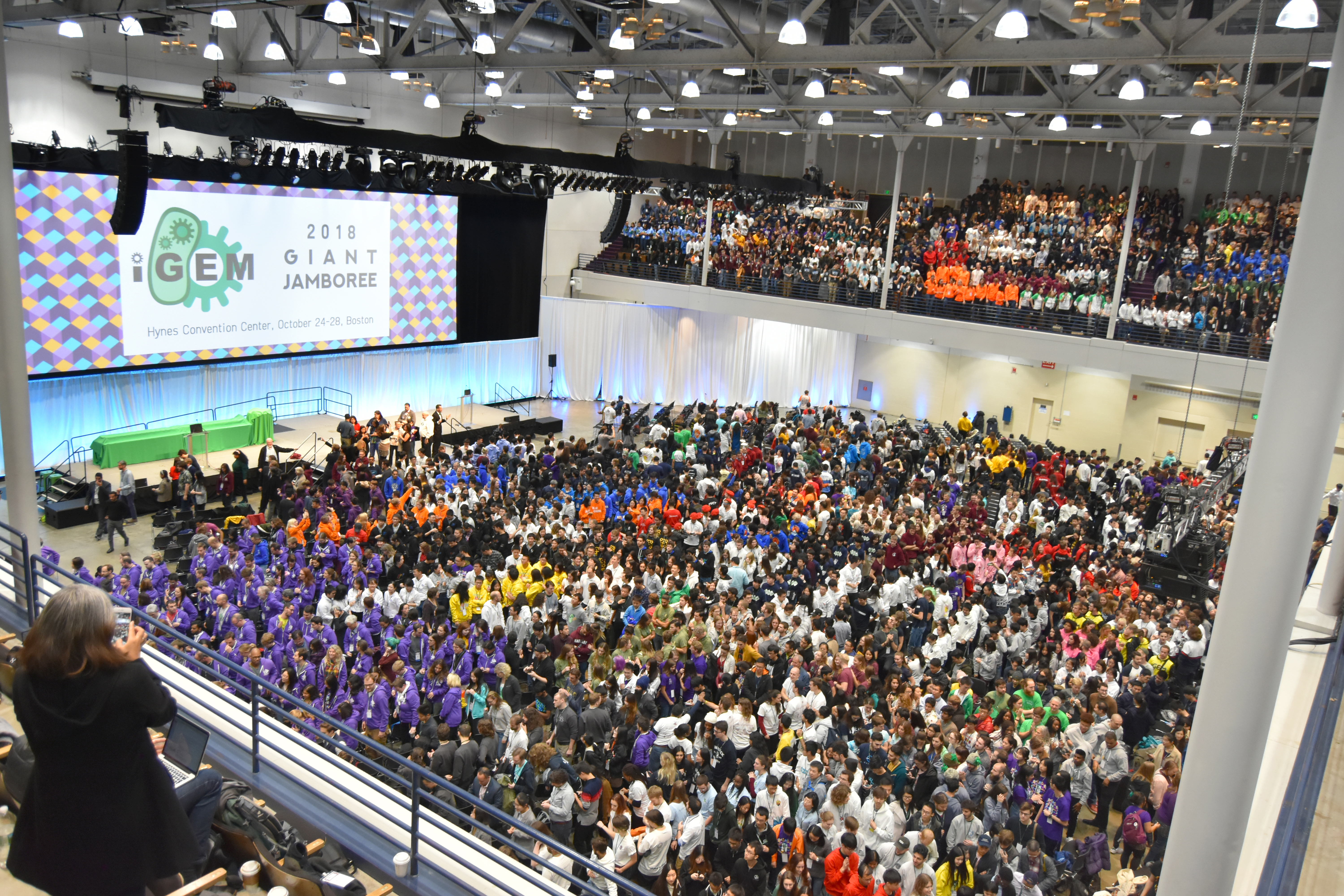
iGEM 2018 from aboveLast month, several of my Promega colleagues and I attended the 2018 iGEM Giant Jamboree in Boston, MA. This annual event is the culmination of the International Genetically Engineered Machines competition, in which 350+ teams of high school, undergraduate and graduate students use synthetic biology to solve a problem they see in the world.

The iGEM Giant Jamboree is the closest I have ever come to a scientific utopia. For four days, several thousand students from 45 countries come together to share their experiences and discuss ways that science can change the world. They present impressive projects with real-world applications including human diagnostics and alternative energy. Collaboration and open science are among the core tenets of iGEM, and itโ€™s not unusual to see three or more countries represented on the Collaborators slide at the end of a presentation. Each project also contains a public engagement component, which many teams fulfill with educational programs or partnerships with underrepresented communities. Continue reading “In a Perfect World, Bacteria Wins”

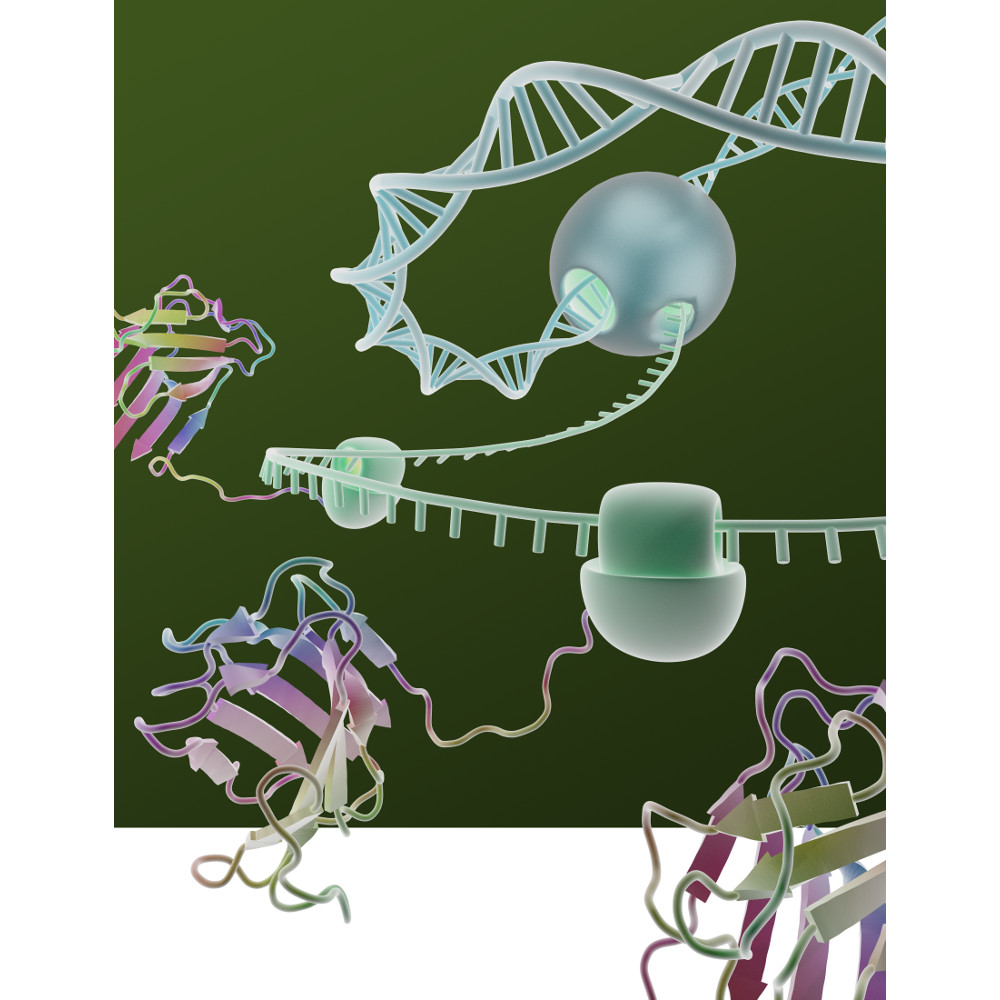
Cell Free Application: Characterization of Long Non-coding RNA Inhibition of Transcription

Long noncoding RNAs have been shown to regulate chromatin states, transcriptional activity and post transcriptional activity (1). Only a few studies have observed long non-coding RNAs modulating the translational process (2). The noncoding RNA BC200 has been shown to inhibit translation by interacting with the translation initiation factors, eIF4A and eIF4B.

To characterize how BC200 translational inhibition could be controlled,  a variety of RNAs were transcribed/translated in vitro using the TNT system (Cat. #L4610) from Promega. To each transcription/translation reaction, BC900 RNA, hnRNPE1 and hnRNE2 proteins were added. Inhibition of BC200 activity was noted when proteins were successful expressed (3).

Literature Cited

  1.  Sosinska, P et.al. (2015) Intraperitoneal invasiveness of ovarian cancer from the cellular and molecular perspective. Ginekol. Pol. 86, 782โ€“86.
  2. Geisler, S. and Coller, J. (2013) RNA in unexpected places: long non-coding RNA functions in diverse cellular contexts. Nat.Rev. Mol. Cell. Bio. 14,699โ€“12.
  3. Jang, S. et. al. (2017) Regulation of BC200 RNA-mediated translation inhibition by hnRNP E1 and E2. FEBS Letters. 591, 393โ€“5.

Long-Lasting Beauty from the Humble Egg

Egg tempera image of multiple people surrounding a dais - Panel by Fra Angelico
“The Coronation of the Virgin” tempera on panel by Fra Angelico [Public domain], via Wikimedia Commons

Chicken eggs are widely found in most grocery stores. They are a cheap and unassuming source of protein, easy to cook as you desire (e.g., fried, scrambled, hard boiled) or use as a binder for other food items (e.g., meatloaf, cakes, cookies). One reason I keep laying hens myself is not only for fresh eggs but also to have egg shells other colors than white, the predominant color sold in US grocery stores. However, did you know that these humble eggs have uses that donโ€™t end up in the stomach and instead, are a feast for the eyes? I was introduced to the concept of egg tempera, a medium used for painting, by my colleague, Karen Stakun, artist and manager of our graphics department during a discussion about chickens. I was intrigued by the concept.

Continue reading “Long-Lasting Beauty from the Humble Egg”