Every October, the noise starts up again: it’s breast cancer’s turn for awareness. I brace for it a little every year. What bothers me isn’t the concept, it’s watching companies race to out-pink each other.
A pink ribbon on a shirt or a car can foster a certain amount of solidarity, but at the corporate level, the awareness noise is genuinely inescapable: a building lit up pink for the night, a pink yogurt lid, or a player running out onto the field in pink cleats. Many companies have run some version of the same campaign, and what actually happens to the profit from pink merchandise varies wildly: modest percentages, hard caps on total donations, or numbers that only recently moved after enough people asked questions.
In addition to the question of money is the question of effect: what does a company’s participation do? If the goal actually is awareness, I’ve never understood who remains unaware. It tends to generate goodwill instead, and the sometimes cynical among us might call that marketing, whether or not that’s the intent.
Here’s a sentence that’s true to me, one most people have their own version of: my sister had breast cancer. One in eight women in the U.S. will hear that diagnosis in her lifetime (though women aren’t the only ones who get it). So we are aware. We have been aware for a long time.
At one point, however, we actually needed awareness, in the literal sense of the word. When the American Cancer Society started its breast cancer awareness campaign in 1985, breast cancer was a disease people didn’t discuss in polite company, self-exams weren’t routine, and mammograms weren’t the norm they are now. Getting people to talk about it, check themselves, and get screened was a real, specific goal, and awareness did its job at the time. Last year marked the campaign’s fortieth anniversary, a point at which even the American Cancer Society’s own retrospective pointedly admitted: awareness alone isn’t enough anymore.
October runs on that word, awareness, as if noticing something were the same as solving it. As if on November 1st, we can dust off our hands, congratulate ourselves, and move on to the next color of the month. But breast cancer research doesn’t run on that calendar. Real, promising work has been happening. Learning about it might not change anything either, not directly, but it’s one step closer to what the American Cancer Society itself is now calling “Turning Awareness Into Action.”
More Than a Pretty Face
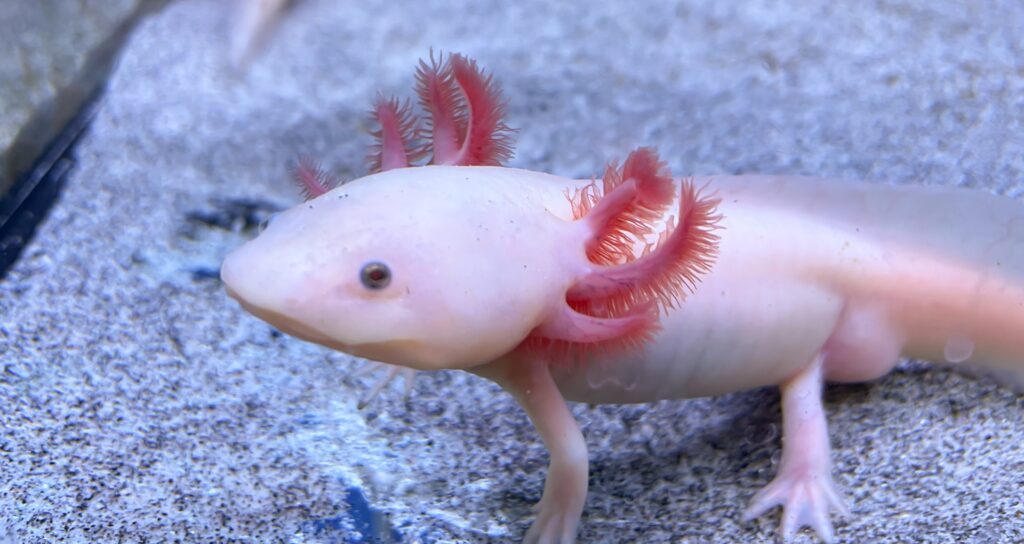
This starts, perhaps unexpectedly, with the axolotl, a foot-long Mexican salamander known for its perpetual smile and the feathery gills that fan out from its head like a spray of coral. The most common pet-store variety is also, conveniently for this piece, pale pink. It has become plastered across backpacks, folders, plush toys, and t-shirts. My nine-year-old niece and her friends are obsessed with them.
Axolotls also regenerate limbs, spinal tissue, even parts of the brain, and every one of those replacement cells carries a small chance of inheriting a DNA copy error, a mutation that could eventually lead to cancer. Given how much regeneration occurs, axolotls should get far more cancer than they actually do. Researchers suspected part of the answer might lie in the animal’s own defenses: its adaptive immune system is unusually weak, so mucus and innate immunity do most of the actual protecting.
To learn more, researchers pulled on their nitrile gloves, collected the axolotl mucus, and screened it for peptides likely to fight infection. After narrowing thousands of possible candidates, they found four with significant antimicrobial properties. Given that axolotls have unusually strong cancer resistance, and that peptides in other amphibians have shown anticancer effects, they also tested select peptides directly against breast cancer cells. Three peptides killed the cancer cells at every dose tested, while leaving healthy cells untouched.
That selectivity is rare. A follow-up gene expression test showed what was happening inside the cancer cells: genes tied to tumor growth and spread quieted down, while tumor suppressor genes, including BRCA1 and BRCA2, ramped up. These genes carry real weight because a BRCA mutation can raise lifetime risk of breast cancer onset above 70%.
BRCA1 isn’t just a name in this paper; it’s a recently discovered name in my family genetics. My sister carries the mutation, inherited from my dad. His sister, my aunt Polly, died of breast cancer at 39, well before BRCA testing existed, but almost certainly was a carrier herself. I also carry the mutation. My sister’s lump is how any of us found out at all. Her diagnosis flagged my vulnerability before cancer showed up to alert me. So when a study says a molecule turned that specific gene back on, that’s a meaningful data point to some.
The axolotl research isn’t a usable treatment yet. It could be decades before it leads to a clinical trial, if it even develops that far. The authors say as much themselves, and list exactly what still has to happen before this finding becomes more than a promising lead.
The Boring Version
The axolotl story is buzzy, built around an animal that’s undeniably charming. A salamander with a strange smile is exactly the kind of research that gets shared and discussed. Much of the actual progress against this disease isn’t nearly as share-worthy, but it’s equally promising.
Datopotamab deruxtecan is an antibody-drug conjugate (ADC) already reaching patients. It’s a treatment engineered to recognize TROP2, a protein many breast cancer cells display in far greater numbers than healthy cells do. It delivers its toxic payload only once it finds that protein. This targeted selectivity is in direct contrast to conventional chemotherapy, which takes a blunt-force approach, killing any fast-dividing cell it meets, cancerous or not.
This ADC was originally approved for one subtype of breast cancer in January 2025, then for triple-negative disease the following year, after a trial showed it significantly outperformed standard chemotherapy. That approval mattered more than most: triple-negative breast cancer lacks the receptors most other targeted therapies rely on, and has historically had far fewer treatment options as a result.
While this ADC is a treatment, circulating tumor DNA (ctDNA) is a test. ctDNA solves a different kind of problem entirely: not what to give someone, but whether a cancer is developing resistance to a treatment already in use. This applies to a different subtype than the ADC does, hormone receptor-positive, HER2-negative disease, where a specific mutation called ESR1 can develop as a resistance mechanism to the standard treatment. That mutation shows up in a blood draw months before a scan would provide the visual confirmation required for alternative treatment, leaving a gap between detection and action.
What nobody had proven was whether switching treatment that early, before a scan confirmed anything, actually helped. In September 2026, the FDA approved a drug called camizestrant based on a trial that answered exactly that question: patients who switched as soon as the mutation showed up in ctDNA did significantly better than those who waited for a scan to confirm progression first.
No Finish Line
Every year, November 1st predictably ends the period of “awareness,” but none of this wraps up that neatly. The axolotl paper is a promising lead, not a cure. The ADC’s approval doesn’t undo triple-negative breast cancer. It just seems to treat it better than before. Recognizing and treating resistance early doesn’t mean the disease is gone. It means someone gets another try sooner.
We tend to prefer resolution over the open-ended questions these research findings pose. From books to relationships to house renovations, we don’t want to be left with uncertainty. Maybe that’s why an awareness month or a single activity can feel so good, and even deceptively productive. We can track the beginning, middle, and November 1st of it all.
I’ve reached for that same one-and-done kind of certainty myself, the feel-good high of a gesture with a clean beginning and end. Years ago, at a “Swinging for the Cure” softball game, I wore pink ribbons for my aunt Polly, sent pictures to family, felt good about myself, went out for pizza, and moved on. I was full of awareness for three, maybe even four whole hours.
In addition to being Breast Cancer Awareness Month, this October also marks the one-year anniversary of my preventative double mastectomy. With additional surgeries still needed for other BRCA1-related vulnerabilities, I’m not at a finish line. Neither is a survivor like my sister, who will live with post-treatment anxiety for the rest of her life. Nor is a family member of those affected like my dad, who still misses his sister and has now watched two daughters face different outcomes of the same mutation.
Research will never have a finish line either, but that doesn’t mean nothing ever gets resolved. Individual questions get answered one at a time, inside something larger that never closes. Someone, right now, is running a test that will turn “maybe” into “yes” or “no” for someone who needs that answer. They’re not doing it with a ribbon. They’re doing it with a pair of nitrile gloves and the same patience and persistence it took to collect a salamander’s mucus in the first place.
References
Dastagir N, Liebsch C, Kutz J, Wronski S, Pich A, Obed D, et al. (2025) Identification of antimicrobial peptides from the Ambystoma mexicanum displaying antibacterial and antitumor activity. PLoS ONE 20(3): e0316257. https://doi.org/10.1371/journal.pone.0316257
Targeted Oncology. (2025) The Top Breast Cancer News of 2025. https://www.targetedonc.com/view/the-top-breast-cancer-news-of-2025
Circulating tumor DNA in breast cancer: updates from SABCS 2025. PMC. https://pmc.ncbi.nlm.nih.gov/articles/PMC13220570/
FDA Grants Accelerated Approval to Camizestrant With a CDK4/6 Inhibitor for ESR1-Mutated HR-Positive, HER2-Negative Locally Advanced or Metastatic Breast Cancer. (2026) U.S. Food and Drug Administration. https://www.fda.gov/drugs/resources-information-approved-drugs/fda-grants-accelerated-approval-camizestrant-cdk46-inhibitor-esr1-mutated-hr-positive-her2-negative
FDA Approves New Treatment for Triple-Negative Breast Cancer. (2026) Memorial Sloan Kettering Cancer Center. https://www.mskcc.org/news/fda-approves-new-treatment-for-triple-negative-breast
The Very Pink, Very Controversial Business of Breast Cancer Awareness. (2014) Racked. https://www.racked.com/2014/10/22/7572161/breast-cancer-awareness-controversy
Knot Our Pink Ribbon. Breast Cancer Action. https://www.bcaction.org/about-think-before-you-pink/campaigns/knot-our-pink-ribbon/
Study Estimates Breast Cancer Risk by Age for Women With BRCA Mutations. (2025) Breastcancer.org. https://www.breastcancer.org/research-news/risk-estimates-by-age-for-brca-mutations
Turning Awareness Into Action: 40 Years of Breast Cancer Awareness Month. (2025) American Cancer Society. https://www.cancer.org/cancer/latest-news/our-impact/turning-awareness-into-action-40-years-of-breast-cancer-awareness-month.html

Elise Johnson
Latest posts by Elise Johnson (see all)
- Nitrile Gloves, Not Ribbons - October 1, 2026
- ADC Development: The Questions Running in the Background - July 30, 2026
- Time Capsules in the Language of Science - July 23, 2026