A. gossypii on cotton leaf. Image credit: Clemson University – USDA Cooperative Extension Slide Series, , United States [CC BY 3.0
The extensive and repetitive use of neonicotinoids has led to the development of resistance in several insect species including, the cotton aphid, A. gossypii. A. gossypii is a widely distributed pest that affects watermelons, cucumbers, pumpkin, cotton, and citrus crops, among others, making it one of the most economically important agricultural pests known. Thiamethoxam is a neonicotinoid insecticide that irreversibly binds to the nicotinic acetylcholine receptors (nAChRs) of cells in the nervous system and interferes with the transmission of nerve impulses in insects (1).
To further understand the mechanisms of resistance to thiamethoxam and other neonicotinoids, Wu et al. recently investigated (2) expression changes in the transcripts of P450 in thiamethoxam-susceptible and thiamethoxam-resistant cotton aphid strains. Nine P450 genes were significantly overexpressed in the resistant strain (especially CYP6CY14). The involvement of overexpressed P450s was examined through RNA interference (RNAi) introduced via artificial diet and dsRNA feeding.
My career took a different direction than what I had envisioned in grad school, and that was a good thing.
Several years ago, I made the move from academia to the biotech industry. Leaving my research in academia seemed like a huge risk to take, but it was a positive career change that I only recently realized was a long time in the making.
Before joining Promega, I was a post-doc at the University of Wisconsin–Madison. I worked on these fascinating enzymes that add nucleotides to the 3ʹ ends of RNAs, developed a Next-Gen Sequencing assay to measure their activities, discovered a bizarre and novel activity of one of the enzymes, and wrote a patent application.
I love science. Being immersed in a tough problem in the lab and then working as hard as I possibly can to solve it is so rewarding and satisfying to me! I really enjoyed my research project, but I found myself interested in a variety of other science topics. The thought of having my own lab where I worked on the same types of enzymes for 30+ years made me anxious. Why did I feel that way? I attributed it to the apprehension of the hard work it would take to establish a lab and get tenure.
Meanwhile, at UW–Madison, we had begun a campus-wide discussion to brainstorm about solutions for sustaining the biomedical research enterprise in the US. I attended almost every meeting and, overall, was left with an ominous feeling. Many scientists clearly loved their work but were frustrated and discouraged by the prospect of losing (or never getting) funding. Is this what I really wanted? I reminded myself of my enthusiasm for science and convinced myself it would be worth it once I had a lab up and running and was mentoring my own students.
The periodic table is one of the most pivotal and enduring tools of modern science. It’s seen from the inside covers of elementary science textbooks to the walls of chemistry labs all around the world. To honor the 150th anniversary of its discovery, the United Nations General Assembly and UNESCO have declared 2019 to be the International Year of the Periodic Table of Chemical Elements.
As with all scientific progress, Dmitri Mendeleev’s periodic
table was the result of decades—centuries, even—of research performed by
scientists all over the world. Aristotle first theorized the existence of basic
building blocks of matter over 2,500 years ago, which later were believed to be
earth, air, fire and water. Alchemist Hennig Brand is credited with discovering
phosphorus in the late 17th century, sparking chemists to begin
pursuing these basic atomic elements.
Have you ever had a day where you feel exceptionally good? As intake on the world kind of good? You feel so much better than the previous couple of days that you stop to wonder why.
Then it dawns on you.
The sun is out. It’s been cloudy for the past week but now—SUNSHINE.
You go out to lunch or for a walk just to take in those rays. Sure, it feels warmer than your darkened office space, but it’s the light rather than warmth that’s making a difference.
You purposely don’t wear sunglasses and it feels like the light is coming in through your eyes and massaging that part of your brain that is your happy zone. Are you imagining it or is the sun really affecting how you feel?
In a study reported in the September 2018 issue of Cell we learn that this is not a figment of your or my imagination (1). There is, in fact, a type of retinal cell that transports sunlight directly to the part of our brains that affects mood.
Eyes and the Body’s Master Clock
Circadian rhythms are innate time-keeping functions found in all multicellular organisms. This subject of the 2017 Nobel prize in Physiology or Medicine, circadian rhythms are fueled by daily light-dark cycles and are critical to the function of neurologic, immune, musculoskeletal and cardiac tissues (2). Nearly every mammalian cell is affected by circadian rhythms.
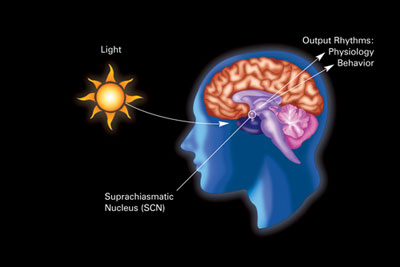
The human body has a circadian master clock, the suprachiasmatic nucleus or SCN. The SCN is a highly innervated tissue located in the hypothalamus (see image). It is connected directly to the retina by the optic nerve, and thus is influenced by external light and dark.
Light enters the eyes and affects the SCN (physiologic effects), and as discussed in recent research, Fernandez et al. here, the perihabenular nucleus (behavioral effects). (Image in public domain.)
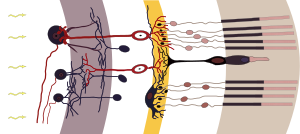
The retina of the eye is the light-gathering instrument for this organ. Historically, it’s been understood that the retina is composed of two cell types, rods and cones, that function in transmitting light and images to the optic nerve, which sends those signals to the brain.
Some parts of the retina. Light enters the eye (from left) and passes through to the rods and cones. Here a chemical change converts the light to nerve signals. Image-based on drawing by Ramón y Cajal, 1911 and licensed under Wikimedia commons.
Studies by Hattar et al. in the early 2000s identified another cell found in the retina, the melanopsin-containing intrinsically photoactive retinal ganglion cells (ipRGCs) as the transmitter of circadian light signals (3). Through this direct connection to the SCN, the circadian master clock, the ipRGCs can influence a wide range of light-dependent functions independent of image processing (4).
Now Fernandez et al. have identified multiple types of ipRGCs. They showed that ipRGCs that mediate the effects of light on learning work via the SCN, while the pathway for light influencing emotions is different.
They discovered a new target of ipRGC cells, the perihabenular nucleus (PHb). The PHb is a newly recognized thalamic region of the brain. The authors showed that the connection between light and mood is regulated by ipRGCs through the PHb versus the SCN. They show that the PHb is integrated into other mood-regulating centers of the thalamic region.
In Conclusion
Daylight, and lack thereof, does affect both our mood and our ability to learn. In this 2018 report, we have learned that the pathways for these effects are distinct, and gain an understanding of a new thalamic region by which the light and mood actions occur. This information could influence the development of better drugs and/or therapies for major depressive disorders.
For those of us with seasonal affective disorder, the evidence is undeniable—lack of light can cause issues, from sleep-wake problems, to mood and learning issues.
And while we can’t create sunshine, a special lamp or lightbox may help to gain some full-spectrum light. To learn more about how to choose such a lamp and when to use it, see this Mayo clinic article for details.
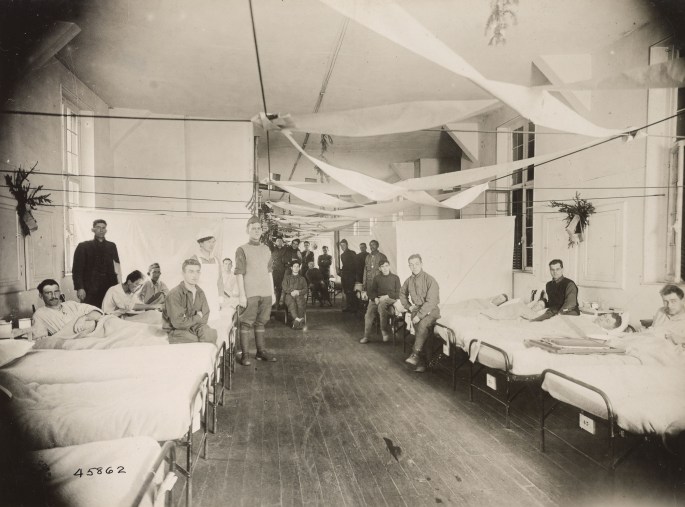
One hundred years ago, the world was taking its first deep breaths as it celebrated the end of World War I. The Armistice of Compiègne, was signed on November 11,1918, officially ending the four-year long conflict, which claimed the lives of more than 8 million soldiers (1). What the world didn’t yet realize was that they had been battling a far deadlier enemy in the hospitals and at home than any army the soldiers faced on the fields of war.
During the last year of the war, a deadly influenza virus rampaged around the globe leaving between 50 and 100 million dead in its wake.
Influenza Ward, France 1918.
The boys were coming in with colds and a headache and they were dead within two or three days. Great big handsome fellows, healthy men, just came in and died. There was no rejoicing in Lille the night of the Armistice. Sister Catherine Macfie from her post at casualty clearing station no. 11 at St André near Lille, France (2).
The red roof of Woods Hollow Child Care center peeks out over the prairie swale at the Promega Madison campus.
Woods Hollow Children’s Center is a prominent feature on the Promega Madison campus, due not only to the building’s distinctive red metal roof, but also the sights, sounds and energy that emanate from it. Playground laughter echoes across the prairie, little ones with their teachers stop in to explore the art at the Promega gallery, children and scientists alike share the meandering paths between lab, manufacturing and office buildings.
The fully accredited child center for children 6 weeks to 10 years old has been part of the Promega community since 1991 when the company built and began financially supporting Woods Hollow, making it available to employees as well as families in the surrounding community. (Promega employees do not receive a break in tuition, but they are given priority for admission. And Promega funding allows Woods Hollow to keep operating costs down while also being able to hire top teachers and offer them competitive wages.)
During its 27 years in operation, the center has served more than 2000 families, many of those with multiple children. It is natural to assume that someday perhaps at least a few of those kids would grow up to work at Promega.
We have published 130 blogs here at Promega this year (not including this one). I diligently reviewed every single one and compiled a list of the best 8.5%, then asked my coworkers to vote on the top 5 out of that subset. Here are their picks:
Glucose is an energy metabolite necessary for cellular survival and growth whether or not the cell is part of a tumor. Not only do cancer cells switch from oxidative phosphorylation to aerobic glycolysis (the Warburg effect) to gain more glucose, a hallmark of cancer, but they also increase the amount of glucose taken up from the surrounding extracellular space. However, the lack of glucose can have a negative effect on cells, causing them to become apoptotic in the absence of this metabolite. Cancer cells have methods to get around the requirement for glucose, including upregulating glucose transporters to improve access to the energy metabolite. In this Redox Biology article, researchers describe how activating androgen receptor in response to a lack of glucose affects the amount of GLUT1 expressed on prostate cancer cells, making the cells resistant to glucose deprivation.
To set the stage, two prostate cancer cell lines, LNCaP, an androgen-sensitive cell line, and LNCaP-R, an androgen-insensitive cell line, were deprived of glucose. Both cell lines showed signs of cell death, but LNCaP-R cells died in greater numbers. To probe how LNCaP cells died, several inhibitors (a pan-caspase inhibitor, two necroptosis inhibitors and a ferroptosis inhibitor) were added but did not change the way the cells died. However, an autophagy inhibitor enhanced cell death, suggesting the cells were necrotic not apoptotic. Teasing apart if the necrosis of LNCaP cells was due to glucose availability or merely disrupted glycolysis, the glucose analog 2DG was added to the medium with glucose. The cells survived when treated with 2DG, suggesting it was the absence of glucose that induced necrosis. When LNCaP cells were cultivated in medium that replaced glucose with mannose or fructose, the cells survived, another point in favor of sugar depletion causing cell death.
We are in the midst of a very intense time of the year, with holidays and seasonal celebrations like Thanksgiving (recently past), Hanukkah this week and Christmas a mere two-plus weeks away.
Wrap that up with a New Year’s celebration and “Wham”—more friends, family and food/alcohol than one normally enjoys in a three-month period.
Yet it can also be the season of SAD—seasonal affective disorder when the amount of daylight decreases daily, and for those of us in the northern latitudes, cold weather intensifies. We’re eating more, getting less sunshine and quite probably less exercise. Hibernation is great for bears, not so good for humans.
It’s the wintertime blues. For myself and many, once the solstice passes and day length starts to increase, mood improves. But noticeable day-length increases don’t really occur here until mid-February. That’s a long time to feel the blues.
We inherit our cells’ mitochondria from our mother. These energy-producing organelles are present in large numbers in most cells, meaning that cells can contain thousands of copies of the DNA associated with the mitochondria (mtDNA)—all passed on wholly from our mother. New evidence suggests, however, that this cannon principle of maternal-only inheritance of mtDNA might need to be refined. And it all started with a four-year-old boy.
XWe use cookies and similar technologies to make our website work, run analytics, improve our website, and show you personalized content and advertising. Some of these cookies are essential for our website to work. For others, we won’t set them unless you accept them. To learn more about our approach to Privacy we invite you to Read More
By clicking “Accept All”, you consent to the use of ALL the cookies. However you may visit Cookie Settings to provide a controlled consent.
We use cookies and similar technologies to make our website work, run analytics, improve our website, and show you personalized content and advertising. Some of these cookies are essential for our website to work. For others, we won’t set them unless you accept them. To find out more about cookies and how to manage cookies, read our Cookie Policy.
If you are located in the EEA, the United Kingdom, or Switzerland, you can change your settings at any time by clicking Manage Cookie Consent in the footer of our website.
Necessary cookies are absolutely essential for the website to function properly. These cookies ensure basic functionalities and security features of the website, anonymously.
Cookie
Duration
Description
cookielawinfo-checbox-analytics
11 months
This cookie is set by GDPR Cookie Consent plugin. The cookie is used to store the user consent for the cookies in the category "Analytics".
cookielawinfo-checbox-functional
11 months
The cookie is set by GDPR cookie consent to record the user consent for the cookies in the category "Functional".
cookielawinfo-checbox-others
11 months
This cookie is set by GDPR Cookie Consent plugin. The cookie is used to store the user consent for the cookies in the category "Other.
cookielawinfo-checkbox-advertisement
1 year
The cookie is set by GDPR cookie consent to record the user consent for the cookies in the category "Advertisement".
cookielawinfo-checkbox-necessary
11 months
This cookie is set by GDPR Cookie Consent plugin. The cookies is used to store the user consent for the cookies in the category "Necessary".
cookielawinfo-checkbox-performance
11 months
This cookie is set by GDPR Cookie Consent plugin. The cookie is used to store the user consent for the cookies in the category "Performance".
gdpr_status
6 months 2 days
This cookie is set by the provider Media.net. This cookie is used to check the status whether the user has accepted the cookie consent box. It also helps in not showing the cookie consent box upon re-entry to the website.
lang
This cookie is used to store the language preferences of a user to serve up content in that stored language the next time user visit the website.
viewed_cookie_policy
11 months
The cookie is set by the GDPR Cookie Consent plugin and is used to store whether or not user has consented to the use of cookies. It does not store any personal data.
Analytical cookies are used to understand how visitors interact with the website. These cookies help provide information on metrics the number of visitors, bounce rate, traffic source, etc.
Cookie
Duration
Description
SC_ANALYTICS_GLOBAL_COOKIE
10 years
This cookie is associated with Sitecore content and personalization. This cookie is used to identify the repeat visit from a single user. Sitecore will send a persistent session cookie to the web client.
vuid
2 years
This domain of this cookie is owned by Vimeo. This cookie is used by vimeo to collect tracking information. It sets a unique ID to embed videos to the website.
WMF-Last-Access
1 month 18 hours 24 minutes
This cookie is used to calculate unique devices accessing the website.
_ga
2 years
This cookie is installed by Google Analytics. The cookie is used to calculate visitor, session, campaign data and keep track of site usage for the site's analytics report. The cookies store information anonymously and assign a randomly generated number to identify unique visitors.
_gid
1 day
This cookie is installed by Google Analytics. The cookie is used to store information of how visitors use a website and helps in creating an analytics report of how the website is doing. The data collected including the number visitors, the source where they have come from, and the pages visted in an anonymous form.
Advertisement cookies are used to provide visitors with relevant ads and marketing campaigns. These cookies track visitors across websites and collect information to provide customized ads.
Cookie
Duration
Description
IDE
1 year 24 days
Used by Google DoubleClick and stores information about how the user uses the website and any other advertisement before visiting the website. This is used to present users with ads that are relevant to them according to the user profile.
test_cookie
15 minutes
This cookie is set by doubleclick.net. The purpose of the cookie is to determine if the user's browser supports cookies.
VISITOR_INFO1_LIVE
5 months 27 days
This cookie is set by Youtube. Used to track the information of the embedded YouTube videos on a website.
Performance cookies are used to understand and analyze the key performance indexes of the website which helps in delivering a better user experience for the visitors.
Cookie
Duration
Description
YSC
session
This cookies is set by Youtube and is used to track the views of embedded videos.
_gat_UA-62336821-1
1 minute
This is a pattern type cookie set by Google Analytics, where the pattern element on the name contains the unique identity number of the account or website it relates to. It appears to be a variation of the _gat cookie which is used to limit the amount of data recorded by Google on high traffic volume websites.
![A. gossypii on cotton leaf. Image credit: Clemson University - USDA Cooperative Extension Slide Series, , United States [CC BY 3.0 (https://creativecommons.org/licenses/by/3.0)], via Wikimedia Commons](https://www.promegaconnections.com/wp-content/uploads/2019/01/Aphis_gossypii04-300x290.jpg)