
The Centers for Disease Control in the United States is reporting a 17% increase in rabies-related inquiries in 2026 (1), and reported rabies exposures are up. Four baby goats at a mobile petting zoo in North Carolina tested positive for the disease after a wild skunk got into their enclosure. Nearly 300 people across multiple counties, including children and residents of an assisted living facility, were evaluated for possible exposure from that event alone (2). In Maryland in July, there were two reports of two rabid beaver attacks (2). In New Jersey, a man was bitten on the leg by a rabid raccoon, and in New Hampshire, a mystery animal thought to be either a gray fox or a fisher cat attacked three people in three separate attacks (2). The increase in incidents is not restricted to the United States either, with seals in Cape Town, South Africa reportedly contracting the disease from land mammals with ongoing seal-to-seal transmission noted for the first time (3).
These recent developments underscore the need for quality rabies testing.
What is rabies? How is it spread?
Rabies is a fatal zoonotic disease caused by Rabies virus (RABV), a negative-sense, single-stranded RNA virus belonging to the genus Lyssavirus. The virus is transmitted primarily through direct contact with infectious material (saliva or nervous tissue) from infected animals, typically via bites or scratches or through contact with mucous membranes.
Rabies is a deadly disease for pets and humans alike; it has an extremely high mortality rate at around 99.9% (4). It’s also surprisingly prevalent. Worldwide there are an estimated 59,000–60,000 human deaths from rabies every year, mainly in areas such as Africa and Asia, where dogs transmit the disease. While in the US, around 5,000 animal rabies cases transmitted by wildlife occur annually (5). Because of this relatively common prevalence and mortality, testing is critical to identifying outbreaks quickly.
How is rabies prevented?
Vaccination is the main prevention method. Despite the availability of highly effective preventative vaccines, significant logistical and economic challenges persist (particularly in resource-limited settings).
Why do we need to do field surveillance for rabies and how is rabies tested?
Vaccines do prevent rabies, but what happens if a case isn’t reported? How do we prevent an outbreak if we do not detect the source? Field surveillance and rapid diagnostic testing are essential for controlling rabies spread and preventing onward transmission with progression towards outbreaks. Public health officials can then know where to issue safety warnings and where to prepare vaccine options if needed.
Rabies can only currently be confirmed using brain tissue samples. That means if a domestic dog bites someone, and rabies is a concern, the dog must be euthanized before confirmatory testing (6). Potentially infected brain tissue requires careful handling because it may contain infectious virus that poses significant biosafety risks. The sample also needs to stay relatively fresh which can be difficult. A cold chain must typically be maintained to preserve the sample for the testing.
How is the diagnostic testing for rabies done?
The Direct Fluorescent Antibody (DFA) test is standard for routine sensitive and specific post-mortem diagnosis (6). In practice, the test involves incubating fluorescent antibodies with rabies-suspect brain tissue, allowing the antibodies to bind rabies virus particles with antibody and virus complexes. This is visualized as fluorescent areas in the tissue using a microscope. Brain impressions are made upon microscope slides, which are fixed and incubated with fluorescein isothiocyanate (FITC)-labeled antibodies to rabies virus, then viewed using epi-fluorescence microscopy. The main limitations of this method are the requirement for a high-quality fluorescence microscope and the need for trained and experienced personnel. Although the DFA technique has a sensitivity between 95–100%, some studies recommend confirmation by another technique, such as virus isolation in cell culture (7). Another method, molecular diagnostic testing for RABV, relies on reverse transcription quantitative PCR (RT-qPCR) to detect and identify viral RNA from processed samples.
How does Maxwell help with the testing of rabies?
A validation study to assess extraction platform performance and viral inactivation was conducted by a team of researchers at the Veterinary Diagnostic Laboratory at Kansas State University.
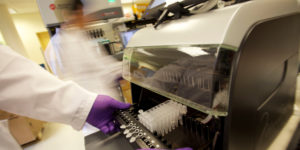
This study examined whether PrimeStore® molecular transport medium (PS-MTM) could be used to provide safe collection, storage and transport of samples for molecular testing of rabies virus (RABV) by qPCR methods. One of the requirements for successful detection of RABV by qPCR is successful isolation of the viral RNA. For RNA isolations from PS-MTM samples, the laboratory tested extraction using the Maxwell benchtop automated extraction instrument (7).
The Maxwell instrument gives labs a standardized, walk-away workflow from an inactivated sample straight to purified nucleic acid. That pairing cuts real operational weight: less occupational exposure risk for personnel handling suspected rabies specimens, no cold chain to maintain in transit, and consistently lower Ct values than alternative automated workflows, meaning more complete recovery and more efficient amplification, across every ratio and incubation time tested.
RNA extracted using Maxwell instruments yielded consistently lower Ct values during qPCR across all sample-to-PS-MTM ratios (1:3, 1:2, and 1:1) and incubation times tested, indicating superior efficiency in isolating high-quality RNA for input into qPCR assays.
Performance holds even under pressure. Maxwell extraction from inactivated samples still delivers reliable qRT-PCR results, because a diagnostic result is only as good as the nucleic acid behind it. In an outbreak, a degraded sample doesn’t just fail quietly, it can produce a false negative at exactly the moment public health officials need an accurate answer.
Why sample handling and preparation matters in rabies testing
Events like the North Carolina petting zoo incident show how fast an infected animal can cascade into a public health response involving hundreds of people. Confidence in such a costly response starts with the sample: standardized, safe collection and extraction that consistently deliver trustworthy nucleic acid for qPCR. That’s what makes rabies molecular diagnostics more feasible, safer, and more reliable, so that public health officials can make confident decisions.
To learn more, download our APHL Innovate 2026 presentation with Kansas State University, From Bench to Bat: Enabling One Health Through Standardization and Application Flexibility.
Literature Cited
- Stitt, A. (2026) CDC warns clinicians of surge in rabies activity. Healio Infectious Disease News [Internet: CDC warns clinicians of surge in rabies activity [Intenet: https://www.healio.com/news/infectious-disease/20260911/cdc-warns-clinicians-of-surge-in-rabies-activity Accessed: 09/16/2026)
- Louis, J. (2026) Amid new CDC Advisory, AVMA details recent rabies exposure incidents, reiterates vaccination policy. Dvm360 September 15. [Internet:https://www.dvm360.com/view/avma-details-rabies-exposure-incidents-vaccination-policy-cdc-advisory Accessed Sept. 16]
- Bothma, Nic. (2026) A deadly cross over: In South Africa, rabies moves from land animals to seals. August 24. [Internet: https://news.mongabay.com/2026/08/a-deadly-cross-over-in-south-africa-rabies-moves-from-land-animals-to-seals/ Accessed 09/16/2026]
- Rabies (2024) World Health Organization June 5. [Internet: https://www.who.int/news-room/fact-sheets/detail/rabies Accessed 09/30/2026]
- CDC Rabies. (2025) Rabies in the United States: Protecting Public Health 09/30 [Internet: https://www.cdc.gov/rabies/php/protecting-public-health/index.html Accessed: 09/16/2026]
- CDC Rabies (2026) Laboratory Methods for Rabies Testing 01/20. [Internet: https://www.cdc.gov/rabies/php/labs-specimens/testing.html Accessed 09/16/2026]
- Rodrigues, A.C. et al. (2022) A comparative study of direct fluorescent antibody, mouse inoculation, and tissue culture infection testing for rabies diagnoses. J. Virol. Meth. 300, 114 [Internet: https://www.sciencedirect.com/science/article/pii/S0166093421003657 Accessed: 09/16/2026]
- Seetahal, J.F.R. (2026) Evaluation of PrimeStore® Molecular Transport Medium for Rabies Virus Inactivation. Scientific Poster. APHL 2026

Parker Smith
Latest posts by Parker Smith (see all)
- Taming the Bite: How Maxwell Takes the Fear Out of Rabies Testing - September 18, 2026
- Timing Matters in Legionella Testing - September 9, 2026
- Mitigating Disease by Testing Wastewater at Large Events - July 15, 2026