The United States just closed an unprecedented Cyclospora outbreak (2, 7). Nearly 20,000 people were sickened across the 2026 season, the biggest cluster traced to recalled iceberg lettuce. Which means somewhere a kid who refused to eat his greens is feeling extremely vindicated.
Cyclospora is not the pathogen most people picture when they think of summer stomach trouble. That is usually a bacterium like Salmonella or E. coli, or a virus like norovirus. Among parasites, Cryptosporidium, the one behind the diarrhea outbreaks that shut down public pools, is the more common summer name (5). Which makes this season the exception: the rarer of the two parasites is the one that exploded, and the one the news zeroed in on this year.
Since May 1, the CDC has counted 19,883 laboratory-confirmed cases acquired domestically, across 49 states and the District of Columbia, with 1,064 hospitalizations and two deaths, up from just 1,180 cases in the same period a year earlier (2). The largest single cluster was an outbreak traced to recalled iceberg lettuce sourced from central Mexico, which accounted for 12,883 of those cases across 21 states (3). The CDC declared that outbreak over on September 11, though the FDA’s investigation into how the contamination occurred remains open (3). With recent cases dwindling, the CDC moved off weekly surveillance updates on September 15, shifting to periodic reporting (2).
Note: Death from cyclosporiasis is rare; both fatalities were in Michigan, in people with significant underlying conditions (2, 4).
The illness
Cyclospora cayetanensis is a single-celled parasite endemic to tropical and subtropical regions (1). It colonizes the small intestine and causes watery, sometimes frequent diarrhea that can subside and return, along with nausea, fatigue and loss of appetite (1). Symptoms typically begin about a week after infection, though the range runs from two days to two weeks or more (1). The waxing and waning pattern is not random: the illness follows a relapsing course as the parasite moves through its replication cycle (1). Untreated cases can drag on for weeks (1). Most healthy people recover on their own, and a prescription antibiotic works for those who need it (1). Immunocompromised patients face a higher risk of severe or prolonged illness (1).
This can be easy to mistake for an ordinary stomach bug. Easy to miss in testing, too.
How it spreads

Cyclospora spreads through food or water contaminated with human feces, and only rarely through direct person-to-person contact (1). Humans are thought to be the only definitive host, meaning the only organism in which the parasite can complete its sexual reproduction cycle (8). The reason it moves so poorly from person to person lies in its life cycle: the oocyst is not infectious when it is shed and must spend one to two weeks maturing in the environment before it can infect a new host (1). That delay is why contaminated produce imported from regions where the parasite is endemic, rather than infected food handlers, tends to drive US outbreaks.
This year’s outbreak fit that pattern. On July 17, a supplier recalled all the iceberg lettuce it had sourced from central Mexico, covering both retail and food-service products across the country (3).
Note: The CDC also tracked other, separate clusters not tied to the lettuce, and the FDA’s investigation into how the contamination occurred remains open even after the outbreak closed (3).
Finding it and tracing it
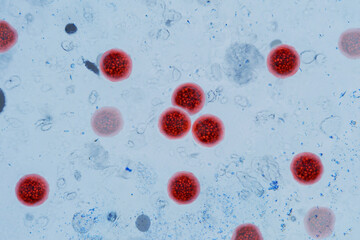
The reported case total belies the true scale, and detection is a large part of why. The parasite leaves the body as an oocyst, a microscopic hard-shelled capsule shed in low numbers. Routine stool examinations often miss it because oocysts are small and do not take up standard stains (1). Labs can spot them with specialized stains or under ultraviolet light, where the oocysts naturally glow, but only if someone orders those tests (1). Multiplex PCR panels can now identify Cyclospora, and separate it from look-alikes such as Cryptosporidium, in a single run (6). But those panels are not universally available across the United States, and a clinician who does not suspect the parasite may never order the right test. On top of that, the CDC estimates a six-week lag between illness and confirmation, so even a final count trails the real one (2).
Tracing outbreaks is harder still. Unlike pathogens such as Salmonella, which can be whole-genome sequenced and tied to a single source with high precision, Cyclospora lacks an equivalent genomic tool, so its outbreaks are slower and harder to solve (2). The parasite also cannot be grown in a lab dish the way bacteria can, and there is no animal model to study it outside of human patients, which leaves researchers with fewer tools to work with (8). Both jobs, detecting the parasite and tracing it, begin at the same step: extracting its nucleic acid from stool, a sample full of the inhibitors that can compromise a reaction. Cryptosporidium poses the same challenge at the lab bench, which is precisely why telling the two apart matters.
Cousins, not twins
Cyclospora and Cryptosporidium look nearly identical from the outside. Both are single-celled gut parasites, both shed oocysts, both cause the same watery illness and both slip past the same routine tests. But getting the diagnosis wrong has real consequences: the two are treated with different drugs, spread through different routes and require entirely different outbreak responses (1, 5). One is a produce problem, the other is a water problem. One is treated with an antibiotic; the other usually clears on its own and calls for a different drug when it doesn’t (1, 5).
The most reliable way to tell them apart is at the molecular level, which is also where the science gets interesting. How their genomes differ, what those differences mean for detection and treatment, and why the tools to trace one outbreak have outpaced the tools to trace the other: those are the questions this series takes on next.
Note: national season figures reflect CDC surveillance updated September 15, 2026 (data as of September 14); outbreak figures reflect the CDC’s September 11 final.
References
- CDC. Clinical Overview of Cyclosporiasis (symptoms, life cycle, transmission, treatment, testing). https://www.cdc.gov/cyclosporiasis/hcp/clinical-overview/
- CDC. Surveillance of Cyclosporiasis — 19,883 laboratory-confirmed U.S. cases, 1,064 hospitalizations, 2 deaths, across 49 states and DC, versus 1,180 in 2025; CDC describes 2026 as an “unprecedented” season; updated September 15, 2026 (data as of September 14). https://www.cdc.gov/cyclosporiasis/php/surveillance/index.html
- CDC and FDA. Cyclospora Outbreak Linked to Iceberg Lettuce (Taylor Farms de Mexico, central Mexico) — 12,883 cases across 21 states; outbreak declared over September 11, 2026; FDA contamination investigation ongoing. https://www.cdc.gov/cyclosporiasis/outbreaks/07-26/index.html and https://www.fda.gov/food/outbreaks-foodborne-illness/investigation-multistate-outbreak-cyclospora-illnesses-iceberg-lettuce-july-2026
- Michigan Department of Health and Human Services. Infectious Disease Outbreaks, cyclosporiasis (Michigan case data and the two deaths). https://www.michigan.gov/mdhhs/keep-mi-healthy/infectious-diseases/infectious-disease-outbreaks
- CDC. About Cryptosporidium Infections; transmission, treatment, recreational water. https://www.cdc.gov/cryptosporidium/about/index.html and https://www.cdc.gov/cryptosporidium/causes/index.html and https://www.cdc.gov/cryptosporidium/treatment/index.html
- ARUP Laboratories. Gastrointestinal Parasite Panel by PCR (detects Cyclospora cayetanensis in a single multiplex run). https://ltd.aruplab.com/Tests/Pub/2011150
- CDC. Health Alert Network notice on the 2026 increase in domestically acquired cyclosporiasis — describes the surge as substantially above prior years. https://www.cdc.gov/han/php/notices/han00531.html
- Michigan Medicine Health Lab. The Hidden Life of Parasites Like Cyclospora (expert quotes on host specificity, no lab culture system, no animal model). https://www.michiganmedicine.org/health-lab/hidden-life-parasites-cyclospora

Latest posts by Shannon Sindermann (see all)
- The Parasite That Made Headlines This Summer: Cyclospora - September 29, 2026
- Why Antibiotic Resistance Is an Environmental Problem Too - July 28, 2026
- What Happens When You Delay an Ebola Vaccine Booster by 18 Months? - June 18, 2026