Last year, on Promega’s 40th anniversary, we received a generous gift from a friend in the industry: Eppendorf. That gift was an exchange program. The teenage child of any Promega employee was given the opportunity to visit an Eppendorf family in another country, and in return host the Eppendorf family’s child in their home. The goal was for both children to experience another culture and build a relationship with each other.
In 2019, 11 Promega children bid good-bye to their parents,
hopped on a plane, and flew to Germany. There they would stay for three weeks with
a family they’ve never met. For all involved, it proved to be a valuable and
positive learning opportunity. Here are a few takeaways from their experience:
The three 2019 Real-Time PCR Grant Winners have been hard at work in the six months since winning their grants. Each winner was eligible to receive up to $10,000 in free PCR reagents as well as the opportunity to collaborate with our knowledgeable technical service and training teams.
One of the 2019 winners, Alberto Biscontin (University of Padova, Italy), performs research in the fields of Neurogenetics and Chronobiology. He is looking to shed greater light on the circadian rhythms of the Antarctic krill. Alberto published his most recent analysis in Nature and GoTaq® qPCR Master Mix helped him validate expression of genes for his study.
His qPCR data showed support for internal mechanisms that not only support daily living but also clarified the overwintering process of the krill. Now that Alberto has sized up some zooplankton, we asked him to share a little more about himself and his research:
Q: How long have you been a researcher? A: I have been a researcher since 2012.
Q: How did you decide to research Antarctic krill? A: In 2013, I had the opportunity to join the international Antarctic research program PolarTime. [It] brought together eight research groups with different scientific expertise to study seasonal and daily rhythms in the Antarctic krill Euphausia superba.
Q: When you are not busy at the bench, what do you like to do? A: Traveling. I love strolling through open-air markets.
Q: Are there any tips or tricks you have learned that make your job easier? A: You can easily switch from a classic RT-PCR protocol to a cheaper and faster One-step protocol using the same primers and temperatures.
Q: What comes next? A: I would like to characterize the clock machinery of other polar organisms to understand whether high latitude clocks have developed similar strategies to cope with [the] polar environment. Moreover, a better understanding of marine circadian clocks could help to shed light on the evolution of the animal circadian machinery.
You can find Alberto’s most recent publication in Nature Scientific Reports. The 2020 Real-Time PCR Grant will be coming soon. Be sure to follow us on social media for the most up-to-date information regarding the 2020 Grant, including application deadlines and winner notifications!
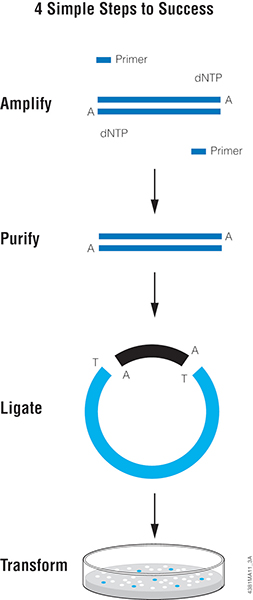
One of the easiest methods for cloning blunt-ended DNA fragments including PCR products is T-vector cloning, such as with pGEM®-T or pGEM®-T Easy Vector Systems. This method takes advantage of the “A” overhang added by a PCR enzyme like Taq DNA Polymerase. T vectors are linearized plasmids that have been treated to add 3′ T overhangs to match the A overhangs of the insert. The insert is directly ligated to the T-tailed plasmid vector with T4 DNA ligase. The insert can then be easily transferred from the T vector to other plasmids using the restriction sites present in the multiple cloning region of the T vector.
Proofreading polymerases like Pfu do not add “A” overhangs so PCR products generated with these polymerases are blunt-ended. In a previous blog, we discussed a simple method for adding an A-tail to any blunt-ended DNA fragment to enable T-vector cloning. Below, we think about the next step: Ligation.
Science touches our lives, daily. But far too many scientific concepts and terms are misunderstood and used incorrectly. Even those of us wearing a “scientist” badge sometimes misappropriate terms, which can act to reproduce the misuse.
A basic level of science literacy is so important for all of us. Why? So that when bombarded with comments about vaccination or climate change on a social media site, we are able to sift through the jargon, understand what’s correct and what is not correct, and make decision based in facts vs. internet gossip. With just a bit of knowledge of basic science terms, you are better protected against deception and you’ll know how to sort facts from fiction.
Here are a few general science terms that are commonly misunderstood and misused.
Promega created a special incentive to reward field science consultants who help the scientific community via the Helix onsite stocking program. The winner had to meet ambitious criteria to receive 2 round-trip tickets to anywhere in the world, as well as a week of paid vacation and spending money. I won and choose to use my award to travel to Switzerland. Here is the story of my amazing trip!
This blog is written by guest blogger, Caitlin Cavanaugh.
Since I was a little girl, my parents have often reminisced about one of their favorite overseas trips taken to Switzerland in 1977. This was a trip that my parents term “BC”, which in our house refers to their fun, childless married days “Before Caitlin.” They’ve shared their photos many times of the snow capped mountains and lush, green valleys. The Swiss Alps look very different from peaks in the US, with their steep, jagged peaks and clear, blue lakes. As a nature lover and an avid hiker, I knew this would be the perfect destination to realize my love for the outdoors and to follow in the footsteps of my parents—42 years later.
This is part 3 of a three-part series on FFPE sample processing. Part 1 (link) Part 2 (link)
I would like to automate FFPE processing, but I am worried about sample cross contamination, how can I minimize my risks?
As a gold standard for oncology research, hundreds of millions of FFPE samples are collected and banked worldwide. These samples provide a rich source of data for identification of biomarkers in the search for early detection assays for cancer as well as diagnostics that could help direct treatment decisions and monitor treatment.
PCR amplification with a proofreading polymerase, like Pfu DNA polymerase, will leave you with a blunt end. However, another thermostable DNA polymerase, like Taq DNA Polymerase, adds a single nucleotide base to the 3’ end of the DNA fragment, usually an adenine, creating an “A” overhang. This “A” overhang can create difficulties when cloning the fragment is your end goal. You might consider creating a blunt end with Klenow or adding restriction sites to the ends of your PCR fragment by designing them in your primers. But why go through all those extra steps, when that “A” overhang allows efficient cloning of these fragments into T-Vectors such as the pGEM®-T Vectors? Fewer steps? Who can argue with that?
Asian elephants with babies in Planckendael zoo, Muizen near Mechelen, Flanders, Belgium. Image copyright: Ad Meskens [CC BY-SA 4.0 (https://creativecommons.org/licenses/by-sa/4.0)] via Wikimedia Commons
Wildlife conservation is a major focus around the world. With habitat loss and climate change, Asian elephant populations are under severe pressure. Add in an infectious disease that is fatal to the young and you have a recipe for disaster. Even with efforts to breed the endangered Asian elephants in zoos to build the population, elephant endotheliotropic herpesvirus (EEHV) thwarts conservation efforts. EEHV causes hemorrhagic disease in Asian elephants younger than 10 years old, a disease with rapid onset and high mortality. In fact, some numbers indicate EEHV is the cause of death for at least 25% of Asian elephants born in zoos and the wild globally.
Bioluminescent reporter assays are an excellent choice for analyzing gene regulation because they provide higher sensitivity, wider dynamic range and better signal-to-background ratios compared to colorimetric or fluorescent assays. In a typical genetic reporter assay, cells are transfected with a vector that contains the sequence of interest cloned upstream of a reporter gene, and the reporter activity is used to determine how the target sequence influences gene expression under experimental conditions. A second control reporter encoded on the same or a different plasmid is an essential internal control. The secondary reporter is used to normalize the data and compensate for variability caused by differences in cell number, lysis efficiency, cell viability, transfection efficiency, temperature, and measurement time.
Basic Introduction to the Strategy of Reporter Gene Assays
For genetic reporter assays, using a secondary control vector with a weak promoter like PGK or TK to ensures that the control does not interfere with activation of your primary reporter vector. Transfection of high amounts of the control plasmid or putting the control reporter under control of a strong promoter like CMV or SV40 often leads to transcriptional squelching or other interference with the experimental promoter (i.e., trans effects). Reporter assays can also be used to quantitatively evaluate microRNA activity by inserting miRNA target sites downstream or 3´ of the reporter gene. For example, the pmirGLO Dual-Luciferase miRNA Target Expression Vector is based on dual-luciferase technology, with firefly luciferase as the primary reporter to monitor mRNA regulation and Renilla luciferase as a control reporter for normalization.
Here in Technical Services we often talk with researchers who are just starting their project and looking for advice on designing their genetic reporter vector. They have questions like:
How much of the upstream promoter region should be included in the vector?
How many copies of a response element will be needed to provide a good response?
Does the location of the element or surrounding sequence alter gene regulation?
These assays are relatively easy to understand in principle. Use a primary and secondary reporter vector transiently transfected into your favorite mammalian cell line. The primary reporter is commonly used as a marker for a gene, promoter, or response element of interest. The secondary reporter drives a steady level of expression of a different marker. We can use that second marker to normalize the changes in expression of the primary under the assumption that the secondary marker is unaffected by what is being experimentally manipulated.
While there are many advantages to dual-reporter assays, they require careful planning to avoid common pitfalls. Here’s what you can do to avoid repeating some of the common mistakes we see with new users:
XWe use cookies and similar technologies to make our website work, run analytics, improve our website, and show you personalized content and advertising. Some of these cookies are essential for our website to work. For others, we won’t set them unless you accept them. To learn more about our approach to Privacy we invite you to Read More
By clicking “Accept All”, you consent to the use of ALL the cookies. However you may visit Cookie Settings to provide a controlled consent.
We use cookies and similar technologies to make our website work, run analytics, improve our website, and show you personalized content and advertising. Some of these cookies are essential for our website to work. For others, we won’t set them unless you accept them. To find out more about cookies and how to manage cookies, read our Cookie Policy.
If you are located in the EEA, the United Kingdom, or Switzerland, you can change your settings at any time by clicking Manage Cookie Consent in the footer of our website.
Necessary cookies are absolutely essential for the website to function properly. These cookies ensure basic functionalities and security features of the website, anonymously.
Cookie
Duration
Description
cookielawinfo-checbox-analytics
11 months
This cookie is set by GDPR Cookie Consent plugin. The cookie is used to store the user consent for the cookies in the category "Analytics".
cookielawinfo-checbox-functional
11 months
The cookie is set by GDPR cookie consent to record the user consent for the cookies in the category "Functional".
cookielawinfo-checbox-others
11 months
This cookie is set by GDPR Cookie Consent plugin. The cookie is used to store the user consent for the cookies in the category "Other.
cookielawinfo-checkbox-advertisement
1 year
The cookie is set by GDPR cookie consent to record the user consent for the cookies in the category "Advertisement".
cookielawinfo-checkbox-necessary
11 months
This cookie is set by GDPR Cookie Consent plugin. The cookies is used to store the user consent for the cookies in the category "Necessary".
cookielawinfo-checkbox-performance
11 months
This cookie is set by GDPR Cookie Consent plugin. The cookie is used to store the user consent for the cookies in the category "Performance".
gdpr_status
6 months 2 days
This cookie is set by the provider Media.net. This cookie is used to check the status whether the user has accepted the cookie consent box. It also helps in not showing the cookie consent box upon re-entry to the website.
lang
This cookie is used to store the language preferences of a user to serve up content in that stored language the next time user visit the website.
viewed_cookie_policy
11 months
The cookie is set by the GDPR Cookie Consent plugin and is used to store whether or not user has consented to the use of cookies. It does not store any personal data.
Analytical cookies are used to understand how visitors interact with the website. These cookies help provide information on metrics the number of visitors, bounce rate, traffic source, etc.
Cookie
Duration
Description
SC_ANALYTICS_GLOBAL_COOKIE
10 years
This cookie is associated with Sitecore content and personalization. This cookie is used to identify the repeat visit from a single user. Sitecore will send a persistent session cookie to the web client.
vuid
2 years
This domain of this cookie is owned by Vimeo. This cookie is used by vimeo to collect tracking information. It sets a unique ID to embed videos to the website.
WMF-Last-Access
1 month 18 hours 24 minutes
This cookie is used to calculate unique devices accessing the website.
_ga
2 years
This cookie is installed by Google Analytics. The cookie is used to calculate visitor, session, campaign data and keep track of site usage for the site's analytics report. The cookies store information anonymously and assign a randomly generated number to identify unique visitors.
_gid
1 day
This cookie is installed by Google Analytics. The cookie is used to store information of how visitors use a website and helps in creating an analytics report of how the website is doing. The data collected including the number visitors, the source where they have come from, and the pages visted in an anonymous form.
Advertisement cookies are used to provide visitors with relevant ads and marketing campaigns. These cookies track visitors across websites and collect information to provide customized ads.
Cookie
Duration
Description
IDE
1 year 24 days
Used by Google DoubleClick and stores information about how the user uses the website and any other advertisement before visiting the website. This is used to present users with ads that are relevant to them according to the user profile.
test_cookie
15 minutes
This cookie is set by doubleclick.net. The purpose of the cookie is to determine if the user's browser supports cookies.
VISITOR_INFO1_LIVE
5 months 27 days
This cookie is set by Youtube. Used to track the information of the embedded YouTube videos on a website.
Performance cookies are used to understand and analyze the key performance indexes of the website which helps in delivering a better user experience for the visitors.
Cookie
Duration
Description
YSC
session
This cookies is set by Youtube and is used to track the views of embedded videos.
_gat_UA-62336821-1
1 minute
This is a pattern type cookie set by Google Analytics, where the pattern element on the name contains the unique identity number of the account or website it relates to. It appears to be a variation of the _gat cookie which is used to limit the amount of data recorded by Google on high traffic volume websites.