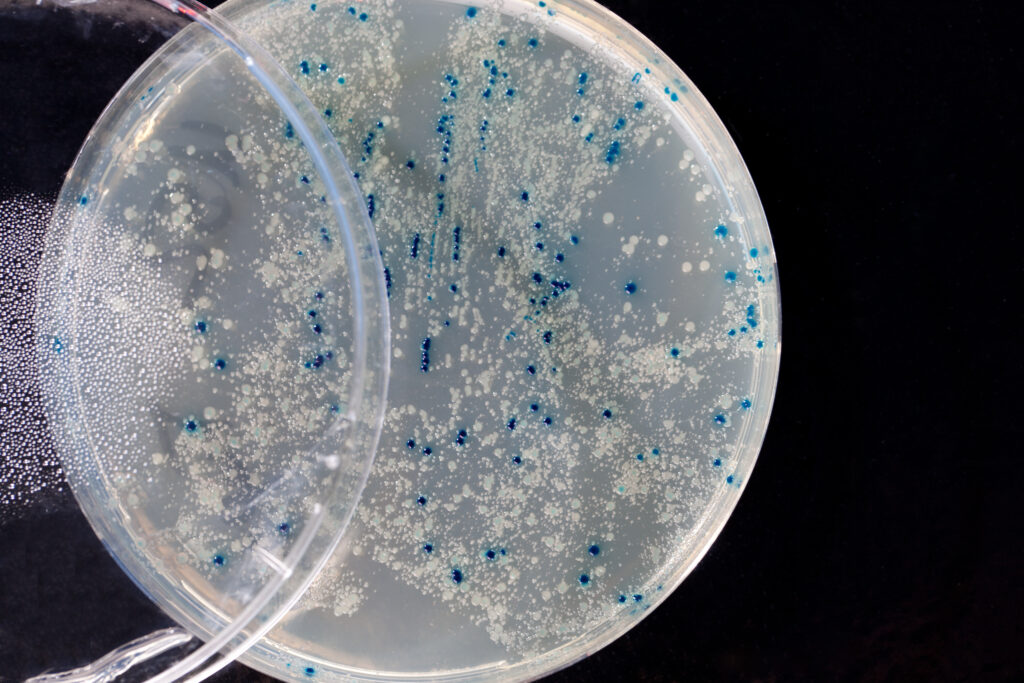
In the fifty years since the first reported transformation of recombinant plasmids into bacteria (1), plasmid cloning has become one of the pillars of synthetic biology research and manufacturing biopharmaceuticals.
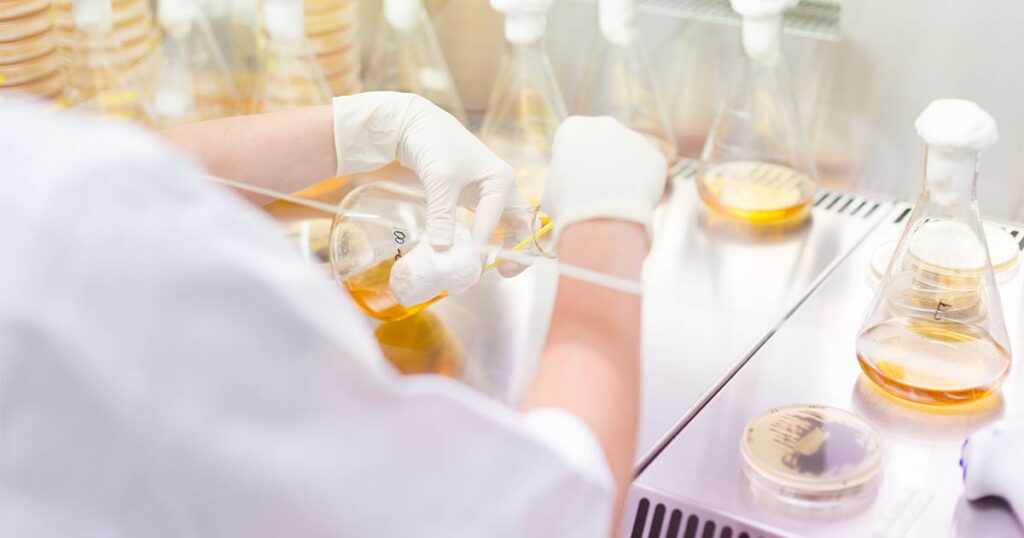
But purifying plasmids is no small feat. It can often take hours of hands-on time to go from culture to eluate with low-throughput and time-sensitive manual methods. Automating plasmid purification is the way to go, whether you’re isolating a single plasmid from a large volume culture or creating a library of thousands of different constructs.
I was blasting a holiday music playlist while driving recently, and Presley’s Blue Christmas played. I couldn’t get the phrase “Christmas Cloning Blues” out of my mind, and by the time I arrived at my destination, this happened:
Whether you’re looking to learn about nucleic acid analysis, wondering how to do an ELISA assay, or simply have ten minutes to kill in your day, Promega resources have you covered! We’ve revamped and upgraded our hub of self-service resources so we can provide the most up-to-date scientific support. Here are some highlights of what’s new:
We’ve learned a few important lessons from the COVID-19 pandemic.
Perhaps the most significant one is the importance of an early and rapid global response to the initial outbreak. A coordinated response—including widespread use of masks and other personal protective equipment (PPE), travel restrictions, lockdowns and social distancing—could save lives and reduce long-term health effects (1). Widespread availability of effective vaccines goes hand in hand with these measures.
New Boosters to Fight Omicron
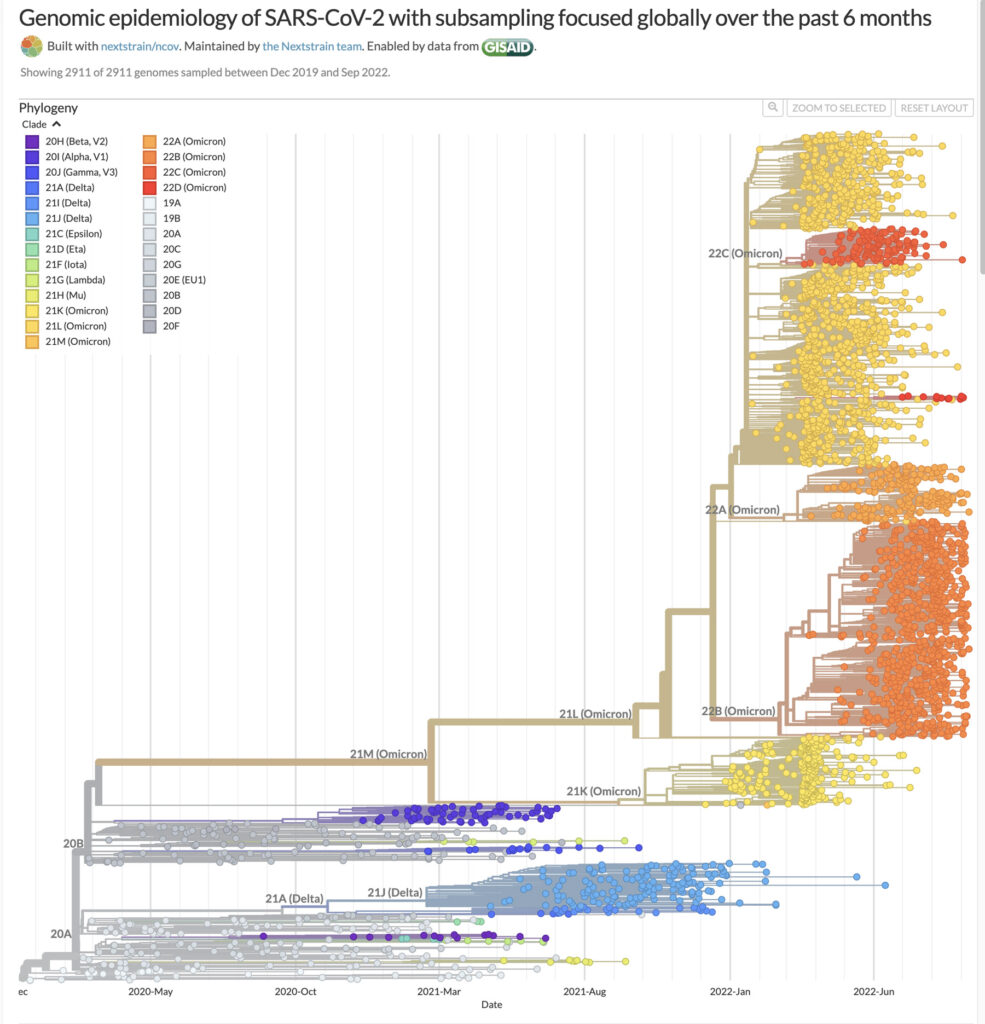
In August 2022, Pfizer/BioNTech announced the US Food and Drug Administration (FDA) had granted emergency use authorization (EUA) for a new adapted-bivalent COVID-19 booster vaccine for individuals 12 years and older. This vaccine combines mRNA encoding the wild-type Spike protein from the original vaccine with another mRNA encoding the Spike protein of the Omicron BA.4/BA.5 subvariants. Moderna also announced FDA EUA for its new Omicron-targeting COVID-19 booster vaccine. The Omicron variant of SARS-CoV-2 shows multiple mutations across its subvariants, and it is currently the dominant SARS-CoV-2 variant of concern across the world.
Genomic epidemiology of SARS-CoV-2 with subsampling focused globally over the past 6 months. This phylogenetic tree shows evolutionary relationships of SARS-CoV-2 viruses from the ongoing COVID-19 pandemic. Image from Nextstrain.org; generated September 20, 2022
Booster doses of vaccines have become a way of life, both due to declining effectiveness of the original vaccines especially in older adults (2), and the rapid mutation rate of SARS-CoV-2 (3). Clinical data for the new Pfizer/BioNTech booster vaccine showed superior effectiveness in eliciting an immune response against Omicron BA.1 compared to the original vaccine. Previously, Moderna published interim results from an ongoing phase 2-3 clinical trial, showing that the new bivalent booster vaccine elicited a superior neutralizing antibody response against Omicron, compared to its original COVID-19 vaccine (4).
Today’s guest blog was written in collaboration with Melissa Martin, a former global marketing intern with Promega. She is a senior at the University of Wisconsin-Madison where she is double majoring in zoology and life sciences communication, with a certificate in environmental studies.
Peer-reviewed papers are considered the most technical and in-depth way to learn about research and scientific advances. As a student or scientist, you will not only want to read scholarly articles to learn about what others are doing in your field but also to expand your knowledge and learn about scientific advances in completely new areas of study. With countless disciplines of science covering wide-ranging topics such as cell biology, physical chemistry or human behavior, it can be overwhelming to do a general search and find articles and journals that will have the topics relevant to your interests.
A graduate student believes he has mastered the art of “the assay”. No need to run duplicates, he knows exactly which one will get him the answers he needs right away.
To challenge this, his PI proposes an exercise. He asks of the graduate student, “What happens when you treat cells with doxorubicin?”
The graduate student raises his cells, treats them accordingly, and decides to run a cell viability assay to determine their fate. He returns to the PI with the final verdict: his cells are dead.
The PI takes a look at the data and asks the graduate student to repeat the experiment with an additional assay for cytotoxicity―but the cytotoxicity assay shows that the cell membranes are intact, which only puzzles the graduate student. The PI asks him to run a third assay for apoptosis, and when the student does so, it becomes clear that the cells are dying.
The PI uses this opportunity to make his point: “Now do you see why I ask for more than one assay?”
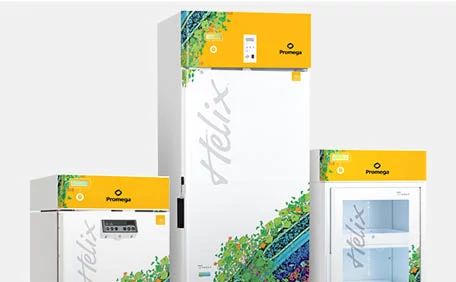
The Helix on-site stocking program has been a resource for scientists for many years. With customized onsite stocking, inventory management and automated billing, losing precious time to a missing reagent is a thing of the past.
To better understand the impact of Helix on our customers’ research, we spoke to Chris Thompson of Pro-GeneX, a clinical laboratory in Atlanta, GA. “Using the Helix system has been a game changer from the first day we got it,” Chris said. “It was simple to set up and use from the start and has never let us down. We routinely show it off to visitors to our lab because we are so impressed with it. I only wish all my reagents used a system like this. From an inventory perspective it is the best invention in our lab!”
Today’s guest blog was written in collaboration with Melissa Martin, a former global marketing intern with Promega. She is a senior at the University of Wisconsin-Madison where she is double majoring in zoology and life sciences communication, with a certificate in environmental studies.
Schools, businesses and organizations across the globe are increasingly implementing sustainable practices within their workspaces. From large-scale projects like installing solar arrays to behind-the-scenes initiatives like composting cafeteria food waste, “going green” is a reality of the modern workplace.
But one workspace otherwise known for being cutting edge and innovative is still struggling to implement the practices and culture of sustainability.
In her role as a teaching lab coordinator at the Johns Hopkins Institute for Nanobiotechnology (INTB), Christine Duke noticed a contrast between campus-wide sustainability initiatives and research labs:
“There is something missing here. Why aren’t we doing anything in the labs?”
In 3D cell culture models, cells are grown under conditions that allow the formation of multicellular spheroids or microtissues. Instead of growing in a monolayer on a plate surface, cells in 3D culture grow within a support matrix that allows them to interact with each other, forming cell:cell connections and creating an environment that mimics the situation in the body more closely than traditional 2D systems. Although 3D cultures are designed to offer a more physiologically accurate environment, the added complexity of that environment can also present challenges to experimental design when performing cell-based assays. For example, it can be a challenge for assay reagents to penetrate to the center of larger microtissues and for lytic assays to disrupt all cells within the 3D system.
Earlier this week Terry Riss, a Senior Product Specialist at Promega, presented a Webinar on the challenges of performing cell-based assays on microtissues in 3D cell culture. During the Webinar, Terry gave an overview of the different methods available for 3D cell culture, providing a description of the advantages of each. He then discussed considerations for designing and optimizing cell-based assays for use in 3D culture systems, providing several recommendations to keep in mind when performing cell viability assays on larger microtissue samples.
When it comes to purchasing a microplate reader for fluorescence detection, the most common question is whether to choose a monochromator-based reader or filter-based reader. In this blog, we’ll discuss how both types of plate readers work and factors to consider when determining the best plate reader for your need.
How do monochromator-based plate readers work?
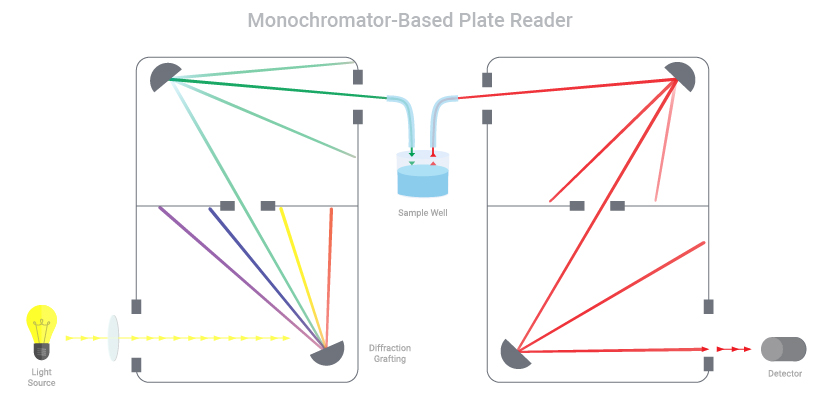
Monochromators work by taking a light source and splitting the light to focus a particular wavelength on the sample. During excitation, the light passes through a narrow slit, directed by a series of mirrors and diffraction grating and then passes through a second narrow slit prior to reaching the sample. This ensures the desired wavelength is selected to excite the fluorophore. Once the fluorophore is excited, it emits light at a different, longer wavelength. This emission light is captured by another series of mirrors, grating and slits to limit the emission to a desired wavelength, which then enters a detector for signal readout.
XWe use cookies and similar technologies to make our website work, run analytics, improve our website, and show you personalized content and advertising. Some of these cookies are essential for our website to work. For others, we won’t set them unless you accept them. To learn more about our approach to Privacy we invite you to Read More
By clicking “Accept All”, you consent to the use of ALL the cookies. However you may visit Cookie Settings to provide a controlled consent.
We use cookies and similar technologies to make our website work, run analytics, improve our website, and show you personalized content and advertising. Some of these cookies are essential for our website to work. For others, we won’t set them unless you accept them. To find out more about cookies and how to manage cookies, read our Cookie Policy.
If you are located in the EEA, the United Kingdom, or Switzerland, you can change your settings at any time by clicking Manage Cookie Consent in the footer of our website.
Necessary cookies are absolutely essential for the website to function properly. These cookies ensure basic functionalities and security features of the website, anonymously.
Cookie
Duration
Description
cookielawinfo-checbox-analytics
11 months
This cookie is set by GDPR Cookie Consent plugin. The cookie is used to store the user consent for the cookies in the category "Analytics".
cookielawinfo-checbox-functional
11 months
The cookie is set by GDPR cookie consent to record the user consent for the cookies in the category "Functional".
cookielawinfo-checbox-others
11 months
This cookie is set by GDPR Cookie Consent plugin. The cookie is used to store the user consent for the cookies in the category "Other.
cookielawinfo-checkbox-advertisement
1 year
The cookie is set by GDPR cookie consent to record the user consent for the cookies in the category "Advertisement".
cookielawinfo-checkbox-necessary
11 months
This cookie is set by GDPR Cookie Consent plugin. The cookies is used to store the user consent for the cookies in the category "Necessary".
cookielawinfo-checkbox-performance
11 months
This cookie is set by GDPR Cookie Consent plugin. The cookie is used to store the user consent for the cookies in the category "Performance".
gdpr_status
6 months 2 days
This cookie is set by the provider Media.net. This cookie is used to check the status whether the user has accepted the cookie consent box. It also helps in not showing the cookie consent box upon re-entry to the website.
lang
This cookie is used to store the language preferences of a user to serve up content in that stored language the next time user visit the website.
viewed_cookie_policy
11 months
The cookie is set by the GDPR Cookie Consent plugin and is used to store whether or not user has consented to the use of cookies. It does not store any personal data.
Analytical cookies are used to understand how visitors interact with the website. These cookies help provide information on metrics the number of visitors, bounce rate, traffic source, etc.
Cookie
Duration
Description
SC_ANALYTICS_GLOBAL_COOKIE
10 years
This cookie is associated with Sitecore content and personalization. This cookie is used to identify the repeat visit from a single user. Sitecore will send a persistent session cookie to the web client.
vuid
2 years
This domain of this cookie is owned by Vimeo. This cookie is used by vimeo to collect tracking information. It sets a unique ID to embed videos to the website.
WMF-Last-Access
1 month 18 hours 24 minutes
This cookie is used to calculate unique devices accessing the website.
_ga
2 years
This cookie is installed by Google Analytics. The cookie is used to calculate visitor, session, campaign data and keep track of site usage for the site's analytics report. The cookies store information anonymously and assign a randomly generated number to identify unique visitors.
_gid
1 day
This cookie is installed by Google Analytics. The cookie is used to store information of how visitors use a website and helps in creating an analytics report of how the website is doing. The data collected including the number visitors, the source where they have come from, and the pages visted in an anonymous form.
Advertisement cookies are used to provide visitors with relevant ads and marketing campaigns. These cookies track visitors across websites and collect information to provide customized ads.
Cookie
Duration
Description
IDE
1 year 24 days
Used by Google DoubleClick and stores information about how the user uses the website and any other advertisement before visiting the website. This is used to present users with ads that are relevant to them according to the user profile.
test_cookie
15 minutes
This cookie is set by doubleclick.net. The purpose of the cookie is to determine if the user's browser supports cookies.
VISITOR_INFO1_LIVE
5 months 27 days
This cookie is set by Youtube. Used to track the information of the embedded YouTube videos on a website.
Performance cookies are used to understand and analyze the key performance indexes of the website which helps in delivering a better user experience for the visitors.
Cookie
Duration
Description
YSC
session
This cookies is set by Youtube and is used to track the views of embedded videos.
_gat_UA-62336821-1
1 minute
This is a pattern type cookie set by Google Analytics, where the pattern element on the name contains the unique identity number of the account or website it relates to. It appears to be a variation of the _gat cookie which is used to limit the amount of data recorded by Google on high traffic volume websites.