There is nothing like a bit of recognition to energize your efforts, right? Promega was recently awarded the 2019 Distinguished Performer: Sustainability award, as one of the Deloitte Wisconsin 75 awardees.
This award is not so much a feather in our cap, as fuel for our sustainability fire both in Madison, and globally. Here are a few details on the award and why Promega was chosen.
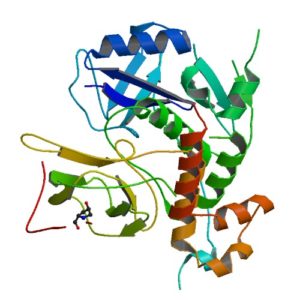
Structure of a HIF-1a-pVHL-ElonginB-ElonginC complex
William G. Kaelin Jr., Sir Peter J. Ratcliffe and Gregg L. Semenza were awarded the 2019 Nobel Prize in Physiology or Medicine for their discoveries of how cells sense and adapt to oxygen availability.
Kaelin and Ratcliffe’s labs focused their efforts on the transcription factor HIF (hypoxia-inducible factor). This transcription factor is critical in the cellular adaptation of to changes in oxygen availability.
When oxygen levels are elevated cells contain very little HIF. Ubiquitin is added to the HIF protein via the VHL complex and it is degraded in the proteasome. When oxygen levels are low (hypoxia) the amount of HIF increases.
In 2001 both groups published articles characterizing the interaction between VHL and HIF, and these articles were referenced by the Nobel Prize Organization in their press release about this year’s award. (1,2). Both studies demonstrated that under the normal oxygen conditions hydroxylation of proline residue P564 enabled VHL to recognize and bind to HIF.
The use of cell free expression (i.e., TNT Coupled Transcription/Translation System) by both labs was key in the characterization of the VHL:HIF interaction The labs utilized HIF and VHL 35-S labeled proteins generated via the TNT system under both normal or in a hypoxic work station to:
Determine the affect of ferrous chloride and cobaltous chloride on the interaction
Map the specific region of HIF required for the interaction to occur (556-574)
Determine the effect of HIF point mutations on the interaction
Use synthetic peptides to block the interaction
Conclude that a factor in mammalian cells was necessary for the interaction to occur.
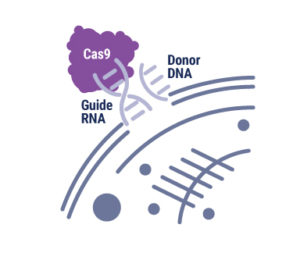
Ribonucleoprotein complex with Cas9, guide RNA and donor ssDNA. Copyright Promega Corporation.
With the advent of genome editing using CRISPR-Cas9, researchers have been excited by the possibilities of precisely placed edits in cellular DNA. Any double-stranded break in DNA, like that induced by CRISPR-Cas9, is repaired by one of two pathways: Non-homologous end joining (NHEJ) or homology-directed repair (HDR). Using the NHEJ pathway results in short insertions or deletions (indels) at the break site, so the HDR pathway is preferred. However, the low efficiency of HDR recombination to insert exogenous sequences into the genome hampers its use. There have been many attempts at boosting HDR frequency, but the methods compromise cell growth and behave differently when used with various cell types and gene targets. The strategy employed by the authors of an article in Communications Biology tethered the DNA donor template to Cas9 complexed with the ribonucleoprotein and guide RNA, increasing the local concentration of the donor template at the break site and enhancing homology-directed repair. Continue reading “All You Need is a Tether: Improving Repair Efficiency for CRISPR-Cas9 Gene Editing”
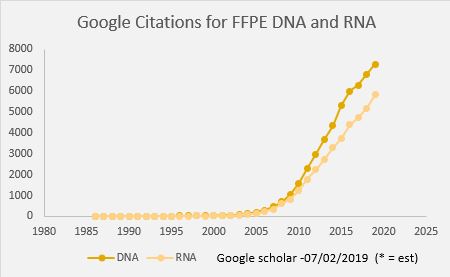
Peer-reviewed publications containing data dervived from analysis of nucleic acids isolated from FFPE samples have increased dramatically since 2006.
Formalin Fixed Paraffin Embedded samples (FFPE) have been a mainstay of the pathology lab for over 100 years. Initially FFPE blocks were sectioned, stained with simple dyes and used for studying morphology, but now a variety of biomolecules can be analyzed in these samples. Over the past 10 years we have discovered that there is a treasure trove of genomics data waiting to be unearthed in FFPE tissue. While viral RNAs and miRNA were some of the first molecules found to be present and accessible for analysis starting in the 1990s, improvements to DNA and RNA extraction methods have demonstrated that PCR, qPCR, SNP genotyping, Exome and WGS are possible. This has resulted scientific publications of DNA and RNA data generated from FFPE samples starting in 2006, and today we see immense amounts of data generated from FFPE—with nearly 2000 citations in 2018 reporting sequencing of FFPE samples.
Depending on the type of project, prospective or
retrospective, the genomics scientist has an opportunity to affect the
probability of success by better understanding the fixation process. The
challenge with FFPE is the host of variables that have the potential to
negatively affect downstream assays.
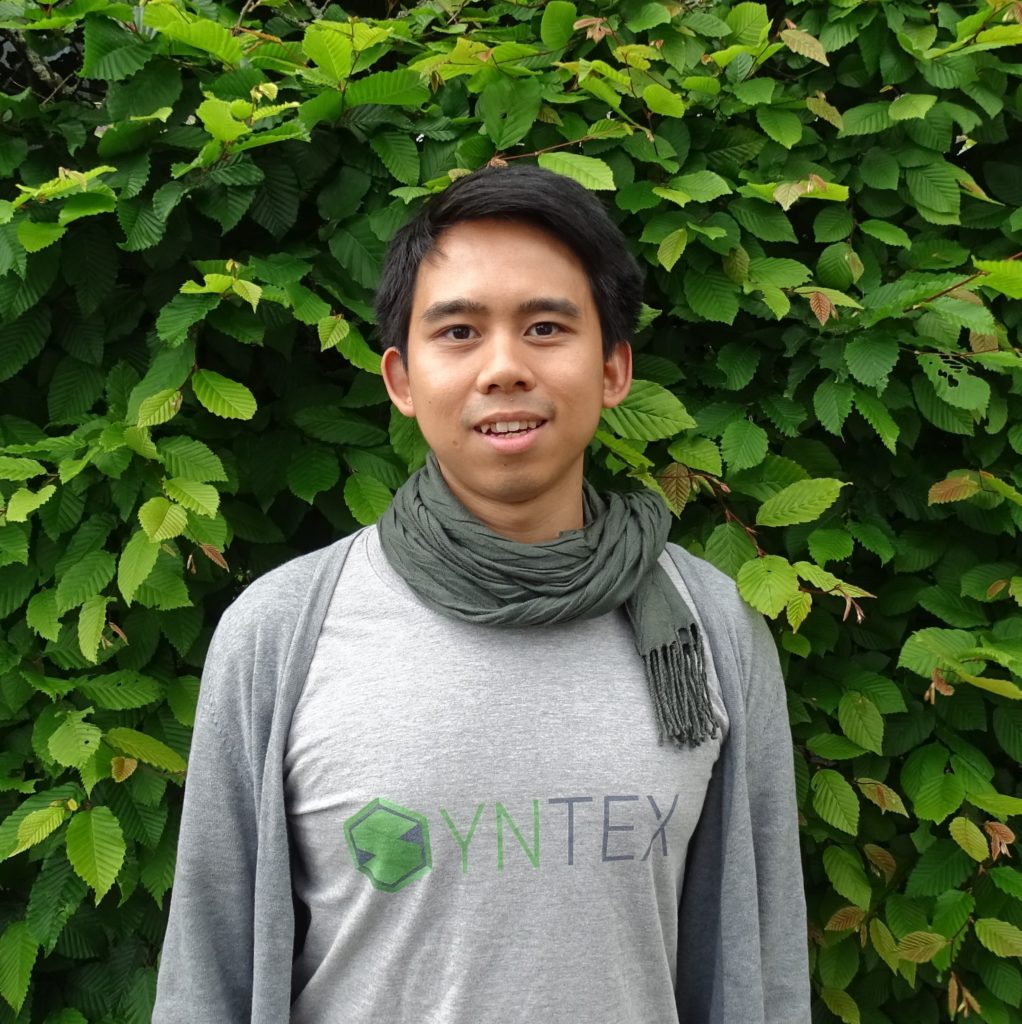
Today’s blog is guest-written by Wihan Adi, a Master’s student majoring in physics at Justus-Liebig-University in Giessen and team member of iGEM Marburg. Although his background is in nuclear and particle physics, his research interests shifted toward affordable biosensors for point-of-care cancer detection, which is how he ended up doing microbiology for iGEM.
Back in March when the iGEM season had just started, Maurice, a fellow iGEM Marburg team member, told me that he was exchanging emails with Margaretha Schwartz from Promega. Given my background as a physics student, Promega was not a household name for me at the time. “So, are you interested in automating a plasmid purification protocol?” asked Maurice. He told me that Promega was willing to supply the Wizard® MagneSil® Plasmid Purification System for this purpose; that was another name that added to my confusion.
Wihan Adi2019 iGEM Marburg Team
This year, iGEM Marburg is aiming to establish a fast phototrophic organism as a synthetic biology chassis. For this goal we chose Synechococcus elongatus UTEX 2973, with a reported doubling time of 90 minutes. More specifically, we are creating an easy to use toolbox to empower rapid design testing, including genome engineering tools, self-replicating plasmid systems, natural competence and a Golden Gate-based part library. Our team chose to work on phototrophic organisms because we envision accelerating research in this particular field. (Note: Last year, Marburg’s iGEM project won the Grand Prize!)
In the fall of 1989, a small group of forensic scientists, law enforcement officials and representatives from Promega Corporation gathered in Madison, Wisconsin, for the very first International Symposium on Human Identification (ISHI). At the time, DNA typing was in its infancy and had not yet been validated as a forensic method. The available technology consisted of two methods: detection of restriction fragment length polymorphisms (RFLPs) and variable number of tandem repeats (VNTRs). Promega had developed products based on both analytical methods, which essentially provide a DNA “fingerprint” or profile for each individual tested.
Among the attendees at that first symposium was Tom Callaghan, then a graduate student. That experience made a significant impact on his career path. Last week, at ISHI 30, he presented a session on rapid DNA testing. Dr. Callaghan currently serves as a Senior Biometric Scientist for the FBI. In 1999, he was instrumental in launching the FBI’s Combined DNA Index System (CODIS) and in 2003, he became the first CODIS Unit Chief.
Our innate immune system was meant to do good. Up until a
century ago, most humans died from infectious diseases like diarrhea,
tuberculosis and meningitis. Over millions of years, our immune system has
evolved to fight these life-threatening infections from pathogens. As a result,
we have developed a highly efficient response to these tiny invaders. But it
seems that our immune system may be turning against us.
Formal judgment in any context is nerve-racking. Scientists, familiar with being judged, rely on others to evaluate (and hopefully accept) everything from a PhD thesis defense to grant proposals and peer-reviewed journal article submissions. The frustrating part is not knowing exactly what the judges are looking for. Sure there are requirements and guidelines to follow—but how are the judges going to interpret them? It would be a whole lot easier if we could just peek into their minds. Unfortunately for most, that fantasy isn’t likely to turn into reality.
But if you are part of an iGEM team, today is your lucky day! Our own Preeta Guptan volunteers as a judge for the iGEM competition, and in today’s article, you will get her insider’s perspective about what iGEM judges look for. You will also get some tips to help you excel in the iGEM competition—and effectively communicate about science in general.
Preeta is an External Innovation Manager at Promega, which means she seeks out and investigates technology that might be valuable for Promega to license or acquire. The opportunity to scout up-and-coming synthetic biology advances was one reason she wanted to be an iGEM judge, but curiosity was at the core of her decision. Preeta and the other judges bring their unique perspectives and experiences to each iGEM project and team they evaluate. Here are some suggestions from Preeta:
Joe Willie Smith’s instrumental art installation is a collaborative experience of sound and color.
Joe Willie Smith has always been a creator. As a young child growing up in Milwaukee, his mother encouraged him to make art and find beauty in the everyday. Following years of work in printing and graphic design (including posters for Gil-Scott Heron and Chaka Khan), Smith began channeling his inspiration and creativity into building playable “sonic sculptures” out of found objects. “They’re not all considered instruments…sometimes I just make soundscapes out of them,” Smith says.
As the artist-in-residence for the Promega Fall Art Showcase, Smith set out to create a sonic sculpture from collected items from the Promega campus. He planned to perform on the instrument at the opening of the Art Show, but his creative process led to something much more—a collaborative experience in sound and color.
Nicole Haselwander and Stephanie Shea accept the Seeds of Change award for Promega.
Community Shares of Wisconsin presented Promega with its Seeds of Change award for our workplace giving efforts. The award is presented to a local business that shows innovation, growth, and commitment to Community Shares of Wisconsin. Over the past 15 years Promega and our employees have collectively contributed more than $717,000 to Community Shares work! Our 100% corporate matching helps employee gifts go twice as far to member nonprofits and the community.
Charitable giving programs and paid time off for community service are examples of Promega’s commitment to corporate responsibility. Learn more at https://www.promega.com/responsibility #corporateresponsibility
Nicole Haselwander and Stephanie Shea were on hand at the Community
Change-Maker Awards hosted by Community Shares of Wisconsin to accept the Seeds
of Change award on behalf of Promega Corporation. “It was an incredibly
inspiring and uplifting program,” says Stephanie.
XWe use cookies and similar technologies to make our website work, run analytics, improve our website, and show you personalized content and advertising. Some of these cookies are essential for our website to work. For others, we won’t set them unless you accept them. To learn more about our approach to Privacy we invite you to Read More
By clicking “Accept All”, you consent to the use of ALL the cookies. However you may visit Cookie Settings to provide a controlled consent.
We use cookies and similar technologies to make our website work, run analytics, improve our website, and show you personalized content and advertising. Some of these cookies are essential for our website to work. For others, we won’t set them unless you accept them. To find out more about cookies and how to manage cookies, read our Cookie Policy.
If you are located in the EEA, the United Kingdom, or Switzerland, you can change your settings at any time by clicking Manage Cookie Consent in the footer of our website.
Necessary cookies are absolutely essential for the website to function properly. These cookies ensure basic functionalities and security features of the website, anonymously.
Cookie
Duration
Description
cookielawinfo-checbox-analytics
11 months
This cookie is set by GDPR Cookie Consent plugin. The cookie is used to store the user consent for the cookies in the category "Analytics".
cookielawinfo-checbox-functional
11 months
The cookie is set by GDPR cookie consent to record the user consent for the cookies in the category "Functional".
cookielawinfo-checbox-others
11 months
This cookie is set by GDPR Cookie Consent plugin. The cookie is used to store the user consent for the cookies in the category "Other.
cookielawinfo-checkbox-advertisement
1 year
The cookie is set by GDPR cookie consent to record the user consent for the cookies in the category "Advertisement".
cookielawinfo-checkbox-necessary
11 months
This cookie is set by GDPR Cookie Consent plugin. The cookies is used to store the user consent for the cookies in the category "Necessary".
cookielawinfo-checkbox-performance
11 months
This cookie is set by GDPR Cookie Consent plugin. The cookie is used to store the user consent for the cookies in the category "Performance".
gdpr_status
6 months 2 days
This cookie is set by the provider Media.net. This cookie is used to check the status whether the user has accepted the cookie consent box. It also helps in not showing the cookie consent box upon re-entry to the website.
lang
This cookie is used to store the language preferences of a user to serve up content in that stored language the next time user visit the website.
viewed_cookie_policy
11 months
The cookie is set by the GDPR Cookie Consent plugin and is used to store whether or not user has consented to the use of cookies. It does not store any personal data.
Analytical cookies are used to understand how visitors interact with the website. These cookies help provide information on metrics the number of visitors, bounce rate, traffic source, etc.
Cookie
Duration
Description
SC_ANALYTICS_GLOBAL_COOKIE
10 years
This cookie is associated with Sitecore content and personalization. This cookie is used to identify the repeat visit from a single user. Sitecore will send a persistent session cookie to the web client.
vuid
2 years
This domain of this cookie is owned by Vimeo. This cookie is used by vimeo to collect tracking information. It sets a unique ID to embed videos to the website.
WMF-Last-Access
1 month 18 hours 24 minutes
This cookie is used to calculate unique devices accessing the website.
_ga
2 years
This cookie is installed by Google Analytics. The cookie is used to calculate visitor, session, campaign data and keep track of site usage for the site's analytics report. The cookies store information anonymously and assign a randomly generated number to identify unique visitors.
_gid
1 day
This cookie is installed by Google Analytics. The cookie is used to store information of how visitors use a website and helps in creating an analytics report of how the website is doing. The data collected including the number visitors, the source where they have come from, and the pages visted in an anonymous form.
Advertisement cookies are used to provide visitors with relevant ads and marketing campaigns. These cookies track visitors across websites and collect information to provide customized ads.
Cookie
Duration
Description
IDE
1 year 24 days
Used by Google DoubleClick and stores information about how the user uses the website and any other advertisement before visiting the website. This is used to present users with ads that are relevant to them according to the user profile.
test_cookie
15 minutes
This cookie is set by doubleclick.net. The purpose of the cookie is to determine if the user's browser supports cookies.
VISITOR_INFO1_LIVE
5 months 27 days
This cookie is set by Youtube. Used to track the information of the embedded YouTube videos on a website.
Performance cookies are used to understand and analyze the key performance indexes of the website which helps in delivering a better user experience for the visitors.
Cookie
Duration
Description
YSC
session
This cookies is set by Youtube and is used to track the views of embedded videos.
_gat_UA-62336821-1
1 minute
This is a pattern type cookie set by Google Analytics, where the pattern element on the name contains the unique identity number of the account or website it relates to. It appears to be a variation of the _gat cookie which is used to limit the amount of data recorded by Google on high traffic volume websites.