Last summer, we announced our most ambitious sustainability goals ever. This year, as part of our annual reporting, we are proud to share that over 20% of our global electricity is supplied by renewable sources. This represents a ten-fold increase in our renewable energy usage over the past three years.
The Albrecht Group in the Department of Biology at the University of Fribourg, investigates circadian rhythms in biological systems. Recently Urs Albrecht submitted a photo of baby squid for the Swiss Art + Science Competition sponsored by Promega AG. We have covered squid communication in a separate blog. Here we talk to him about the photo and the inspiration behind it.
How did you become interested in squids as an experimental model?
Dr. Urs Albrecht
My lab works mainly with mice. Other professors work with different organisms such as Drosophila, C. elegans, plants, and yeast at our university. One of them, Simon Sprecher, became interested in marine biology and started a course for students. I immediately thought that’s a great idea because it is something different, and few actually look deeply into the biology of marine organisms. The literature on squids is scarce and old, and they are challenging to keep in lab conditions. Yet, my colleague ordered Loligo vulgaris eggs from Villefranche Sur Mer in France and started establishing them to hatch and grow in Fribourg. He was successful. The next step was setting up experimentation. However, squids have brains, and to carry out experiments with them, we needed to apply for authorization from the Swiss Government. I helped out, but it was challenging because there were no standards and regulations, as nobody works on these animals in Switzerland. Now we are interested in studying the communication between squids. It is easy to observe how they change color, because they are transparent. The change in color is related to their stress level and mood.
What went into taking the image “One Out”?
I’ve been a hobby photographer since I am ten years old. So when I went to my colleague’s lab and looked at the baby squids, I said, “Ohh, they are beautiful.” They looked really stunning, and some of them started changing colors in front of me. I thought that was a fascinating behavior, and I wanted to capture that.
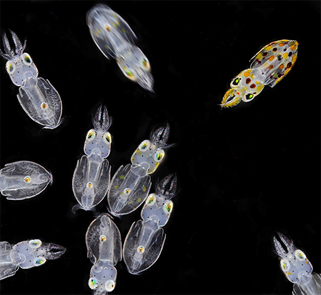
Baby squids are transparent and colorful. I had to think about how I could best picture them. I decided to have them in a Petri dish and put them on a stand with lighting coming from below on a black background. I made several images. On one of them, there was this situation where one of the squids was changing color. It was very different from all the others. It immediately came to my mind that something was happening. They were communicating.
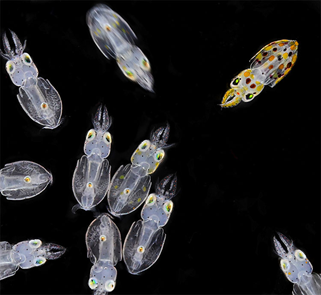
One Out (winner Promega AG Swiss Art + Science Competition) by Urhs Albrecht, University of Fribourg
Squids are mysterious creatures roaming seas and oceans. They are also the subjects Urs Albrecht chose for his winning picture in the Swiss Art + Science competition, “One Out.” The photo shows squid juveniles, one of which displays striking colors in opposition to the rest. The bright individual is also physically removed from the group, may be scared or angry. The image is fascinating because we can see complex biology at play with the naked eye. Squids are Coleoid cephalopods, mollusks with arms attached to their heads. They have lost their shell and developed larger and highly differentiated brains and camera-type eyes through evolution. Their nervous system is highly organized. The central brain acts as the decision-making unit, and the peripheral nervous system processes motor and sensory information.
After a long hiatus sparked by the COVID-19 pandemic, the Promega Art Showcase will return next week with a new exhibition titled “A Vibrant Welcome Back!”
Promega Art Showcase
Why is a biotechnology company hosting an art show?
At its core, science is rooted in creativity. Scientists investigate the unknown and search for novel solutions that can improve our quality of life. We believe that observing and creating art reenergizes the imagination, inspiring scientists to look from new perspectives and step outside of the norms.
Promega has hosted quarterly art showcases in the BioPharmaceutical Technology Center since 1996. These showcases are open to the public and have featured the work of local, national and international artists. Past shows have included sculptors, folk artists, photographers, and painters. The December-March show each year features artwork by Promega employees and their family members.
The 2022 Summer Art Showcase features the work of Derrick Buisch, a painter and professor at the University of Wisconsin-Madison, alongside Bettina Madini, a European contemporary artist and fashion designer.
Tracking the spread of COVID-19 has been a tremendous challenge throughout the pandemic, but doing so is a key step toward containing the virus. Many communities have relied on patient testing and contact tracing, with limited success. In search of better methods, some countries have made inroads in a different form of disease surveillance: wastewater-based epidemiology (WBE). This approach involves testing wastewater for the presence of pathogens, primarily through DNA and RNA analysis, and has proved to be an accurate and highly effective way to keep tabs on the prevalence and progression of COVID-19 at the population level.
Switzerland is among those countries that have implemented WBE in their efforts to stay ahead of the pandemic. Since WBE first emerged in 2020 as a promising tool, several Swiss laboratories undertook wastewater testing, and protocols were established early.
“At the beginning, the methods to actually detect coronavirus in wastewater were rather laborious and complicated, and involved a lot of resources,” said Dr. Claudia Bagutti, microbiologist and molecular biologist in the State Laboratory of Basel-City, Switzerland.
Bagutti heads a small team performing applied biosafety research. In 2020, her lab was tasked with developing an assay for detecting COVID-19 in wastewater. However, the available methods were prohibitively complex and resource intensive.
In the meantime, researchers at Promega recognized that Promega products and methodologies could potentially be applied to WBE and set to work developing simpler and more efficient method for wastewater analysis. In the spring of 2021, Bagutti’s team decided to try adopting this method.
“Promega had a very nice method which was less laborious and much easier to handle, and that’s why we gave it a try,” said Bagutti.
In the ensuing study, Bagutti and her team analyzed effluent from the catchment area of one municipal wastewater plant in Switzerland. They examined the total wastewater output of around 270,000 people. Viral RNA was extracted using Promega’s Maxwell® RSC Environ Wastewater TNA Kit. The number of RNA copies present, representing the overall concentration of COVID-19 in each sample, was determined via quantitative reverse transcriptase (RT-qPCR) using the GoTaq® Enviro Wastewater SARS-CoV-2 Systems, also from Promega. The viral RNA was subsequently sequenced with next generation sequencing, and the results correlated quite well with the COVID-19 cases in the catchment area. Remarkably, this study detected the Omicron variant in a wastewater sample one day prior to the first reported case identified through patient testing.
“We observed a similar spread to most other western countries with respect to the time of the first discovery of these variants,” said Bagutti. “We were also able to demonstrate the presence [of Omicron] in the wastewater before it came up in a sample of a COVID-19 patient test, which of course shows the usefulness of wastewater monitoring for the prediction of new variants and infection dynamics.”
WBE is especially promising in that it provides population-level data independent of patient testing. Health departments can be alerted to the presence of COVID-19 earlier than would otherwise be possible with traditional testing and can take precautions to contain the spread. In creating a more user-friendly method for wastewater analysis, Promega has opened the door for more laboratories to conduct WBE, which could provide communities around the world with the information they need to preempt the progression of COVID-19.
“The Promega method is very straightforward to handle,” said Bagutti. “It only takes a small volume of wastewater, which makes it handy. It’s less time-consuming compared to the methods which were in the literature at the beginning of the pandemic, and it just works very well. We also did experience great support from Promega.”
At this point, much of the wastewater analysis performed in Switzerland is done with the Promega method, including in federal, state or private labs. The swift advance of WBE in Switzerland speaks to the colossal effort put forth both by Promega researchers in developing the necessary products and methodologies, as well by those labs that have made use of Promega’s products to monitor COVID-19 in wastewater.
“It’s really been a success story for us, from the beginning,” said Bagutti.
Learn more about Promega’s work with wastewater-based epidemiology.
Nucleic acid extraction is a time-consuming, resource-intensive process, but it doesn’t have to be. Automated systems are becoming more and more accessible and often can be operated with simple “plug and play” kits, freeing valuable resources
With these systems increasingly within reach, perhaps you’re thinking about introducing automated nucleic acid extraction into your lab. As you consider your options, here’s eight reasons why we think you should automate your nucleic extraction workflows.
1. Reach your project milestones and publish faster.
In the fast-paced, competitive environment of research and technology development, efficiency is key to reaching project milestones and publishing your work. Managing your resources effectively–especially time–can help you reach those goals.
Time spent on manual nucleic acid extractions is time lost on parallel work, which cuts down productivity. Automation is not only often faster than manual preparations, but it also frees your team to do more valuable hands-on work.
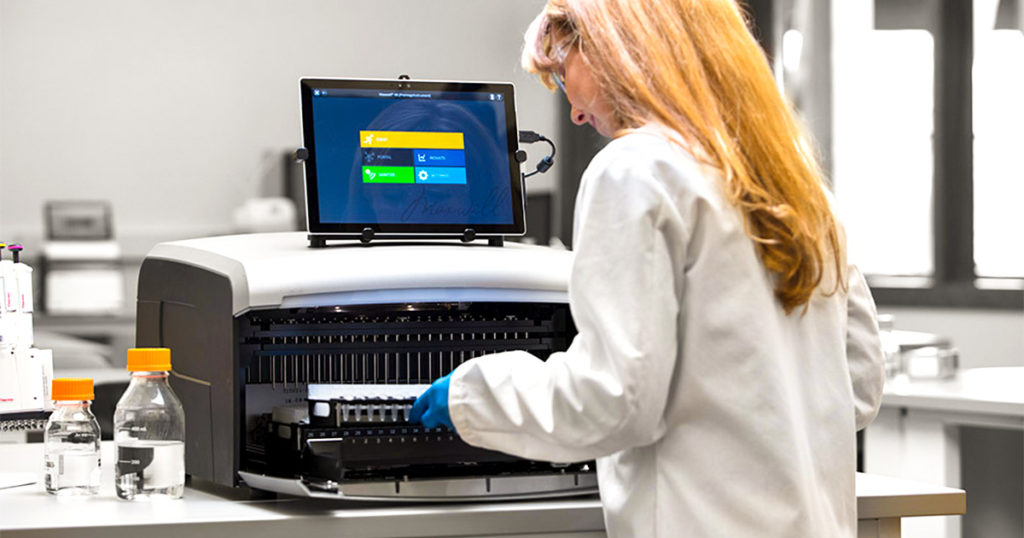
As an example, the Maxwell® RSC cuts 40 minutes of hands-on-time per 16 samples. As the number of samples scales to 96 and beyond, liquid handlers like the Hamilton Star or Tecan Fluent can save many hours of hands-on-time per day.
Today’s blog is written by Brady Musson, Director of Global Logistics at Promega.
Our priority is ensuring that Promega customers receive everything they need, exactly when they need it. As the Director of Global Logistics at Promega, that is my primary focus, and the expertise of my entire team. I want to assure you that we’re doing everything we can so you can focus on keeping your work moving.
There are many factors that go into realizing these goals, and I would like to take a moment to address how Promega is managing some of the recent challenges. Our long-term, sustainable approach to business helps us weather uncertainty and instability. Our strong network of relationships allows us to explore creative solutions when challenges arise. Above all, our employees are willing to do what it takes to support the important work being done by life scientists around the world.
Kepler Center is the home of Promega customer service, kit packaging and shipping.
Massively parallel sequencing (MPS) has gained popularity for specialized forensic applications. However, the amplification of short tandem repeats (STRs) and analysis by capillary electrophoresis (CE) remains the gold standard for the vast majority of forensic laboratories.
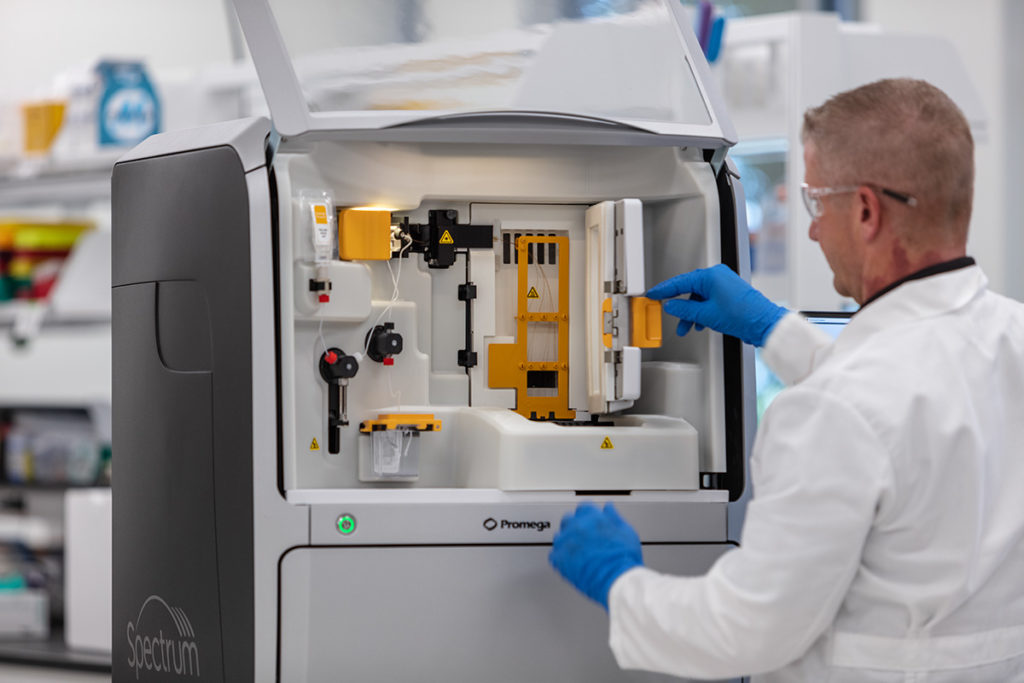
Recently, Promega announced the launch of the Spectrum CE System, a new capillary electrophoresis instrument that supports future 8-color technology while maintaining compatibility with existing 5- and 6-color kits—even ones that Promega does not sell. In a market with limited instrumentation options for CE analysis, the Spectrum CE system offers features designed to streamline the workflow for analyzing casework and database samples.
Ah summer. The time for lazy afternoons spent dozing in a hammock, lulled to sleep by the quiet buzz of bees hard at work collecting nectar and pollen from the first flowers of the year. It sounds idyllic, but unfortunately, such afternoons are falling increasingly silent. As uniformly green lawns replace patchworks of dandelions and clover, the bees are disappearing.
May 14 is World Migratory Bird Day (WMBD). The overall mission of this globally recognized event is to raise awareness of migratory birds and protect them by recognizing issues related to their conservation. Over the years, WMBD has focused on issues such as climate change, plastic pollution, the illegal killing of birds, and barriers to migration. The theme for 2022 is focused on light pollution.
XWe use cookies and similar technologies to make our website work, run analytics, improve our website, and show you personalized content and advertising. Some of these cookies are essential for our website to work. For others, we won’t set them unless you accept them. To learn more about our approach to Privacy we invite you to Read More
By clicking “Accept All”, you consent to the use of ALL the cookies. However you may visit Cookie Settings to provide a controlled consent.
We use cookies and similar technologies to make our website work, run analytics, improve our website, and show you personalized content and advertising. Some of these cookies are essential for our website to work. For others, we won’t set them unless you accept them. To find out more about cookies and how to manage cookies, read our Cookie Policy.
If you are located in the EEA, the United Kingdom, or Switzerland, you can change your settings at any time by clicking Manage Cookie Consent in the footer of our website.
Necessary cookies are absolutely essential for the website to function properly. These cookies ensure basic functionalities and security features of the website, anonymously.
Cookie
Duration
Description
cookielawinfo-checbox-analytics
11 months
This cookie is set by GDPR Cookie Consent plugin. The cookie is used to store the user consent for the cookies in the category "Analytics".
cookielawinfo-checbox-functional
11 months
The cookie is set by GDPR cookie consent to record the user consent for the cookies in the category "Functional".
cookielawinfo-checbox-others
11 months
This cookie is set by GDPR Cookie Consent plugin. The cookie is used to store the user consent for the cookies in the category "Other.
cookielawinfo-checkbox-advertisement
1 year
The cookie is set by GDPR cookie consent to record the user consent for the cookies in the category "Advertisement".
cookielawinfo-checkbox-necessary
11 months
This cookie is set by GDPR Cookie Consent plugin. The cookies is used to store the user consent for the cookies in the category "Necessary".
cookielawinfo-checkbox-performance
11 months
This cookie is set by GDPR Cookie Consent plugin. The cookie is used to store the user consent for the cookies in the category "Performance".
gdpr_status
6 months 2 days
This cookie is set by the provider Media.net. This cookie is used to check the status whether the user has accepted the cookie consent box. It also helps in not showing the cookie consent box upon re-entry to the website.
lang
This cookie is used to store the language preferences of a user to serve up content in that stored language the next time user visit the website.
viewed_cookie_policy
11 months
The cookie is set by the GDPR Cookie Consent plugin and is used to store whether or not user has consented to the use of cookies. It does not store any personal data.
Analytical cookies are used to understand how visitors interact with the website. These cookies help provide information on metrics the number of visitors, bounce rate, traffic source, etc.
Cookie
Duration
Description
SC_ANALYTICS_GLOBAL_COOKIE
10 years
This cookie is associated with Sitecore content and personalization. This cookie is used to identify the repeat visit from a single user. Sitecore will send a persistent session cookie to the web client.
vuid
2 years
This domain of this cookie is owned by Vimeo. This cookie is used by vimeo to collect tracking information. It sets a unique ID to embed videos to the website.
WMF-Last-Access
1 month 18 hours 24 minutes
This cookie is used to calculate unique devices accessing the website.
_ga
2 years
This cookie is installed by Google Analytics. The cookie is used to calculate visitor, session, campaign data and keep track of site usage for the site's analytics report. The cookies store information anonymously and assign a randomly generated number to identify unique visitors.
_gid
1 day
This cookie is installed by Google Analytics. The cookie is used to store information of how visitors use a website and helps in creating an analytics report of how the website is doing. The data collected including the number visitors, the source where they have come from, and the pages visted in an anonymous form.
Advertisement cookies are used to provide visitors with relevant ads and marketing campaigns. These cookies track visitors across websites and collect information to provide customized ads.
Cookie
Duration
Description
IDE
1 year 24 days
Used by Google DoubleClick and stores information about how the user uses the website and any other advertisement before visiting the website. This is used to present users with ads that are relevant to them according to the user profile.
test_cookie
15 minutes
This cookie is set by doubleclick.net. The purpose of the cookie is to determine if the user's browser supports cookies.
VISITOR_INFO1_LIVE
5 months 27 days
This cookie is set by Youtube. Used to track the information of the embedded YouTube videos on a website.
Performance cookies are used to understand and analyze the key performance indexes of the website which helps in delivering a better user experience for the visitors.
Cookie
Duration
Description
YSC
session
This cookies is set by Youtube and is used to track the views of embedded videos.
_gat_UA-62336821-1
1 minute
This is a pattern type cookie set by Google Analytics, where the pattern element on the name contains the unique identity number of the account or website it relates to. It appears to be a variation of the _gat cookie which is used to limit the amount of data recorded by Google on high traffic volume websites.