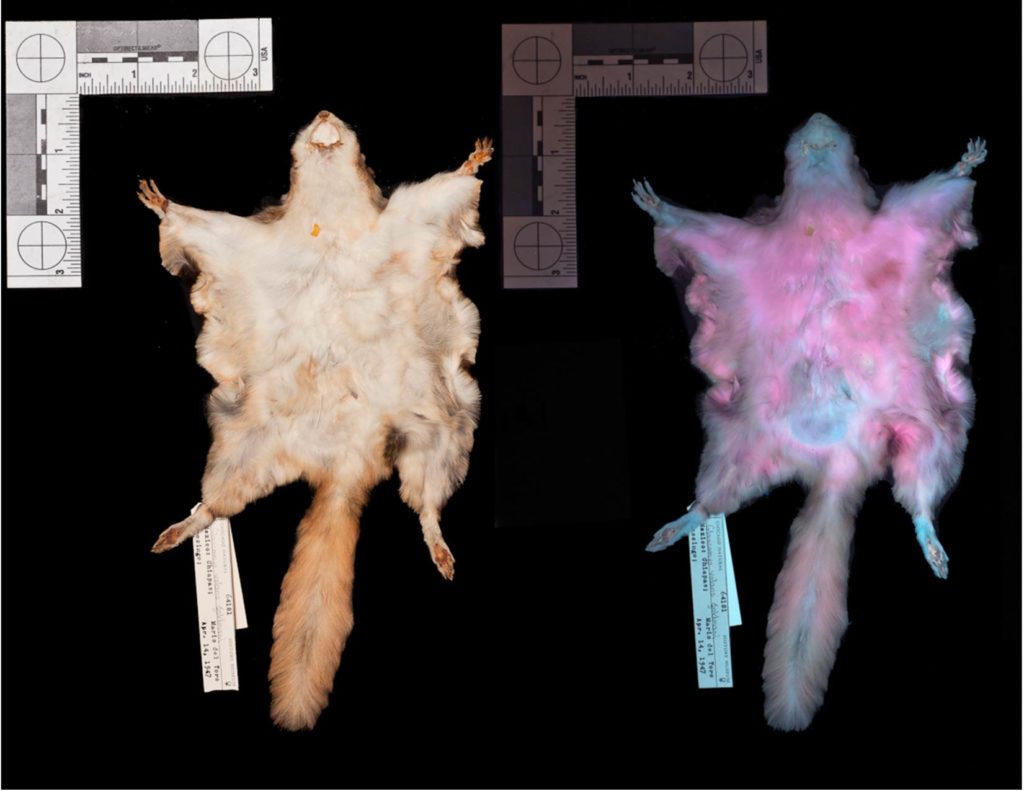
A flying squirrel museum specimen under normal light versus ultraviolet light. Photo courtesy of AM Kohler, et al.
In May 2017, a surprising discovery was made in the woods of Bayfield County, Wisconsin, just about a 5-hour drive north of Promega headquarters. Jonathan Martin, Associate Professor of Forestry at Northland College, was exploring the forest with an ultraviolet (UV) light in search of fluorescent lichen or plant life. What he found instead was a bright pink glow coming from a most unexpected source—a flying squirrel.
When Wisconsin plunged into a deep freeze during last week’s
polar vortex, I built a roaring fire in my fireplace and settled into my
armchair with a thick blanket and a video game controller. Except for the
twenty minutes I spent driving to and from the office, I stayed warm and
toasty.
Birds, however, don’t have it quite as easy. To survive freezing temperatures, non-migratory birds have developed many interesting adaptations. Many species grow extra down layers and huddle together for wind protection. Others, like the black-capped chickadee, use a process called regulated hypothermia to drop their resting body temperature by as much as 22°F to conserve energy. I’m particularly fascinated by the process of regional hypothermia—many species of ducks and gulls use a countercurrent heat exchange system to keep vital organs warm while letting temperatures fall in extremities.
Birds that aren’t accustomed to cold weather don’t have
these adaptations, though. When a bird—or any animal—ends up far outside of its
natural habitat, the consequences can be deadly.
Ebola virus (EBOV) and Marburg virus (MARV) are two closely-related viruses in the family Filoviridae. Filoviruses are often pathogenic, causing hemorrhagic fever disease in human hosts. The Ebola outbreak of 2014 caught the world by surprise by spreading so quickly and severely that public health organizations were unprepared. The devastating outcome was a total of over 11,000 deaths by the time the outbreak ended in 2016. Research that provides further understanding of filoviruses and their potential for transmission is important in preventing future outbreaks from occurring. But what if the outbreak comes from a virus we’ve never seen before?
Měnglà virus was discovered among filoviruses isolated from Old World fruit bats (Rousettus)
All in the viral family
A recent study published in the journal Nature Microbiology provides evidence of a newly identified filovirus species. Using serum samples taken from bats, a well-known host for filoviruses, Yang et al. isolated and identified viral RNA for an unclassified viral genome sequence using next generation sequencing analysis. This new virus genome sequence was organized with the same open reading frames as other filoviruses, encoding for nucleoprotein (NP), viral protein 35 (VP35), VP40, glycoprotein (GP), VP30, VP24, and RNA-dependent RNA polymerase (L). This new genome sequence shared up to 54% of the nucleotide sequences for the filovirus species Lloviu virus (LLOV), EBOV and MARV, with MARV being the most similar. Their analysis suggested that this novel virus should be classified within the Filoviridae family tree as a separate genus, Dianlovirus, and was named Měnglà virus (MLAV).
Redundancy equips us to survive. We have more than one lung or one kidney for a reason—if one organ in a pair gets damaged, we can still manage if the other is functional. At the cellular level, we have two copies of each chromosome in every non-germline cell. Each copy was inherited originally from a single sperm and ovum, which are “haploid” cells. Consequently, there are two copies of any given gene in non-germline “diploid” cells. In many cases, should one copy of a gene be damaged, the cell can still survive with the other, functional copy of a gene. In plants, this redundancy is common, and many plants exhibit polyploidy. In an extreme example of polyploidy, the large (by bacterial standards) but otherwise unassuming species Epulopiscium contains tens of thousands of copies of its genome.
Imagine you are a high school student living in a community devastated by gun violence and death. In the U.S., this could be one of many communities, but it happens to be Baltimore which had 301 deaths due to gun violence in 2017 (with a per capita rate well above other large cities). Then imagine you were part of an organization within that community that helped you, along with other students, gain knowledge and skills to come up with a viable solution to the problem using synthetic biology.
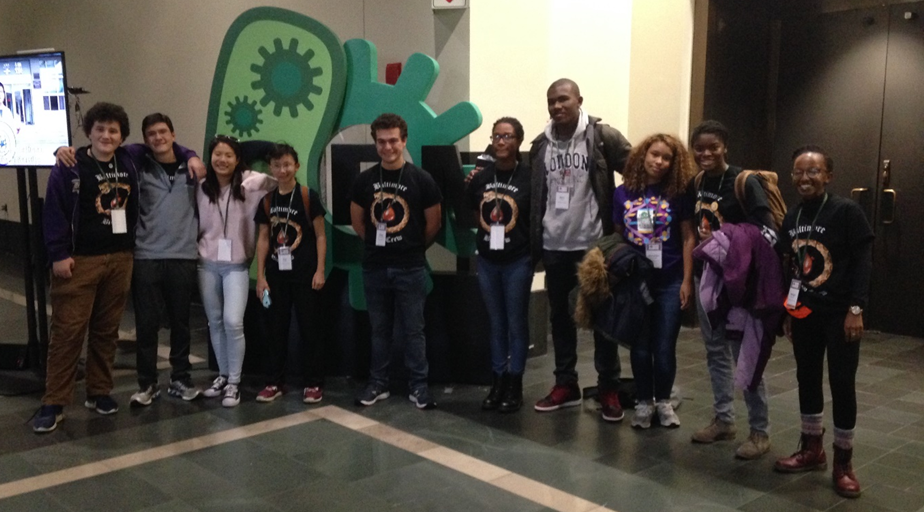
Baltimore Bio-Crew at the 2018 iGEM Giant Jamboree
This is exactly how the Baltimore Bio-Crew came up with their iGEM project, Coagulance Rx. The Baltimore Bio-Crew decided to tackle this community issue head-on. One team member, Mercedes Ferandes, reflected, “Living in Baltimore City, I have not only witnessed gun violence in front of me, but have had family members and friends die from it. I wanted to try to decrease the amount of deaths by gun violence using iGEM.”
After some research, they discovered that many of the gun violence deaths were due to blood loss and could have been prevented. The impoverished neighborhoods where this violence occurs lack the resources to provide timely emergency medical treatment. Many of these deaths can be attributed to delayed arrival of emergency response teams—wait times for an ambulance can be over an hour.
Although there were several contributing factors beyond their control, the team wanted to address this problem by focusing on blood clotting and how it could be helpful as a quick temporary treatment for open wounds. This solution could offer a reliable, cost efficient way to save lives by slowing or stopping blood loss until a victim could get medical attention. The team decided to pursue the use of snake venom after coming across some previous iGEM projects that had used it for clotting. Team member Henry Ryles pointed out that the need for snake venom powerful enough to clot blood quickly led them to choose the venom of the Russell’s Viper (Daboia russelii).
PROTACs or Proteolysis-Targeting Chimeras are an emerging tool in protein degradation studies, potentially suited to any need involving the removal of a specific protein. These small-molecule chimeras are exciting due to: 1) their target specificity; and 2) their ability to enable target destruction versus target inhibition. Here we discuss a paper that presents a roadmap for PROTAC development.
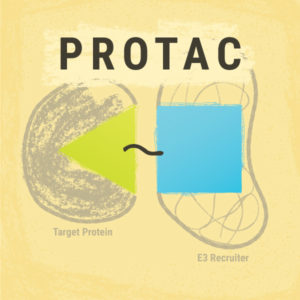
PROTAC components: target protein ligand, E3 ligase and linker.
Destruction/Inhibition: Is There a Difference? An analogy that microbiologists (and wrestlers or anyone that has ever spent time in a locker room shower) would understand, is fungicidal versus fungistatic compounds. A fungicidal compound kills fungus. A fungistatic compound just slows the fungus down a bit.
A small-molecule inhibitor attaches to its target protein, but for how long? What inhibitor testing must be done to determine how long the inhibition lasts?
On the other hand, a small-molecule agent that causes protein degradation first targets the protein of interest, then attaches ubiquitin to that target. Once a protein is marked with ubiquitin, it’s a dead man. E3 ligase must be involved, but if the ubiquitin is added by E3, the end is near. Next stop, Hades.
This ubiquitinated protein is headed to the proteasome and proteins that go there don’t come back. Ubiquitination was called the ‘molecular kiss of death’ when this discovery was awarded the Nobel prize in Chemistry in 2004.
About PROTACs
PROTACs are degrader molecules composed of three parts: 1) a ligand that is specific for the target protein; 2) a ligand for E3 ligase; and 3) a linker molecule that connects the two ligands. The E3 ligase is one of three enzymes that can add ubiquitin to a cellular component, but only ubiquitins added by the E3 ligase cause targeting to the proteasome (Zoppi et al.).
The periodic table is one of the most pivotal and enduring tools of modern science. It’s seen from the inside covers of elementary science textbooks to the walls of chemistry labs all around the world. To honor the 150th anniversary of its discovery, the United Nations General Assembly and UNESCO have declared 2019 to be the International Year of the Periodic Table of Chemical Elements.
As with all scientific progress, Dmitri Mendeleev’s periodic
table was the result of decades—centuries, even—of research performed by
scientists all over the world. Aristotle first theorized the existence of basic
building blocks of matter over 2,500 years ago, which later were believed to be
earth, air, fire and water. Alchemist Hennig Brand is credited with discovering
phosphorus in the late 17th century, sparking chemists to begin
pursuing these basic atomic elements.
Have you ever had a day where you feel exceptionally good? As intake on the world kind of good? You feel so much better than the previous couple of days that you stop to wonder why.
Then it dawns on you.
The sun is out. It’s been cloudy for the past week but now—SUNSHINE.
You go out to lunch or for a walk just to take in those rays. Sure, it feels warmer than your darkened office space, but it’s the light rather than warmth that’s making a difference.
You purposely don’t wear sunglasses and it feels like the light is coming in through your eyes and massaging that part of your brain that is your happy zone. Are you imagining it or is the sun really affecting how you feel?
In a study reported in the September 2018 issue of Cell we learn that this is not a figment of your or my imagination (1). There is, in fact, a type of retinal cell that transports sunlight directly to the part of our brains that affects mood.
Eyes and the Body’s Master Clock
Circadian rhythms are innate time-keeping functions found in all multicellular organisms. This subject of the 2017 Nobel prize in Physiology or Medicine, circadian rhythms are fueled by daily light-dark cycles and are critical to the function of neurologic, immune, musculoskeletal and cardiac tissues (2). Nearly every mammalian cell is affected by circadian rhythms.
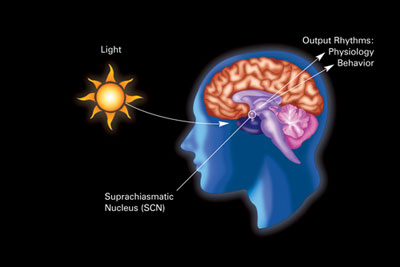
The human body has a circadian master clock, the suprachiasmatic nucleus or SCN. The SCN is a highly innervated tissue located in the hypothalamus (see image). It is connected directly to the retina by the optic nerve, and thus is influenced by external light and dark.
Light enters the eyes and affects the SCN (physiologic effects), and as discussed in recent research, Fernandez et al. here, the perihabenular nucleus (behavioral effects). (Image in public domain.)
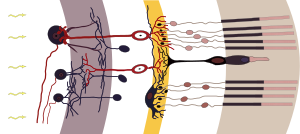
The retina of the eye is the light-gathering instrument for this organ. Historically, it’s been understood that the retina is composed of two cell types, rods and cones, that function in transmitting light and images to the optic nerve, which sends those signals to the brain.
Some parts of the retina. Light enters the eye (from left) and passes through to the rods and cones. Here a chemical change converts the light to nerve signals. Image-based on drawing by Ramón y Cajal, 1911 and licensed under Wikimedia commons.
Studies by Hattar et al. in the early 2000s identified another cell found in the retina, the melanopsin-containing intrinsically photoactive retinal ganglion cells (ipRGCs) as the transmitter of circadian light signals (3). Through this direct connection to the SCN, the circadian master clock, the ipRGCs can influence a wide range of light-dependent functions independent of image processing (4).
Now Fernandez et al. have identified multiple types of ipRGCs. They showed that ipRGCs that mediate the effects of light on learning work via the SCN, while the pathway for light influencing emotions is different.
They discovered a new target of ipRGC cells, the perihabenular nucleus (PHb). The PHb is a newly recognized thalamic region of the brain. The authors showed that the connection between light and mood is regulated by ipRGCs through the PHb versus the SCN. They show that the PHb is integrated into other mood-regulating centers of the thalamic region.
In Conclusion
Daylight, and lack thereof, does affect both our mood and our ability to learn. In this 2018 report, we have learned that the pathways for these effects are distinct, and gain an understanding of a new thalamic region by which the light and mood actions occur. This information could influence the development of better drugs and/or therapies for major depressive disorders.
For those of us with seasonal affective disorder, the evidence is undeniable—lack of light can cause issues, from sleep-wake problems, to mood and learning issues.
And while we can’t create sunshine, a special lamp or lightbox may help to gain some full-spectrum light. To learn more about how to choose such a lamp and when to use it, see this Mayo clinic article for details.
We are in the midst of a very intense time of the year, with holidays and seasonal celebrations like Thanksgiving (recently past), Hanukkah this week and Christmas a mere two-plus weeks away.
Wrap that up with a New Year’s celebration and “Wham”—more friends, family and food/alcohol than one normally enjoys in a three-month period.
Yet it can also be the season of SAD—seasonal affective disorder when the amount of daylight decreases daily, and for those of us in the northern latitudes, cold weather intensifies. We’re eating more, getting less sunshine and quite probably less exercise. Hibernation is great for bears, not so good for humans.
It’s the wintertime blues. For myself and many, once the solstice passes and day length starts to increase, mood improves. But noticeable day-length increases don’t really occur here until mid-February. That’s a long time to feel the blues.
We inherit our cells’ mitochondria from our mother. These energy-producing organelles are present in large numbers in most cells, meaning that cells can contain thousands of copies of the DNA associated with the mitochondria (mtDNA)—all passed on wholly from our mother. New evidence suggests, however, that this cannon principle of maternal-only inheritance of mtDNA might need to be refined. And it all started with a four-year-old boy.
XWe use cookies and similar technologies to make our website work, run analytics, improve our website, and show you personalized content and advertising. Some of these cookies are essential for our website to work. For others, we won’t set them unless you accept them. To learn more about our approach to Privacy we invite you to Read More
By clicking “Accept All”, you consent to the use of ALL the cookies. However you may visit Cookie Settings to provide a controlled consent.
We use cookies and similar technologies to make our website work, run analytics, improve our website, and show you personalized content and advertising. Some of these cookies are essential for our website to work. For others, we won’t set them unless you accept them. To find out more about cookies and how to manage cookies, read our Cookie Policy.
If you are located in the EEA, the United Kingdom, or Switzerland, you can change your settings at any time by clicking Manage Cookie Consent in the footer of our website.
Necessary cookies are absolutely essential for the website to function properly. These cookies ensure basic functionalities and security features of the website, anonymously.
Cookie
Duration
Description
cookielawinfo-checbox-analytics
11 months
This cookie is set by GDPR Cookie Consent plugin. The cookie is used to store the user consent for the cookies in the category "Analytics".
cookielawinfo-checbox-functional
11 months
The cookie is set by GDPR cookie consent to record the user consent for the cookies in the category "Functional".
cookielawinfo-checbox-others
11 months
This cookie is set by GDPR Cookie Consent plugin. The cookie is used to store the user consent for the cookies in the category "Other.
cookielawinfo-checkbox-advertisement
1 year
The cookie is set by GDPR cookie consent to record the user consent for the cookies in the category "Advertisement".
cookielawinfo-checkbox-necessary
11 months
This cookie is set by GDPR Cookie Consent plugin. The cookies is used to store the user consent for the cookies in the category "Necessary".
cookielawinfo-checkbox-performance
11 months
This cookie is set by GDPR Cookie Consent plugin. The cookie is used to store the user consent for the cookies in the category "Performance".
gdpr_status
6 months 2 days
This cookie is set by the provider Media.net. This cookie is used to check the status whether the user has accepted the cookie consent box. It also helps in not showing the cookie consent box upon re-entry to the website.
lang
This cookie is used to store the language preferences of a user to serve up content in that stored language the next time user visit the website.
viewed_cookie_policy
11 months
The cookie is set by the GDPR Cookie Consent plugin and is used to store whether or not user has consented to the use of cookies. It does not store any personal data.
Analytical cookies are used to understand how visitors interact with the website. These cookies help provide information on metrics the number of visitors, bounce rate, traffic source, etc.
Cookie
Duration
Description
SC_ANALYTICS_GLOBAL_COOKIE
10 years
This cookie is associated with Sitecore content and personalization. This cookie is used to identify the repeat visit from a single user. Sitecore will send a persistent session cookie to the web client.
vuid
2 years
This domain of this cookie is owned by Vimeo. This cookie is used by vimeo to collect tracking information. It sets a unique ID to embed videos to the website.
WMF-Last-Access
1 month 18 hours 24 minutes
This cookie is used to calculate unique devices accessing the website.
_ga
2 years
This cookie is installed by Google Analytics. The cookie is used to calculate visitor, session, campaign data and keep track of site usage for the site's analytics report. The cookies store information anonymously and assign a randomly generated number to identify unique visitors.
_gid
1 day
This cookie is installed by Google Analytics. The cookie is used to store information of how visitors use a website and helps in creating an analytics report of how the website is doing. The data collected including the number visitors, the source where they have come from, and the pages visted in an anonymous form.
Advertisement cookies are used to provide visitors with relevant ads and marketing campaigns. These cookies track visitors across websites and collect information to provide customized ads.
Cookie
Duration
Description
IDE
1 year 24 days
Used by Google DoubleClick and stores information about how the user uses the website and any other advertisement before visiting the website. This is used to present users with ads that are relevant to them according to the user profile.
test_cookie
15 minutes
This cookie is set by doubleclick.net. The purpose of the cookie is to determine if the user's browser supports cookies.
VISITOR_INFO1_LIVE
5 months 27 days
This cookie is set by Youtube. Used to track the information of the embedded YouTube videos on a website.
Performance cookies are used to understand and analyze the key performance indexes of the website which helps in delivering a better user experience for the visitors.
Cookie
Duration
Description
YSC
session
This cookies is set by Youtube and is used to track the views of embedded videos.
_gat_UA-62336821-1
1 minute
This is a pattern type cookie set by Google Analytics, where the pattern element on the name contains the unique identity number of the account or website it relates to. It appears to be a variation of the _gat cookie which is used to limit the amount of data recorded by Google on high traffic volume websites.