The cause of type 1 diabetes (T1D) is not well understood. What is known is that in T1D, immune cells attack pancreatic islet cells that produce insulin. In addition, insulin is an autoantigen that activates T cells in diabetic persons.
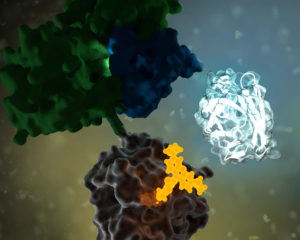
A new discovery by Ahmed et al. could further T1D understanding. These findings are also setting B and T cell paradigms on their ear.
About B Cells and T Cells
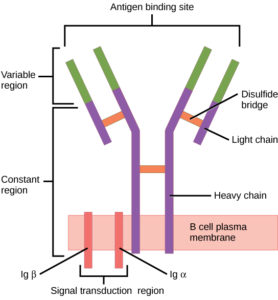
Components of the B-cell receptor.Image by CNX OpenStax. Used with permission under Wikimedia Commons.
B cells (B lymphocytes) are part of the cellular immune response. They act by means of surface receptor molecules that are immunoglobulins. These B cell receptors are created by highly variable gene rearrangements that result in a huge variety of these surface immunoglobulin molecules. The beauty of B cell receptors (BCR) lies in the fact that, through random gene rearrangements comes a such large variety of B cell surface receptors, that any foreign antigen that makes its way into the body is recognized and snagged by a B cell receptor.
It’s FINALLY time to announce the winners of the 2019 Promega iGEM Grant! We received over 150 applications this year, so picking the top 10 was very tough. As always, we’re impressed by the amazing work iGEM teams are doing in the lab and in their communities. The 10 winners listed below will receive $2,000 in free Promega products.
Good luck to all teams competing in iGEM this year, and congratulations to our winners! Don’t forget that Promega has free technical support for all teams competing in iGEM. Our scientists are excited to help out. You can also check out our iGEM Sponsor page, which has tools and resources to help make your project a success. Continue reading “Announcing the 2019 Promega iGEM Grant Winners”
No protein is an island. Within a cell, protein-protein interactions (PPIs) are involved in highly regulated and specific pathways that control gene expression and cell signaling. The disruption of PPIs can lead to a variety of disease states, including cancer.
Two general approaches are commonly used to study PPIs. Real-time assays measure PPI activity in live cells using fluorescent or luminescent tags. A second approach includes methods that measure a specific PPI “after the fact”; popular examples include a reporter system, such as the classic yeast two-hybrid system.
Do you love your research job? What if you couldn’t do that work anymore? What if future researchers couldn’t have the opportunity to build from what you have accomplished and feel the same joy you do about their research?
Unfortunately, these may become more than hypotheticals for the next generation of scientists due to the impact humans are having on the earth. Scientific research has an outsized impact on some aspects of our unsustainable use of resources. Academic research buildings can use four times more energy than a typical office building and can be responsible for one-third of all waste generated on campus. So, can you make scientific research more sustainable?
Genetics are a curious thing. Don’t get me wrong, on paper and in theory, the study and science behind our inheritance completely checks out. However, in practice, it can still be a bit disconcerting to look in the mirror one day and recognize your father’s nose and eyebrows in your own face, or to realize you gesticulate in the same animated fashion as your mother, and sometimes hear her laugh come bubbling out of your own mouth.
More curious still are the structures and behaviors that have been carried throughout evolution to the modern era of humanity, though we are considerably distinguishable from our more primitive ancestors.
And perhaps most curious of all, are the structures we continue to pack along with us, as that have little to no known useful function in the contemporary human body. These features are better known as vestigial structures, and are classically defined as features and behaviors that no longer serve the function and purpose they were designed to perform (in comparison to other creatures with the same parts).
Currently, as I recover from the aftermath of a painful encounter with one of my own vestigial organs, I find myself considering if my late appendix ever did anything much for me, or if it’s only purpose was to lie in wait as a metaphorical ticking time-bomb. Prior to my surprise appendectomy, I hadn’t spared much thought for my appendix, and decided I wanted to honor it’s memory by learning more about it, in addition to several of our other human evolutionary leftovers. Man, I wish I would’ve asked the doctors to hang on to that bad boy for me!
The Evolutionary Junk in Our Trunk
Appendix
The appendix is perhaps the most widely known vestigial organ in the human body of today. If you’ve never seen one, the appendix is a small, pouch-like tube of tissue that juts off the large intestine where the small and large intestines connect. By comparison, in herbivorous vertebrates the appendix is much larger, and functions primarily to aid in the breakdown of cellulose in consumed plants. Today, the appendix is considered a small leftover from one of our plant-eating ancestors. As our diets have changed over time, the role our appendix plays in digestion has declined, leaving plenty of room for speculation regarding what purpose it serves now.
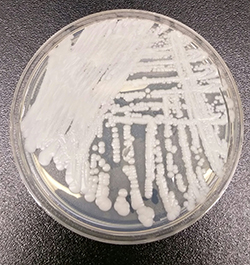
The creamy colonies of C. auris look innocuous. Don’t be fooled. Photo by Shawn Lockhart – Centers for Disease Control, Public Domain, https://commons.wikimedia.org/w/index.php?curid=54680002
Life in the 21st century is full of electronic devices and apps purported to make life easier. Many of us can binge watch movies, videos and news on our phones. There are wireless headphones, electric bicycles, self-operating vacuum cleaners, wine in boxes with taps—and so much more.
This life is, however, not without challenges.
In the event that you or yours ends up in the hospital, the stay could be complicated by an unplanned, unwanted and potentially lethal infection.
A startling report from researchers in Washington indicates that the increasingly acidic waters of the United States Pacific Northwest are turning sea cucumbers into sea pickles.
It seems that spring has finally come to Southern Wisconsin. The snow has melted. Most days it is warm enough you can go outside without a parka, hat and mittens. The tree buds are starting to swell. And that traditional oracle of spring, the American robin (Turdus migratorius), has been spotted in trees and yards—along with its less friendly cousin, the red winged black bird (Agelaius phoeniceus).
While spring brings the return of migratory birds, it also brings an increase in the number of rescued baby birds flooding into local wildlife rescues and humane societies. When the babies come to these centers, they need a warm, soft, breathable and washable home that resembles the nest they were hatched in.
It turns out that knitted or crocheted nests are a perfect solution. The nests aren’t just used for baby birds; baby rabbits, squirrels, bats, ferrets and racoons are just a few additional animals that benefit. And the best part is, you could be improving your own health while you create those cozy nests. Continue reading “For the Birds: Knitting Nests for Baby Birds Might Just Help Your Health To”
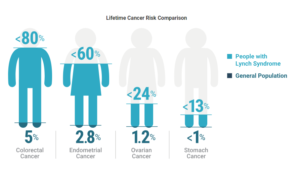
Lynch Syndrome is a hereditary condition caused by germline mutations that inactivate at least one of the major DNA mismatch repair (MMR) genes. Individuals with Lynch Syndrome have an elevated risk of developing several cancers, especially colorectal, uterine and endometrial. Approximately 1 in 279 individuals in the United States is Lynch-positive, but most people are unaware of their status.
Lynch Syndrome results in highly elevated risks of several cancers.
Lynch Syndrome can be diagnosed following screening by microsatellite instability (MSI) analysis or immunohistochemistry (IHC) for the MMR proteins. For some patients, MMR gene sequencing is as easy as an oral “swish.” However, the genetic basis of Lynch Syndrome and its clinical relevancy are relatively recent discoveries. Long before modern sequencing methods simplified testing and diagnosis, a seamstress in Ann Arbor, Michigan correctly predicted her own Lynch Syndrome status based only on her family history. Talking with Dr. Alfred Scott Warthin in the late 19th century, she said that since so many of her family members had died of several specific cancers, she believed that she would follow the same path. Several years later, she unfortunately proved herself right.
Dr. Warthin took interest in the story and began studying the woman’s family. At the time of their conversation, five of her nine siblings had already been diagnosed with uterine, stomach or “abdominal” cancer. Warthin concluded that the family, which he dubbed “Cancer Family G,” did, in fact, have a predisposition to cancer. Warthin and other researchers continued studying the family for several decades. They found that cancers of the colon, uterus and stomach were most common, and that many members of the family were diagnosed at extraordinarily young ages.
In the 1970s, Dr. Henry T. Lynch organized a family reunion for Cancer Family G and subsequently published a report on “Cancer Family Syndrome.” By this time, 95 members of the family had developed one of the expected cancers. Dr. Lynch still didn’t have the technology to determine the molecular basis of the disease, but he noticed that it followed an autosomal dominant inheritance pattern.
In the mid-1990s, three labs simultaneously discovered microsatellite instability and its connection to colorectal cancer. It had been established in bacteria and yeast that inactivating mutations in DNA mismatch repair genes resulted in mutations in microsatellite sequences, so several labs began racing to clone the human homologs of the DNA MMR genes. Within a few months, two labs had cloned the MSH2 gene and found mutations that were present in members of Lynch-positive families who developed cancer.
Around this time, the name “Lynch Syndrome” was adopted to apply to families carrying germline mutations in a gene associated with the condition. Further research established four genes (MSH2, MLH1, MSH6, PMS2) as “Lynch Syndrome Genes,” and researchers began working on guidelines for diagnostic testing (See “The History of Lynch Syndrome” below for further reading).
Today, over two decades later, many researchers are pushing for the adoption of universal tumor screening for Lynch Syndrome. One of the widely recommended screening method is MSI analysis. MSI-H status indicates that certain sections of DNA called microsatellites have become unstable because the major mismatch repair genes that correct errors during DNA replication are not functioning properly. MSI status can influence treatment decisions, based on the 2015 discovery that MSI-H tumors respond well to immunotherapy drugs (1).
Lynch Syndrome awareness is also important knowledge for a patient’s family. Lynch-associated cancers are among the most preventable, so individuals who know they are Lynch-positive can work with their healthcare providers to develop robust strategies for prevention and surveillance. As one Lynch-positive mother said to her Lynch-positive son, “Your knowledge is power, and it’s going to keep you healthy and safe.”
Life with Lynch Syndrome: Read about what a Lynch Syndrome diagnosis means for Carrie Ketcham and her family
Dreaming of Universal Tumor Screening: Learn how cancer genetic counselor Heather Hampel is advocating for universal tumor screening and more Lynch Syndrome awareness
The History of Lynch Syndrome: Dr. C. Richard Boland and Dr. Henry T. Lynch provide a broad review of Lynch Syndrome research, starting over a hundred years ago.
The storms of the previous day had moved eastward, leaving in their wake flooded farm fields and saturated roadside wetlands. At dusk, we loaded the Ford Escort wagon and headed south. We bumped along the maze of farm roads intent upon listening for croaks and snores in the night. At one roadside wetland, I heard my first congress of Spadefoot toads. The sound was deafening, invoking everything that a “congress of snoring toads” brings to mind. Around the corner, in a low spot of a corn field, a lone Spadefoot toad called for a mate; he was joined by a rather enthusiastic Copes Gray tree frog and several chorus frogs. The congress down the road provided a rolling bass to these more melodic anurans.
Wetlands exist in many different shapes and sizes and in many different geographies: coastal margins, mountain valleys, beaches and rocky shores, estuarine wetlands where tidal saltwater and freshwater mix, and inland wetlands. Some of them are ephemeral, some of them permanent. Wetlands serve many different functions, from providing habitat and food for plants and animals to offering protection from floods and maintaining water quality. One acre of one-foot deep wetland is estimated to hold 330,000 gallons of water. Coastal wetlands are important for reducing storm erosion by decreasing tidal surge and buffering the wind. In the US alone, this benefit has an estimated value of $23.2 billion dollars each year.
XWe use cookies and similar technologies to make our website work, run analytics, improve our website, and show you personalized content and advertising. Some of these cookies are essential for our website to work. For others, we won’t set them unless you accept them. To learn more about our approach to Privacy we invite you to Read More
By clicking “Accept All”, you consent to the use of ALL the cookies. However you may visit Cookie Settings to provide a controlled consent.
We use cookies and similar technologies to make our website work, run analytics, improve our website, and show you personalized content and advertising. Some of these cookies are essential for our website to work. For others, we won’t set them unless you accept them. To find out more about cookies and how to manage cookies, read our Cookie Policy.
If you are located in the EEA, the United Kingdom, or Switzerland, you can change your settings at any time by clicking Manage Cookie Consent in the footer of our website.
Necessary cookies are absolutely essential for the website to function properly. These cookies ensure basic functionalities and security features of the website, anonymously.
Cookie
Duration
Description
cookielawinfo-checbox-analytics
11 months
This cookie is set by GDPR Cookie Consent plugin. The cookie is used to store the user consent for the cookies in the category "Analytics".
cookielawinfo-checbox-functional
11 months
The cookie is set by GDPR cookie consent to record the user consent for the cookies in the category "Functional".
cookielawinfo-checbox-others
11 months
This cookie is set by GDPR Cookie Consent plugin. The cookie is used to store the user consent for the cookies in the category "Other.
cookielawinfo-checkbox-advertisement
1 year
The cookie is set by GDPR cookie consent to record the user consent for the cookies in the category "Advertisement".
cookielawinfo-checkbox-necessary
11 months
This cookie is set by GDPR Cookie Consent plugin. The cookies is used to store the user consent for the cookies in the category "Necessary".
cookielawinfo-checkbox-performance
11 months
This cookie is set by GDPR Cookie Consent plugin. The cookie is used to store the user consent for the cookies in the category "Performance".
gdpr_status
6 months 2 days
This cookie is set by the provider Media.net. This cookie is used to check the status whether the user has accepted the cookie consent box. It also helps in not showing the cookie consent box upon re-entry to the website.
lang
This cookie is used to store the language preferences of a user to serve up content in that stored language the next time user visit the website.
viewed_cookie_policy
11 months
The cookie is set by the GDPR Cookie Consent plugin and is used to store whether or not user has consented to the use of cookies. It does not store any personal data.
Analytical cookies are used to understand how visitors interact with the website. These cookies help provide information on metrics the number of visitors, bounce rate, traffic source, etc.
Cookie
Duration
Description
SC_ANALYTICS_GLOBAL_COOKIE
10 years
This cookie is associated with Sitecore content and personalization. This cookie is used to identify the repeat visit from a single user. Sitecore will send a persistent session cookie to the web client.
vuid
2 years
This domain of this cookie is owned by Vimeo. This cookie is used by vimeo to collect tracking information. It sets a unique ID to embed videos to the website.
WMF-Last-Access
1 month 18 hours 24 minutes
This cookie is used to calculate unique devices accessing the website.
_ga
2 years
This cookie is installed by Google Analytics. The cookie is used to calculate visitor, session, campaign data and keep track of site usage for the site's analytics report. The cookies store information anonymously and assign a randomly generated number to identify unique visitors.
_gid
1 day
This cookie is installed by Google Analytics. The cookie is used to store information of how visitors use a website and helps in creating an analytics report of how the website is doing. The data collected including the number visitors, the source where they have come from, and the pages visted in an anonymous form.
Advertisement cookies are used to provide visitors with relevant ads and marketing campaigns. These cookies track visitors across websites and collect information to provide customized ads.
Cookie
Duration
Description
IDE
1 year 24 days
Used by Google DoubleClick and stores information about how the user uses the website and any other advertisement before visiting the website. This is used to present users with ads that are relevant to them according to the user profile.
test_cookie
15 minutes
This cookie is set by doubleclick.net. The purpose of the cookie is to determine if the user's browser supports cookies.
VISITOR_INFO1_LIVE
5 months 27 days
This cookie is set by Youtube. Used to track the information of the embedded YouTube videos on a website.
Performance cookies are used to understand and analyze the key performance indexes of the website which helps in delivering a better user experience for the visitors.
Cookie
Duration
Description
YSC
session
This cookies is set by Youtube and is used to track the views of embedded videos.
_gat_UA-62336821-1
1 minute
This is a pattern type cookie set by Google Analytics, where the pattern element on the name contains the unique identity number of the account or website it relates to. It appears to be a variation of the _gat cookie which is used to limit the amount of data recorded by Google on high traffic volume websites.