Measuring Changing Metabolism in Cancer Cells

Because of the central role of energy metabolism in health and disease, and its effect on other cellular processes, assays to monitor changes in cellular metabolic state have wide application in both basic research and drug discovery. In the webinar โ€œTools for Cell Metabolism: Bioluminescent NAD(P)/NAD(P)H-Glo™ Assaysโ€ Jolanta Vidurigiene, a Senior Research Scientist at Promega, introduces three metabolism assays for measuring oxidized and reduced forms of NAD and NADP.

In this webinar, Jolanta provides background information on why it is important to be able to accurately measure metabolites such as NAD/NADH and NADP/NADPH. She outlines the roles of each, and highlights some of the challenges involved in developing assays that can accurately measure these metabolites. She discusses key considerations for successful NAD(P)/NAD(P)H assays and provides examples of how to use these assays to measure either total (both oxidized and reduced) forms of NAD and NADP, or to measure oxidized and reduced forms individually in a single assay plate.

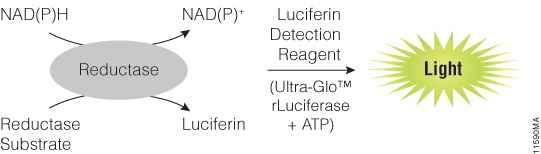
NAD(P)H-Glo™ Assay Mechanism

Continue reading “Measuring Changing Metabolism in Cancer Cells”

Directed Targeted Protein Degradation with Pre-Built HiBiT Cell Lines

Recently, selectively targeting proteins for degradation using the cellโ€™s natural ubiquitin proteasome pathway (UPS) has surfaced as an effective strategy to bypass difficult-to-drug proteins related to diseases like cancer. Using sensitive bioluminescence technology, CRISPR-edited cell lines can facilitate studying popular protein degradation targets.

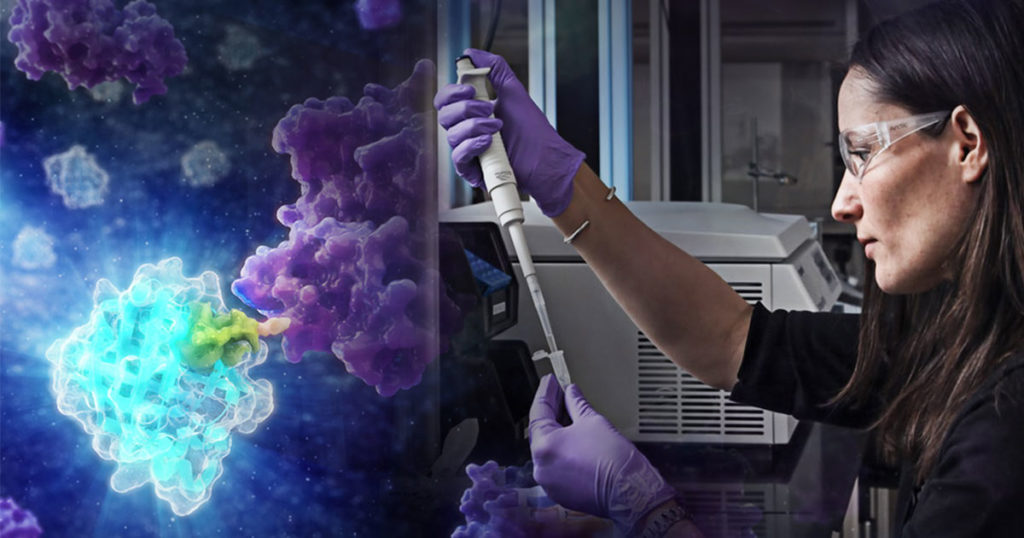
Woman at lab bench and artist 3D rendering of directed targeted protein degradation in a HiBiT cell line

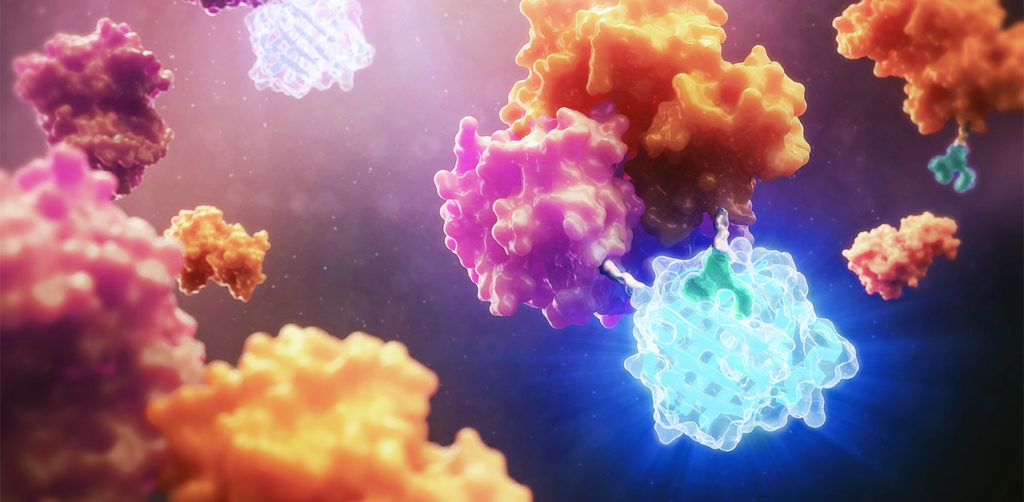
NanoLucยฎ Luciferase (NLuc) has made biology more accessible than ever (1). Further experimentation with NLuc led to creation of a protein complementation system (2) and the discovery of the HiBiT bioluminescent peptide. HiBiT combines spontaneously with the engineered complementary subunit LgBiT to yield an active luciferase called NanoBiTยฎ Luciferase.

Continue reading “Directed Targeted Protein Degradation with Pre-Built HiBiT Cell Lines”

The Power of Vulnerability

Todayโ€™s blog is written by Malynn Utzinger, Director of Integrative Practices, and Tim Weitzel, ESI Architect.

If we want to reignite innovation and passion, we must rehumanize work.

-Silicon Valley CEO of Several Start-ups

If we want to rehumanize work, we need to be more human in the workplace.

-Promegaโ€™s ESI Bootcamp

Vulnerability is the birthplace of intimacy, trust connection, creativity, innovation. For leaders, it is the birthplace of trusted influence. But it is not permission to overshare.

-Brenรฉ Brown

Myths of Vulnerability

Itโ€™s important that we start off by making a few things about vulnerability crystal clear:  being vulnerable is not about over-sharing, being emotionalโ€”or worse, gushy. It is not about sacrificing necessary boundaries or letting go of all discernment when speaking. Vulnerability, as we intend it, is about being real with others. It is about being clear and honest enough within yourself that you can use courage and clarity to state a need or a perspective. Quite the opposite of requiring tears or grand displays of emotion, vulnerability can be expressed with utter command of oneโ€™s emotions, so that the clarity and authenticity of the message is what remains.

Vulnerability is also knowing that you cannot know everything or do your work perfectly or even to your full satisfaction sometimes, and it is having this same understanding and acceptance for others. It is being able to speak to that honestly so that we can build sustainable bridges between ourselves and others. We call this speaking our truths–with discernment.

Finally, vulnerability is knowing that while we must give our best efforts where and whenever we can, we must also know what we canโ€™t control.  In most cases, what we cannot control is outcomes.  Therefore, vulnerability is embracing the uncertainty in how things will go in our relationships and in our work if we risk emotional exposure.  We cannot always know how others will hear what we share, but we can learn to take that risk and speak in service to a common goal.  For example, we might decide to share that the reason we are being so obsessive or insistent on a process is because of a past failure (perceived or real) that we still carry with us.  Even though we cannot control what others will think of our story, we trust that the sharing may help them share a need of their own or to hear our own need differently, so that we can all work together.  This is true in every relationship of our lives, where we learn to share something true for the sake of allowing another human being to know us as we are. 

Continue reading “The Power of Vulnerability”
Thereโ€™s a Vaccine for Thatโ€”Could mRNA Vaccines be Used to Prevent Cancer Recurrence?

mRNA vaccines came roaring onto the public stage in 2020. In the United States and Europe, two of the vaccines that are being used against the SARS-CoV-2 virus are mRNA vaccines. The scientific community has been talking about the potential of this technology against infectious diseases as well as cancer for several years, but no one thought that the first mRNA vaccines would make such a huge, and public, debut.

One big benefit of mRNA vaccines is the speed at which they can be developed. mRNA vaccines use messenger RNA particles to teach our cells to make a bit of protein, which then triggers our bodyโ€™s immune response, and it is relatively easy to synthesize large amounts of mRNA in a laboratory. As promising as this sounds for infectious diseases, the application of mRNA vaccines for oncology might be even more exciting.

Could mRNA vaccines be used for personalized cancer vaccines?
Continue reading “Thereโ€™s a Vaccine for Thatโ€”Could mRNA Vaccines be Used to Prevent Cancer Recurrence?”

Monochromator vs Filter-Based Plate Reader: Which is Better?

When it comes to purchasing a microplate reader for fluorescence detection, the most common question is whether to choose a monochromator-based reader or filter-based reader. In this blog, weโ€™ll discuss how both types of plate readers work and factors to consider when determining the best plate reader for your need.

How do monochromator-based plate readers work?

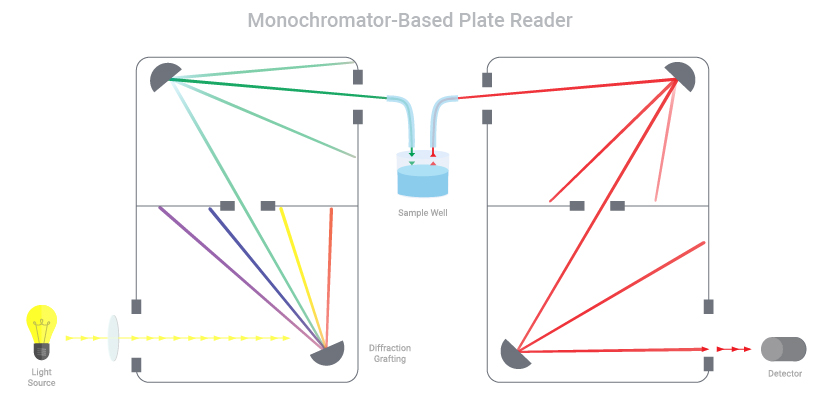
Monochromators work by taking a light source and splitting the light to focus a particular wavelength on the sample. During excitation, the light passes through a narrow slit, directed by a series of mirrors and diffraction grating and then passes through a second narrow slit prior to reaching the sample. This ensures the desired wavelength is selected to excite the fluorophore. Once the fluorophore is excited, it emits light at a different, longer wavelength. This emission light is captured by another series of mirrors, grating and slits to limit the emission to a desired wavelength, which then enters a detector for signal readout.

Monochromator-based plate reader
Continue reading “Monochromator vs Filter-Based Plate Reader: Which is Better?”

Growing Through Sustainability Sensibilities

Inside Kornberg Center at our Fitchburg, WI campus.

We recently announced the opening of our newly constructed Kornberg Center research and development facility on our Fitchburg, WI campus. While we grow our company through new facilities around the globe, it is vitally important that we expand our sustainability efforts along the way. We are committed to preserving and improving our environment for a thriving future.

Prioritizing Sustainability with Best Practices from Around the World

Incorporating sustainability best practices from around the world is key to our long-term planning. Each new Promega facility is designed to meet ambitious sustainability objectives, and innovations incorporated in one project inform the next. We also align projects to meet United Nations Global Compact Sustainable Development Goals. All of our locations collectively contribute to minimizing the effect we have on our environment.

Here are a few of many sustainability initiatives Promega practices around the world:

Continue reading “Growing Through Sustainability Sensibilities”

What Is A Viral Variant?

Every time a genome is replicated, thereโ€™s a chance that an error will be introduced. This is true for all life forms. On a small scale, these mutations can lead to genetic diseases or cancers. On a much larger scale, random mutations are an important tool of evolution.

During the COVID-19 pandemic, the SARS-CoV-2 virus has picked up many mutations as it spread around the world. Most of these mutations have been inconsequential โ€“ the virus didnโ€™t change in any significant way. Others have given rise to variants such as B.1.1.7 and B.1.351, which present complications for public health efforts. By studying the evolution of the virus, we can monitor how itโ€™s spreading and predict the characteristics of variants as they are detected.

SARS-CoV-2 variant
David Goodsell Painting of SARS-CoV-2 Virus
Continue reading “What Is A Viral Variant?”

A SARS-CoV-2 NanoLucยฎ Reporter Virus for Rapid Screening of Antivirals

nanoluc invivo imaging

Before the COVID-19 global pandemic began, Dr. Xuping Xie, Assistant Professor of the University of Texas Medical Branch at Galveston, TX has been studying viruses, such as Dengue and Zika, for more than 10 years. Once the pandemic hit in early 2020, he was prepared to join the fight against the virus. โ€œThere was an urgent need to know: Is there a quicker way to develop therapeutics or antibodies to target SARS-CoV-2?โ€ says Dr. Xie. โ€œThatโ€™s why we immediately launched our SARS-CoV-2 project.โ€

His goal was to create an assay that could 1) screen for antiviral drugs and 2) quickly measure neutralizing antibody levels. The assay could be used to determine the immune status of previously infected individuals and to evaluate various vaccines under development. To achieve this, he wanted to create a reporter virus that is genetically stable and replicates similarly to the wild-type virus in cell culture. 

Continue reading “A SARS-CoV-2 NanoLucยฎ Reporter Virus for Rapid Screening of Antivirals”

Reflections: King’s College London iGEM 2020, Renervate and Future Prospects

Today’s guest blog about the 2020 virtual iGEM Giant Jamboree is written by Abigail Conner, Co-Team Leader of iGEM King’s College London (KCL).

In October 2019, I returned to London from Boston feeling elated after an unforgettable week at the Giant Jamboree. My team, Capacity, had just won a Silver Medal. I had the privilege of presenting in front of the judges about our work. The Giant Jamboree presented me with a vision of where Synthetic Biology will take us and its potential to radically transform our society for the better. Words cannot describe the deep sense of pride I felt to be a part of this community. For the first time, I felt truly empowered as a young scientist and was hugely inspired by the brilliance of my peers. As a result, I was beyond happy to assume the role of Team Leader of KCLโ€™s 2020 team.

Almost immediately after touching down in the United Kingdom, I began to plan our project. Throughout the recruitment process and setting up applications, Stephanie Avraamidesโ€”the Head of Human Practices in Capacityโ€”joined me in leading the team. As Co-Team Leaders, we would establish Renervate, a team of 19 undergraduate students from various STEM backgrounds, from Nutrition to Biomedical Engineering. Although we were fortunate to have met up in person several times before March, the onset of the COVID-19 pandemic scattered us across the world. Our team members represent sixteen different countries, meaning we had to navigate a range of time zones when working virtually. Despite this, we adapted to the virtual setting and worked tirelessly to develop Renervate. Come November, we would be rewarded for our endurance and commitment. I am thrilled to say that Renervate won a Gold Medal, Best Therapeutics Project, and nominations for Best Model and Best Supporting Entrepreneurship at last yearโ€™s Virtual Giant Jamboree.

Continue reading “Reflections: King’s College London iGEM 2020, Renervate and Future Prospects”

Technical Manuals: A New Look

This blog post was cowritten by Sara Klink and Kari Kenefick.

Promega technical manuals have a new look! But never fear, our manuals still contain the protocol instructions for correctly using Promega products and include data, product and component storage information that you need to be successful at the bench. The cover art on our manuals now incorporates the use of imagery created by David Goodsell, which you can also find on our product boxes and at www.promega.com. The new cover image is being applied as we create new technical manuals or revise existing documents. Below are the old (left) and new (right) covers to compare:

Continue reading “Technical Manuals: A New Look”