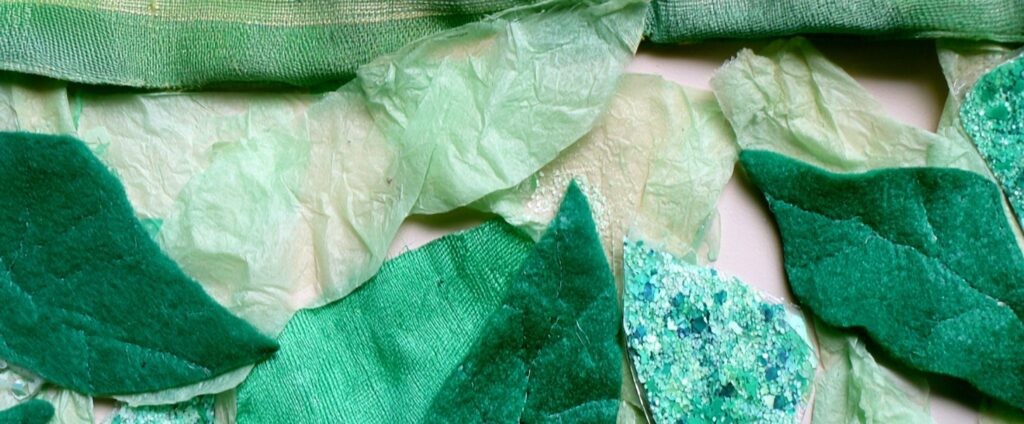
In elementary school, I spent an art class layering greens. Jungle green fabric with a subtle coordinating stripe, delicate spring green tissue paper so translucent you could see through it, pieces of chunky emerald felt cut into the shape of leaves, sparkling seafoam and teal glitter, all of it pressed and glued onto a piece of tagboard in what my teacher called a monochromatic collage. All shades of one color. Mono: one. Chroma: color. I didn’t think about the word at the time because I was too busy glittering.
That same week, I took a science quiz on monocots and dicots and got the answer wrong. I couldn’t remember which plants had one seed leaf and which had two. When I got the test back and saw my error, it clicked. Of course a monocot has one seed leaf. I’d been using mono in art class while missing it on a science quiz down the hall. The root moved between rooms, but I hadn’t learned yet that it could.
That stuck with me. Although my formal education is in English and linguistics, my mind naturally sought out scientific connections. Greek and Latin roots were the place where those two interests didn’t have to compete. They had the precision of formulas, a combinatorial logic where twenty roots could unlock hundreds of words, and they worked on both sides of the hallway.
I write about science now, and the roots have remained my constant companion. A few weeks ago I was researching an organism called Rapaza viridis for a blog post on endosymbiosis. I’d never heard of it, but since viridis is Latin for green (the same root that gives us “verdant”), I already guessed this creature had something to do with photosynthesis. It does. R. viridis is a single-celled predator that steals chloroplasts from the algae it hunts and uses them to photosynthesize.
Learning more about the organism, I came across the term “transient chimerism.” Also new to me, but also immediately legible. The trans in “transient” is the same as in “transparent” and “transport”: ‘across,’ ‘through.’ Something passing through. Chimera: the Greek monster stitched together from a lion, a goat, and a serpent. Put together: a temporary state of being made from parts of more than one organism. The roots came through for me once again.
This keeps happening. I’ll hit a term I’ve never seen, and its pieces already feel familiar. I could spend this entire blog walking through terms and showing you their roots, but definitions only stay interesting for so long (and my family already compares me to the father in My Big Fat Greek Wedding). What I’ve become more interested in is something the roots do beyond defining. The roots that end up in a name tend to carry more than a definition. They carry an interpretation, an argument about the thing itself.
For years, I wondered about apoptosis. I knew apo meant ‘away from.’ I could see ptosis maybe shared something with “asymptote,” but I couldn’t figure out what cell death had to do with calculus. In 1972, John Kerr, an Australian pathologist, had been studying a form of cell death that looked nothing like anything he’d seen before. For most of pathology’s history, the only cell death anyone studied was the kind that showed up when something had gone wrong: a cell damaged by injury or infection or toxins, dying violently. That kind of death had a name: necrosis, from the Greek nekros (‘corpse’). The cell swells, ruptures, spills its contents, and triggers inflammation. Studying liver tissue, Kerr noticed a second kind of death happening quietly alongside it, in cells that hadn’t been damaged at all. The cell death he was watching was the opposite. The cell shrank, and its contents condensed. It broke apart into tidy packages that neighboring cells quietly absorbed. No mess. The body had planned this.
Recognizing that this was a different process, Kerr had been calling it “shrinkage necrosis,” but the name still carried a violence that didn’t ring true. It needed a different word. So he did something I love: he walked down the hall and asked a Greek professor named James Cormack for a better word. Cormack suggested “apoptosis,” from apo (‘away’) and ptosis (‘falling’). The Greeks used the word to describe petals falling from flowers or leaves from trees. They are not torn away by wind but released. It’s something natural, even peaceful. Less a label for cell death than an interpretation of it.
Cormack reached for nature. A German pharmacist named Friedrich Sertürner reached for mythology in his interpretation. He isolated the active compound in opium and needed a name for the substance that put people into a deep, dreamlike state. He called it morphine, after Morpheus, the Greek god of dreams. Morpheus gets his name from morphe, meaning ‘form’ or ‘shape,’ because he could take any form while you slept. The same root gives us “metamorphosis” (‘a change of form’) and “morphology” (‘the study of form’). Sertürner reached past the chemistry and named the experience. It has been a fitting name for over two centuries, not because he understood the molecular mechanism (he didn’t), but because he understood the experience.
In 1885, a French pharmacologist named Raphaël Dubois was studying a luminous click beetle called Pyrophorus. He separated the glow into two components and needed names for them. He called the substrate “luciferin” and the enzyme “luciferase,” both from the Latin lucifer: ‘light-bearer.’ (The word predates its association with the devil by centuries. Lucifer meant ‘morning star’ until a Latin Bible translation used it to render a poetic insult about a fallen king, later reinterpreted as Satan’s fall.) If you’ve ever described a thought as “lucid,” you were using luc: a clear thought, an illuminated one. If you’ve held something “translucent” up to the light, that’s trans + luc, light passing through.
This kind of naming isn’t only for scientists. Promega, like many companies, often builds its product names from established roots because the right roots do half the naming before anyone reads the label. We’re a bioluminescence company, so light keeps showing up in ours. NanoLuc® Luciferase: nanos is Greek for ‘small,’ and luc, a compact bioluminescent enzyme bright enough to track activity inside a single living cell. Lumen is another Latin root that means ‘light,’ the same root in “illuminate.” Our Lumit™ immunoassays, built on lumen, measure immune response by the light a reaction produces. The names carry who we are.
Not every root tells the truth so plainly. Christian de Duve, a Belgian biochemist, coined “autophagy” in 1963. Essentially cellular recycling, the word comes from the Greek auto (‘self,’ as in “autobiography”) and phagein (‘to eat,’ as in “esophagus”), and it’s technically accurate: a stressed cell survives by consuming its own damaged parts and rebuilding from the salvage. The cell is eating itself, but the name makes it sound like destruction when it’s actually renewal, technically correct yet misleading at the same time. (Phagein shows up in another unexpected place: “sarcophagus” literally means ‘flesh-eater,’ because a certain limestone used for coffins was believed to eat the body sealed inside it.)
Autophagy gets the action right but misreads the purpose; other names don’t even get that close. Consider “atom.” The root tomos means ‘to cut’ (the same root behind every “-ectomy” of the surgery world). Add the Greek prefix a– (‘not,’ the same prefix in “atypical” and “asymmetric”) and you get a-tomos: ‘uncuttable.’ The Greek philosopher Democritus coined the term, proposing that matter was made of particles so fundamental they couldn’t be divided further, and the name felt correct for over two millennia until J.J. Thomson discovered the electron and proved that atoms could, in fact, be cut. The most basic unit of chemistry has been carrying an indelible false claim about its own indivisibility.
“Oxygen” carries a similar misstep, though the problem is easier to understand through another word first. “Oxymoron” combines the Greek oxy (‘sharp’) with moros (‘dull’). A word built from two opposites, ‘sharp’ and ‘dull,’ is itself a contradiction, which is exactly what an oxymoron is. The word doesn’t just define the concept; it performs it. The same oxy is in “oxygen,” coined by Antoine Lavoisier in the late 18th century from oxy and genes (‘producer’). Lavoisier used “sharp” to mean ‘acid’ and believed oxygen was the element that made all acids acidic. Around 1810, the chemist Humphry Davy tried to extract oxygen from hydrochloric acid and found none. It was hydrogen and chlorine, nothing else. Lavoisier’s theory collapsed, but the name remained.
Much of the language of science draws from the same two wells: Greek and Latin. Western science has reached for those languages since its beginnings, but not every scientist stayed inside them. In 1992, Raphael Mechoulam’s team at Hebrew University of Jerusalem was tackling a question no one had yet answered: if the brain has receptors for THC, the active compound in cannabis, does it produce its own version? The molecule they isolated to prove it does became the first identified endogenous cannabinoid. When they needed a name, Mechoulam chose the Sanskrit word ananda, meaning ‘bliss.’ Anandamide: the molecule THC had been imitating all along, named for how it feels.
Even the seemingly routine half of the name has a story. “Amide” is a standard chemistry suffix, the kind of thing that looks automatic. It isn’t. It derives from “ammonia,” which itself traces back to the Egyptian god Amun. The Romans called ammonium chloride sal ammoniacus, ‘salt of Amun,’ because they found it near his temple in Libya. If you’ve ever bought a moisturizer with niacinamide or ceramide, you’ve been carrying a deity’s namesake through the drugstore. The molecule Mechoulam named combines Sanskrit bliss on one end and Egyptian divinity on the other.
Sometimes a name reveals not just what someone believed but how deeply they knew what they were looking at. The Aztecs called their ceremonial mushrooms teonanácatl, from the Nahuatl teotl (‘god’) and nanácatl (‘mushroom’). Divine mushroom. (A Spanish friar first recorded the translation “God’s Flesh,” seeing his own Eucharist in the ceremony and concluding, as colonizers often did, that it must belong to the devil. Whether “God’s Flesh” reflects Aztec belief or only what he was primed to see, we’ll never know: the records that might have told us were burned.)
The Aztecs had a centuries-long relationship with the fungus, using it in sacred ceremonies to communicate with the divine, and enshrined what that relationship taught them in the name itself. When Western scientists later classified the same mushroom, they named the genus Psilocybe, from the Greek psilos (‘bare’) and kybe (‘head’): a description of the smooth mushroom cap. Without centuries of experiential relationship, they named the surface. The Aztecs named the sacred.
Every term is a record of what someone understood, or thought they understood, when they chose the word. They carry misunderstandings and breakthroughs, poetic interpretations and factual claims, sacred experience and surface observation, all sealed inside the vocabulary we use every day. Each one is preserved as a time capsule, still carrying that imprint forward.
For me, roots started as a decoding tool, the only language I’d found that belonged to the sciences and the humanities at the same time. What I found inside them was something more elemental: human fingerprints. They’re in every word we reach for, including the name of the building where I work: Agora.
References
Kerr, J.F.R., Wyllie, A.H. and Currie, A.R. (1972). Apoptosis: A Basic Biological Phenomenon with Wide-Ranging Implications in Tissue Kinetics. British Journal of Cancer, 26, 239–257. https://doi.org/10.1038/bjc.1972.33
Dubois, R. (1885). Note sur la physiologie des pyrophores. Comptes rendus des séances de la Société de biologie, 2, 559–562.
Hall, M.P., Unch, J., Binkowski, B.F., et al. (2012). Engineered Luciferase Reporter from a Deep Sea Shrimp Utilizing a Novel Imidazopyrazinone Substrate. ACS Chemical Biology, 7(11), 1848–1857. https://doi.org/10.1021/cb3002478
de Duve, C. (2005). The lysosome turns fifty. Nature Cell Biology, 7, 847–849. https://doi.org/10.1038/ncb0905-847
Devane, W.A., Hanuš, L., Breuer, A., et al. (1992). Isolation and Structure of a Brain Constituent That Binds to the Cannabinoid Receptor. Science, 258(5090), 1946–1949. https://doi.org/10.1126/science.1470919
Sertürner, F.W. (1817). Ueber das Morphium als Hauptbestandteil des Opiums. Annalen der Physik, 55, 56–89.
Kashiyama, Y., Maruyama, M., Nakazawa, M., Kagamoto, T., Imanishi, H., Yamamoto, S., Inoue, M., Onuma, R., Tanifuji, G., Ashida, H., Inada, N., Awai, K., & Miyagishima, S. (2026). Transient molecular chimerism for exploiting xenogeneic organelles. Nature Communications, 17, 2371. https://doi.org/10.1038/s41467-026-70516-x
Furst, P.T. (Ed.). (1972). Flesh of the Gods: The Ritual Use of Hallucinogens. Praeger.
Lavoisier, A.L. (1777). Mémoire sur la combustion en général. Mémoires de l’Académie Royale des Sciences.
Davy, H. (1810). Researches on the Oxymuriatic Acid, its Nature and Combinations. Philosophical Transactions of the Royal Society of London, 100, 231–257.
Thomson, J.J. (1897). Cathode Rays. Philosophical Magazine, 44, 293–316.

Elise Johnson
Latest posts by Elise Johnson (see all)
- Nitrile Gloves, Not Ribbons - October 1, 2026
- ADC Development: The Questions Running in the Background - July 30, 2026
- Time Capsules in the Language of Science - July 23, 2026
