Every October, the noise starts up again: it’s breast cancer’s turn for awareness. I brace for it a little every year. What bothers me isn’t the concept, it’s watching companies race to out-pink each other.
A pink ribbon on a shirt or a car can foster a certain amount of solidarity, but at the corporate level, the awareness noise is genuinely inescapable: a building lit up pink for the night, a pink yogurt lid, or a player running out onto the field in pink cleats. Many companies have run some version of the same campaign, and what actually happens to the profit from pink merchandise varies wildly: modest percentages, hard caps on total donations, or numbers that only recently moved after enough people asked questions.
In addition to the question of money is the question of effect: what does a company’s participation do? If the goal actually is awareness, I’ve never understood who remains unaware. It tends to generate goodwill instead, and the sometimes cynical among us might call that marketing, whether or not that’s the intent.
Here’s a sentence that’s true to me, one most people have their own version of: my sister had breast cancer. One in eight women in the U.S. will hear that diagnosis in her lifetime (though women aren’t the only ones who get it). So we are aware. We have been aware for a long time.
At one point, however, we actually needed awareness, in the literal sense of the word. When the American Cancer Society started its breast cancer awareness campaign in 1985, breast cancer was a disease people didn’t discuss in polite company, self-exams weren’t routine, and mammograms weren’t the norm they are now. Getting people to talk about it, check themselves, and get screened was a real, specific goal, and awareness did its job at the time. Last year marked the campaign’s fortieth anniversary, a point at which even the American Cancer Society’s own retrospective pointedly admitted: awareness alone isn’t enough anymore.
October runs on that word, awareness, as if noticing something were the same as solving it. As if on November 1st, we can dust off our hands, congratulate ourselves, and move on to the next color of the month. But breast cancer research doesn’t run on that calendar. Real, promising work has been happening. Learning about it might not change anything either, not directly, but it’s one step closer to what the American Cancer Society itself is now calling “Turning Awareness Into Action.”
More Than a Pretty Face
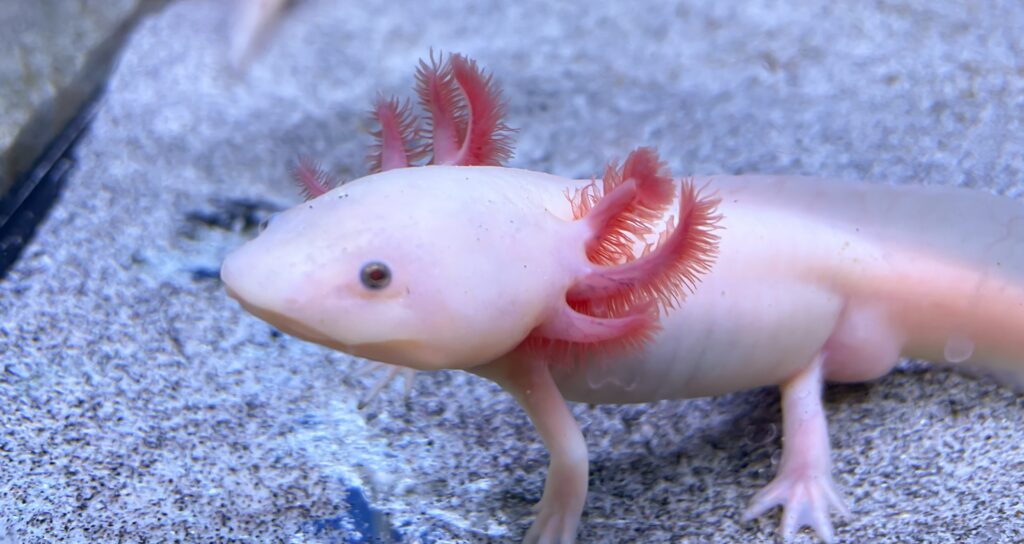
This starts, perhaps unexpectedly, with the axolotl, a foot-long Mexican salamander known for its perpetual smile and the feathery gills that fan out from its head like a spray of coral. The most common pet-store variety is also, conveniently for this piece, pale pink. It has become plastered across backpacks, folders, plush toys, and t-shirts. My nine-year-old niece and her friends are obsessed with them.
Continue reading “Nitrile Gloves, Not Ribbons”