From Gum Disease to Breast Cancer: An Oral Bacterium’s Unexpected Journey

You’re sitting in the dentist’s chair, nodding along to the familiar flossing lecture you’ve been politely ignoring for most of your adult life. Fair enough. It’s hard to get excited about gum health. But it turns out your dentist may have been underselling the pitch.

A study published in January 2026 in Cell Communication and Signaling shows that a common gum disease bacterium can promote breast cancer growth and spread in mice, and the findings hint at a particularly troubling link for people carrying BRCA1 mutations (1). “Floss to help prevent cancer” probably wasn’t on your 2026 bingo card, yet here we are.

Continue reading “From Gum Disease to Breast Cancer: An Oral Bacterium’s Unexpected Journey”

The Breakthrough Was There All Along: Rethinking “Undruggable” Targets Through New Ways of Seeing

If you’ve ever played The New York Times game Connections, you know the feeling. You’re staring at a grid of words, knowing the solution is there, but unable to see how the pieces fit together. All you can do is work with the words in front of you. There are no extra clues, no new information coming. The only option is to shuffle, to look at the same information in a different arrangement until patterns begin to appear. 

Nothing about the problem changes. Then something about how you see it does. 

This pattern of reframing is a familiar truth in scientific research as well. In a recent NPR podcast, “The Medical Matchmaking Machine,” Radiolab explores this idea through a deeply human story. The episode features Dr. David Fajgenbaum, who survived a rare, life-threatening illness and came away with a new realization about the limits of how existing knowledge was being connected. By systematically reexamining existing data and research through a new lens, he was able to identify life-saving connections for his own disease. Through his nonprofit research organization Every Cure, Fajgenbaum then began applying the same approach more broadly across diseases.  

In many cases, potential treatments already exist, but they are buried in data, scattered across studies, or confined to discovery pathways that make connections difficult to see. 

Continue reading “The Breakthrough Was There All Along: Rethinking “Undruggable” Targets Through New Ways of Seeing”

Brewing Immunity: The Vaccine Beer Experiment

What if a vaccine didn’t come in a vial or a syringe, but in a pint glass?

It’s the kind of question that sounds hypothetical–something meant to provoke discussion rather than describe a real experiment. And yet, it’s one that a virologist claims to have taken seriously enough to test in his own kitchen.

Since publicly sharing his experiment and preliminary results, the idea of “vaccine beer” has drawn fascination, skepticism and no small amount of discomfort from across the scientific community.

Continue reading “Brewing Immunity: The Vaccine Beer Experiment”

Life on Mars? Proteomic Secrets of Bacterial Survival in Martian Brines

Could bacteria survive on Mars? While images of the red planet might spark thoughts of barren landscapes and lifeless deserts, Mars holds a fascinating possibility: under suitable conditions, pockets of salty, perchlorate-rich brines could temporarily form on or near its surface. These brines are formed by salts that naturally absorb water from their surroundings. By lowering the temperature at which water freezes, these salts can stabilize liquid water, raising intriguing questions about the potential for microbial life. But what exactly would it take for bacteria to survive there? New research from Kloss et al. published in Scientific Reports sheds light on this cosmic question.

Continue reading “Life on Mars? Proteomic Secrets of Bacterial Survival in Martian Brines”

The Long Road to a Norovirus Vaccine: How Close Are We?

This winter, norovirus outbreaks surged across the U.S., with cases nearly doubling from last year, according to the CDC. Schools, cruise ships, nursing homes and healthcare facilities saw widespread illness, underscoring the urgent need for a norovirus vaccine.

Each year, norovirus causes 685 million infections worldwide and is the leading cause of foodborne illness in the U.S., responsible for 21 million cases annually. Despite its massive impact, there is still no approved vaccine—but recent advancements suggest that this could change.

Continue reading “The Long Road to a Norovirus Vaccine: How Close Are We?”

To Tweet or Not to Tweet: Microblogging for Science Communication

Microblogging is a form of blogging characterized by a shortened format and frequent posting schedule. Instead of personal websites, microblogs reside on social media platforms or apps, making them accessible to interact with and post on smartphones. Microblogs focus on interacting with audiences directly. With the ability to reply to or repost content, microblogging is more conversational and collaborative with audiences than long- form writing.  

Laptop with a newspaper inside of it. next to emoji people connected across the globe.

After its founding in 2006, Twitter (recently renamed “X” by its new owner) quickly became the face of microblogging platforms. Users publish content to the platform in posts of 280 characters that can include images, gifs, videos, and what the platform is most known for: hashtags. Hashtags enable users to search the platform by topic to connect with or follow other users who are writing about those topics. Users can also interact with each other by liking or retweeting tweets, which posts them to their own account. The open forum discussion style makes it possible for individuals to share their stories, offering first-hand accounts of breaking news and fueling political movements such as the Women’s March and Black Lives Matter. 

Continue reading “To Tweet or Not to Tweet: Microblogging for Science Communication”

Squid Games: Camouflage or Communication, It’s All Skin Deep

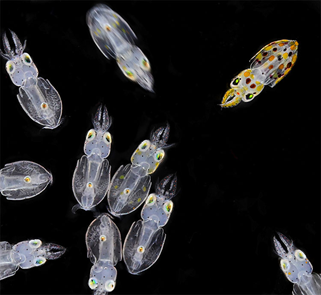
One Out winning image of Promega AG  Art + Science Competition shows baby squid communicating
One Out (winner Promega AG Swiss Art + Science Competition) by Urhs Albrecht, University of Fribourg

Squids are mysterious creatures roaming seas and oceans. They are also the subjects Urs Albrecht chose for his winning picture in the Swiss Art + Science competition, “One Out.” The photo shows squid juveniles, one of which displays striking colors in opposition to the rest. The bright individual is also physically removed from the group, may be scared or angry. The image is fascinating because we can see complex biology at play with the naked eye. Squids are Coleoid cephalopods, mollusks with arms attached to their heads. They have lost their shell and developed larger and highly differentiated brains and camera-type eyes through evolution. Their nervous system is highly organized. The central brain acts as the decision-making unit, and the peripheral nervous system processes motor and sensory information.

Continue reading “Squid Games: Camouflage or Communication, It’s All Skin Deep”

Using Databases to Find Scholarly Sources

Today’s guest blog was written in collaboration with Melissa Martin, a former global marketing intern with Promega. She is a senior at the University of Wisconsin-Madison where she is double majoring in zoology and life sciences communication, with a certificate in environmental studies.

Peer-reviewed papers are considered the most technical and in-depth way to learn about research and scientific advances. As a student or scientist, you will not only want to read scholarly articles to learn about what others are doing in your field but also to expand your knowledge and learn about scientific advances in completely new areas of study. With countless disciplines of science covering wide-ranging topics such as cell biology, physical chemistry or human behavior, it can be overwhelming to do a general search and find articles and journals that will have the topics relevant to your interests.

Young woman searching databases for findingscholarly articles.
Continue reading “Using Databases to Find Scholarly Sources”

Science and Journalism – Opposites or Not So Much?

This blog was written in collaboration with our partners at Promega GmbH.

Scientists are comfortable speaking to people who know their field. Speaking to scientists outside of their field of expertise can become a little more challenging, and many find the greatest challenge of all is speaking to people who do not have a science background and are hearing about a scientific concept for the first time, such as journalists in the popular media. What can scientists and journalists do to make the most of the interface of science and journalism?

Digital image depicting the intersection of science and journalism.

The importance of the interface between science and journalism is increasingly visible with scientific topics appearing on the national news more frequently due to COVID-19, climate change, and diseases like cancer. So, where can journalists go to learn best practices for interviewing scientists and writing about scientific topics? Promega GmbH offers a platform in which scientists and journalists come together and learn from each other in a constructive exchange. In this workshop setting, scientists speak about a certain topic, and journalists from all kinds of backgrounds can ask questions. When the journalist authors an article about what they learned in that workshop, both sides benefit. The scientists’ work becomes visible, and society learns more about scientific research and discovery that can help all of us to better understand the world and contribute to a brighter future.

Here we describe several common themes that have emerged from these science journalism workshops that may help you the next time you find yourself trying to explain your research to someone unfamiliar with your field.

Continue reading “Science and Journalism – Opposites or Not So Much?”

Lessons in History, Hope and Living with Lynch Syndrome from the “Daughter of Family G”

Lynch Syndrome is the autosomal dominant hereditary predisposition to develop colorectal cancer and certain other cancers. This simple, one sentence definition seems woefully inadequate considering the human toll this condition has inflicted on the families that have it in their genetic pedigree.

They Called it a Curse

To one family, perhaps the family when it comes to this condition, Lynch Syndrome has meant heartache and hope; grief and joy; death and life. Their story is told by Ami McKay in her book Daughter of Family G, and it is at once both a memoir of a Lynch Syndrome previvor (someone with a Lynch Syndrome genomic mutation who has not yet developed cancer) and a poignant and honest account of the family that helped science put name to a curse.

“The doctors called it cancer. I say it’s a curse. I wish I knew what we did to deserve it.”

Anna Haab from Daughter of Family G (1)

The scientific community first met “Family G” as the meticulously created family tree, filled with the stunted branches that mark early deaths by cancer. The pedigree was first published in 1913 in Archives of Internal Medicine (2). In the article, Dr. Alderd Warthin wrote: “A marked susceptibility to carcinoma exists in the case of certain family generations and family groups.” In 1925, an expanded pedigree of circles and squares was published in Dr. Warthin’s follow up study in the Journal of Cancer Research (3).  But each circle and square in that pedigree denotes a person. Each line represents their dreams together for the future, and Ms. McKay wants us to know their names: Johannes and Anna, Kathrina, Elmer, Tillie, Sarah Anne (Sally); and—most importantly—Pauline. Because without Pauline there would be no story.

Continue reading “Lessons in History, Hope and Living with Lynch Syndrome from the “Daughter of Family G””