Analysis of a biosimilar mAb using Mass Spectrometry

Several pharmaceutical companies have biosimilar versions of therapeutic mAbs in development. Biosimilars can promise significant cost savings for patients, but the unavoidable differences
between the original and thencopycat biologic raise questions regarding product interchangeability. Both innovator mAbs and biosimilars are heterogeneous populations of variants characterized by differences in glycosylation,oxidation, deamidation, glycation, and aggregation state. Their heterogeneity could potentially affect target protein binding through the F´ab domain, receptor binding through the Fc domain, and protein aggregation.

As more biosimilar mAbs gain regulatory approval, having clear framework for a rapid characterization of innovator and biosimilar products to identify clinically relevant differences is important. A recent reference (1) applied a comprehensive mass spectrometry (MS)-based strategy using bottom-up, middle-down, and intact strategies. These data were then integrated with ion mobility mass spectrometry (IM-MS) and collision-induced unfolding (CIU) analyses, as well as data from select biophysical techniques and receptor binding assays to comprehensively evaluate biosimilarity between Remicade and Remsima.

The authors observed that the levels of oxidation, deamidation, and mutation of individual amino acids were remarkably similar. they found different levels of C-terminal truncation, soluble protein aggregates, and glycation that all likely have a limited clinical impact.  Importantly, they identified more than 25 glycoforms for each product and observed glycoform population differences.

Overall the use of mass spectrometry-based analysis provides rapid and robust analytical information vital for biosimilar development. They demonstrated the utility of our multiple-attribute monitoring workflow using the model mAbs Remicade and Remsima and have provided a template for analysis of future mAb biosimilars.

1. Pisupati, K. et. al. (2017) A Multidimensional Analytical Comparison of Remicade and the Biosimilar Remsima. Anal. Chem 89, 38–46.

Your New Best Research Partner: The Structural Genomics Consortium

Research surrounding drug discovery has historically been highly competitive and expensive. Unfortunately, many late-stage drug failures have occurred over recent years, often due to lack of efficacy. These failures have left the industry searching for new means by which to improve early drug discovery efforts aimed at understanding the drug target and its role in disease. One idea that is gaining traction is partnerships to openly share information at the early, precompetitive stages of drug discovery.

I used to think of open access only in terms of publishing data and information—online sites where you could freely access data without a subscription or membership, and without payment.

Structural Genomics Consortium logo.

Meet the Structural Genomics Consortium (SGC), the international partnership that’s taking open access to a new level in order to advance scientific research for scientists working in a variety of disciplines—structural genomics and beyond. The SGC might just become your new, best laboratory research partner. Continue reading “Your New Best Research Partner: The Structural Genomics Consortium”

Reveal More Biology: How Real-Time Kinetic Cell Health Assays Prove Their Worth

What if you could uncover a small but significant cellular response as your population of cells move toward apoptosis or necrosis? What if you could view the full picture of cellular changes rather than a single snapshot at one point? You can! There are real-time assays that can look at the kinetics of changes in cell viability, apoptosis, necrosis and cytotoxicity—all in a plate-based format. Seeking more information? Multiplex a real-time assay with endpoint analysis. From molecular profiling to complementary assays (e.g., an endpoint cell viability assay paired with a real-time apoptosis assay), you can discover more information hidden in the same cells during the same experiment.
Whether your research involves screening a panel of compounds or perturbing a regulatory pathway, a more complete picture of cellular changes gives you the benefit of more data points for better decision making. Rather than assessing the results of your experiment using a single time point, such as 48 hours, you could monitor cellular changes at regular intervals. For instance, a nonlytic live-cell reagent can be added to cultured cells and measurements taken repeatedly over time. Pairing a real-time cell health reagent with a detection instrument that can maintain the cells at the correct temperature means you can automate the measurements. These repeated measurements over time reveal the kinetic changes in the cells you are testing, giving a real-time status update of the cellular changes from the beginning to the end of your experiment. Continue reading “Reveal More Biology: How Real-Time Kinetic Cell Health Assays Prove Their Worth”

Genes to Cells to Genomes: Where Will Your Research Questions Take You?

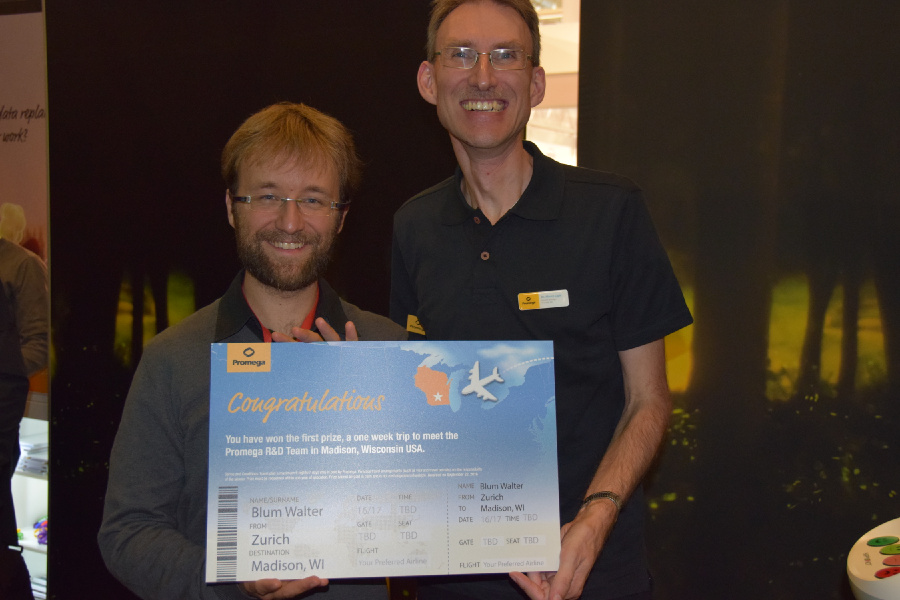
Award presentation
Dr. Walter Blum wins trip to Promega headquarters as part of Promega Switzerland’s 25th Anniversary celebration.

Walter Blum knew how normal cells worked. He had studied and read about the pathways that regulated cell cycles, growth and development; he saw the cell as an amazingly well programmed, intricate machine. What he wanted to understand was: “Why does a cell become crazy? How does it escape immune system surveillance?”

Last week I had the opportunity to sit down with Dr. Blum, a customer of our Promega Switzerland branch. Dr. Blum won a trip to visit our campus in Madison for a week as part of an anniversary celebration for our Switzerland branch. While here, he got an inside peek at research and manufacturing operations, chatted with our scientists, met with our marketing teams and saw the sights in Madison. We talked about his work and what he learned and is taking back with him from his trip to Madison. Continue reading “Genes to Cells to Genomes: Where Will Your Research Questions Take You?”

Measuring Metabolic Changes in T cells with the Lactate-Glo Assay

Immunometabolism

Welcome to the emerging frontier of immunometabolism. A decade ago, immunology and metabolism were seen as two distinct areas of study. However, we now know that specific metabolic activities are required for proper immune cell differentiation and function. In tumor microenvironments, immune cells may even alter their metabolism to compete with tumor cells for limiting nutrients.

Glucose metabolism in Naïve vs Effector T cells

What does your car and T cells have in common? They both shift gears! You can shift gears on your car to change the way the engine’s power is used to match driving conditions; when you’re going uphill, you switch to a higher gear. Similarly, when T cells are activated, they change the way they generate energy to match functional needs. This makes sense because activated T cells (known as effector T cells) require more energy and biomass to support growth, proliferation and effector functions.

While cars run on gas, the main fuel for T cells is glucose. Each glucose molecule is broken down into pyruvate while generating 2 ATP molecules. Naïve T cells completely oxidize pyruvate through oxidative phosphorylation to generate 36 ATPs per glucose molecule. However, when T cells are activated and become effector T cells, glycolysis is used to produce 2 ATPs per glucose molecule. Continue reading “Measuring Metabolic Changes in T cells with the Lactate-Glo Assay”

Cytotoxicity Testing of 9,667 Tox21 Compounds using Two Real-Time Assays by Promega

A recent paper in PLOS One demonstrated real-time cytotoxicity profiling of approximately 10,000 chemical compounds in the Tox21 compound library, using two Promega assays, RealTime-Glo™ MT Cell Viability Assay and CellTox™ Green Cytotoxicity Assay. This is exciting to me, a science writer working at Promega; exciting because it’s tricky figuring out how to write about the utility of our products without sounding like an evangelist.

I don’t know about you, but I tend to shut out evangelists and their messages.

Instead of me telling you about real-time viability and cytotoxicity assays from Promega, here is an example of their use in Tox21 chemical compound library research.

What is the Tox21 compound library?
As described in the article by Hsieh, J-H. et al. (2017) in PLOS One:
“The Toxicology in the 21st Century (Tox21) program is a federal collaboration among the National Institutes of Health, including the National Toxicology Program (NTP) at the National Institute of Environmental Health Sciences and the National Center for Advancing Translational Sciences, the Environmental Protection Agency, and the Food and Drug Administration. Tox21 researchers utilize a screening method called high throughput screening (HTS) that uses automated methods to quickly and efficiently test chemicals for activity across a battery of assays that target cellular processes. These assays are useful for rapidly evaluating large numbers of chemicals to provide insight on potential human health effects.”

Continue reading “Cytotoxicity Testing of 9,667 Tox21 Compounds using Two Real-Time Assays by Promega”

All Aglow in the Ocean Deep

Fascinating bioluminescent organisms floating on dark waters of the ocean. Polychaete tomopteris.

Today’s blog comes to you from the Promega North America Branch Office.

In nature, the ability to “glow” is actually quite common. Bioluminescence, the chemical reaction involving the molecule luciferin, is a useful adaptation for many lifeforms. Fireflies, mushrooms and creatures of the ocean deep use their internal lightshows to cope with a variety of situations. Used for hunting, communicating, ridding cells of oxygen, and simply surviving in the darkness of the ocean depths, bioluminescence is one of nature’s more flashy, and advantageous traits.

In new research published in April in the journal Scientific Reports, MBARI researchers Séverine Martini and Steve Haddock found that three-quarters of all sea animals make their own light.  The study reviewed 17 years of video from Monterey Bay, Calif in oceans that descended to 2.5 miles, to determine the commonality of bioluminescence in the deep waters.

Martini and Haddock’s observations concluded that 76 percent off all observed animals produced some light, including 97 to 99.7 cnidarians (jellyfish), half of fish, and most polychaetes (worms), cephalopods (squid), and crustaceans (shrimp).

Most of us are familiar with the fabled anglerfish, the menacing deep-sea creature known for attracting ignorant prey with a glowing lure attached to their head. As you descend below 200 meters, where light no longer penetrates, you will be surprised at the unexpected color display of the oceans’ sea life. Bioluminescence is not simply an exotic phenomenon, but an important ecological trait that the oceans’ sea creatures have wholeheartedly adopted to cope with complete darkness.

Continue reading “All Aglow in the Ocean Deep”

Surfing the Light Waves: Shrimp, Coral, Turtles and Other Fluorescent Organisms

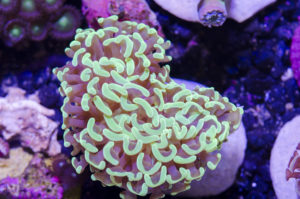
A branching torch coral, Euphyllia glabrescens.

Have you ever walked on a beach and noticed that the waves seem to glow as they roll onto shore? Perhaps you have seen fish or jellyfish that glow in the dark, or maybe you’ve chased fireflies in your backyard or on a camping trip. These are all forms of luminescence (the production of light without adding heat), but the manner that these organisms produce their light can be quite different.

Continue reading “Surfing the Light Waves: Shrimp, Coral, Turtles and Other Fluorescent Organisms”

In Healthy Eating Less is More: The Science Behind Intermittent Fasting

Mix a love of eating with a desire to live a long, healthy life what do you get? Probably the average 21st-century person looking for a way to continue enjoying food despite insufficient exercise and/or an age-related decline in caloric needs.

Enter intermittent fasting, a topic that has found its way into most news sources, from National Institutes of Health (NIH) and Proceedings of the National Academy of Sciences publications to WebMD and even the popular press. For instance, National Public Radio’s “The Salt” writers have tried and written about their experiences with dietary restriction.

While fasting has enjoyed fad-like popularity over the past several years, it is not new. Fasting, whether purposely not eating or eating a restricted diet, has been practiced for 1,000s of years. What is new is research studies from which we are learning the physiologic effects of fasting and other forms of decreased nutrient intake.

You may have heard the claims that fasting makes people smarter, more focused, and thinner. Researchers today are using cell and animal models, and even human subjects, to measure biochemical responses at the cellular level to restricted nutrient intake and meal timing, in part to prove/disprove such claims (1,2).

Continue reading “In Healthy Eating Less is More: The Science Behind Intermittent Fasting”

Making BRET the Bright Choice for In vivo Imaging: Use of NanoLuc® Luciferase with Fluorescent Protein Acceptors

13305818-cr-da-nanoluc-application_ligund

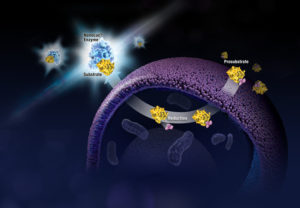
Live animal in vivo imaging is a common and useful tool for research, but current tools could be better. Two recent papers discuss adaptations of BRET technology combining the brightness of fluorescence with the low background of a bioluminescence reaction to create enhanced in vivo imaging capabilities.

The key is to image photons at wavelengths above 600nm, as lower wavelengths are absorbed by heme-containing proteins (Chu, J., et al., 2016 ). Fluorescent protein use in vivo is limited because the proteins must be excited by an external light source, which generates autofluorescence and has limited penetration due to absorption by tissues. Bioluminescence imaging continues to be a solution, especially firefly luciferase (612nm emission at 37°C), but its use typically requires long image acquisition times. Other luciferases, like NanoLuc, Renilla, and Gaussia, etc. either do not produce enough light or the wavelengths are readily absorbed by tissues, limiting their use to near-surface imaging.

The two papers discussed here illustrate how researchers have combined NanoLuc® luciferase with a fluorescent protein to harness bioluminescent resonance energy transfer (BRET) for brighter in vivo imaging reporters.

Continue reading “Making BRET the Bright Choice for In vivo Imaging: Use of NanoLuc® Luciferase with Fluorescent Protein Acceptors”