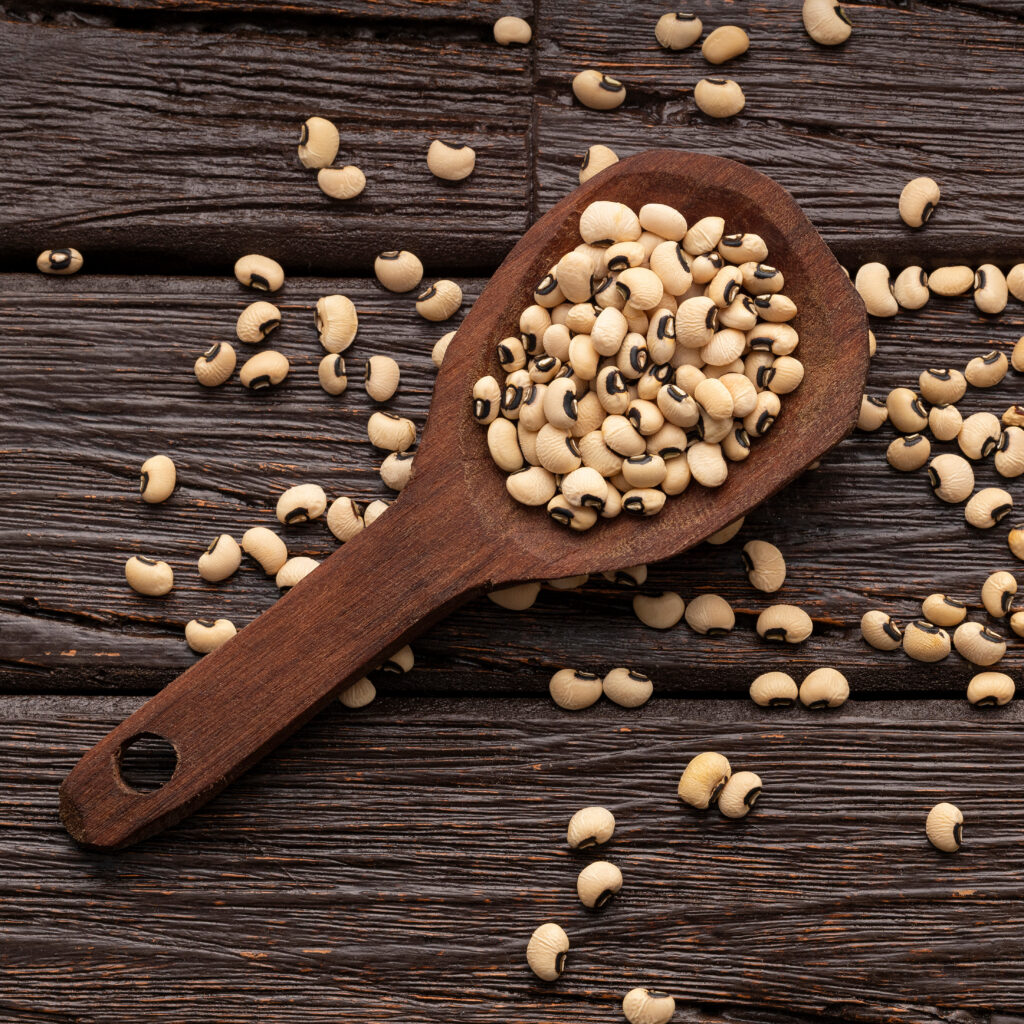
Cowpea (Vigna unguiculata), a humble tan and black legume, is one of the most important food crops in the world. Grown across sub-Saharan Africa, Asia, and parts of the Americas, Cowpea provides protein-rich nutrition for hundreds of millions of people, making it a cornerstone of smallholder agriculture. But cowpea production faces a persistent threat: the cowpea aphid-borne mosaic virus (CABMV), a common virus that can devastate yields across entire growing regions.
What makes CABMV particularly difficult to combat is how the virus infects its host. Instead of relying on viral translational machinery, the virus hijacks the plant’s systems to replicate. CABMV targets a protein called eIF4E, a translation initiation factor that the plant needs to read its own genetic instructions and produce proteins. The virus produces a protein, VPg, that binds directly to eIF4E and redirects the plant’s translational machinery to produce viral proteins instead. The plant can’t simply get rid of eIF4E. Without it, protein synthesis stalls. So how can cowpea defend itself against a virus that exploits one of its most essential proteins?
A new study published in Agronomy by researchers at the Federal University of Pernambuco, the Federal University of Minas Gerais, and Embrapa Recursos Genéticos e Biotecnologia takes a comprehensive look at this problem from the inside out1. The team characterized all three members of the eIF4E gene family in cowpea (eIF4E, eIF(iso)4E, and nCBP) across six cultivated varieties (cultivars) with known contrasting responses to CABMV infection. Two of those cultivars (Bajão and IT85F-2687) are resistant to the virus; the other four (Boca Negra, BR14 Mulato, Pingo de Ouro, and Santo Inácio) are susceptible to the virus.
Using a multi-omics approach that combined genomic, evolutionary and structural analyses, the researchers set out to answer a fundamental question: what makes some versions of eIF4E exploitable by the virus, and others not?
Building the Molecular Foundation
The molecular workflow began with extracting total RNA from 28-day-old plants of all six cultivars using SV Total RNA Isolation System (Promega), followed by reverse transcription into cDNA with the ImProm-II Reverse Transcription System (Promega). The coding sequences for all three eIF4E isoforms were then amplified by PCR and cloned into the pGEM-T Easy Vector System (Promega) for transformation into E. coli. Plasmid DNA from positive clones was purified using the Wizard® Plus SV Minipreps DNA Purification System (Promega) and confirmed by Sanger sequencing.
This end-to-end molecular pipeline gave the researchers clean, verified sequences for each isoform across all six cultivars formed the starting material for the evolutionary, genomic, and structural analyses that form the core of the study.
Understanding the Isoforms
Using the molecular data for the isoforms, researchers were able to construct 3D structural modeling and molecular dynamics simulations. Using AlphaFold 3, an AI-powered protein structure prediction tool developed by Google DeepMind, the team generated high-confidence models for all three isoforms across the six cultivars, then subjected them to 100-nanosecond molecular dynamics simulations to assess how the proteins behave under physiological conditions.
All three isoforms preserved the canonical “cupped hand” architecture characteristic of the eIF4E protein family: a curved sheet of antiparallel beta strands forming the cap-binding pocket, stabilized by alpha helices on the dorsal surface. The electrostatic surface maps confirmed a conserved electropositive cleft on the concave face of each protein, essential for binding the negatively charged mRNA 5′ cap.
But the isoforms weren’t identical in behavior. eIF(iso)4E stood out as the most structurally compact and stable of the three, exhibiting the lowest backbone deviation (RMSD of 1.006 Å) and the highest density of intramolecular hydrogen bonds. This structural rigidity may help explain a pattern observed across many plant-virus systems. A second study found that potyviruses often selectively recruit specific eIF4E isoforms as susceptibility factors, and the VPg-eIF4E interaction is essential for infection2. In de Luna-Aragão et al., researchers propose that eIF(iso)4E’s compactness could make it a particularly stable anchor for viral VPg. This hypothesis, if confirmed, would have direct implications for which isoform breeders should target when engineering resistance.
Where Resistant and Susceptible Cultivars Diverge
The sequence analysis revealed that while the coding sequences across cultivars were highly conserved (over 98% identity for all three isoforms), small but specific polymorphisms distinguished resistant cultivars from susceptible ones. The resistant cultivar Bajão, for example, carried a 6-base-pair insertion in its eIF4E gene. These small changes, when mapped onto the 3D structures, help explain how a single mutation can disrupt the VPg binding interface without compromising the protein’s essential role in translation.
This is the key insight for crop improvement: you don’t need to knock out eIF4E entirely. You just need to find or engineer mutations that break the virus’s grip while leaving the plant’s translation machinery intact.
A Roadmap for Resistance
By providing the first comprehensive 3D structural characterization of the cowpea eIF4E family, this study creates a practical framework for breeding programs. The detailed structural models can guide allele mining, identifying natural resistance variants in cowpea germplasm and inform CRISPR/Cas9-based editing strategies that target specific residues in the VPg binding interface. The goal is durable, broad-spectrum resistance to potyviruses without yield penalties.
References
- de Luna-Aragão, M.A., de Andrade, F.A. et al. Unveiling three functionally diverse isoforms of eIF4E in cowpea through a multi-omics approach. Agronomy 16, 766 (2026). https://doi.org/10.3390/agronomy16070766 ↩︎
- Zlobin, N. & Taranov, V. Plant eIF4E isoforms as factors of susceptibility and resistance to potyviruses. Front. Plant Sci. 14, 1041868 (2023). https://doi.org/10.3389/fpls.2023.1041868 ↩︎

Anna Bennett
Latest posts by Anna Bennett (see all)
- Adapting a Cell-Based Immunoassay for HTS: From the Bench to a 7,000-Compound Screen - October 19, 2026
- The Tilcayo: A Tiny, Scrunch-Faced Cat With a Complicated Family Tree - September 24, 2026
- Midges on the Move: Tracking The Oropouche Virus Into New Territory - August 20, 2026