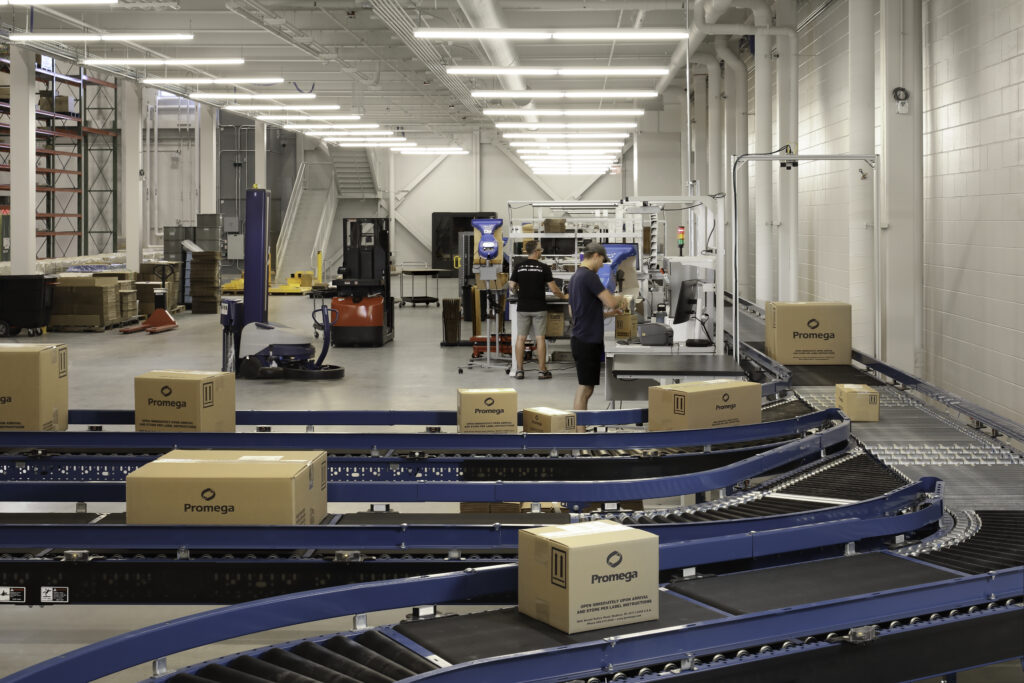
We’re all used to the convenience of online ordering, whether it’s a last-minute birthday gift or a phone charger delivered overnight. That same ease and speed is what scientists expect when ordering critical reagents for their work. At Promega, we get that. That’s why we pledge: You’ll get what you need, when you need it.
For customers in the United States, any order received by 4:00 pm will be delivered the next day. We measure our success in honoring this pledge using a metric called “order fill rate.” Our global order fill rate is consistently above our benchmark of 94.5%, sometimes passing 98%.
But how does that actually happen? With thousands of orders leaving our warehouse every week, it takes more than just good intentions. Here’s a look behind the scenes at how our teams deliver on that promise.
Speed Meets Precision: What Happens After You Order
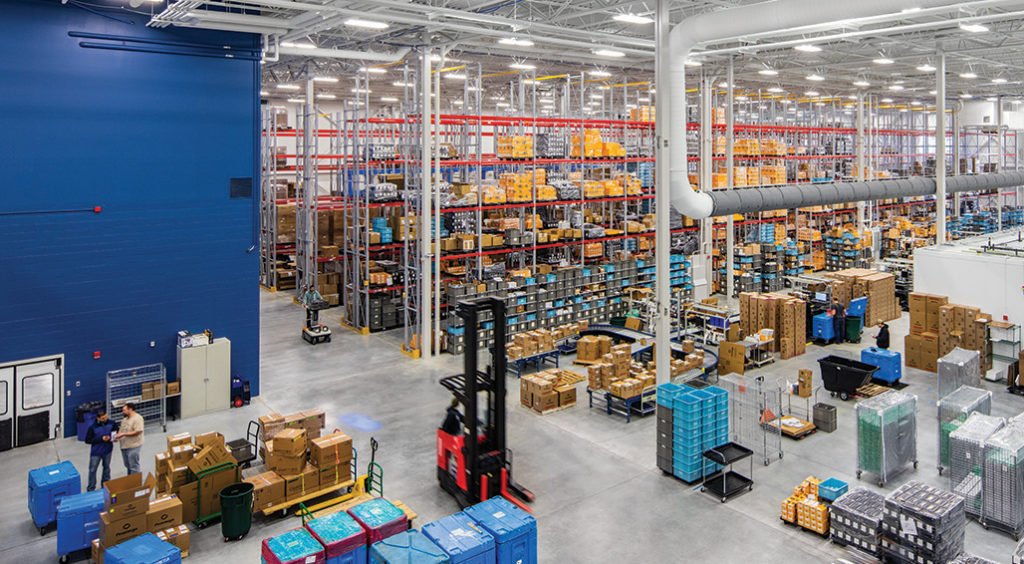
Filling orders on time requires several critical details.
First, the order details must be logged accurately in Promega systems. This includes materials, quantity, billing and shipping addresses, payment information and special considerations. Technology advancements have driven major improvements in this area, while Customer Service shepherds complex orders requiring customized processing and responds to any issues.
Next, the products must be available and ready to pick and pack. This starts with Manufacturing and Dispensing, and Product Finishing performs the final steps of getting the correct assortment of reagents into each properly labeled kit box. These teams work closely with planners to forecast and prioritize lots of each product in the Promega catalog.
Finally, the logistics teams pack the order into appropriate shipping containers and hand it off to a shipping partner to transport it to its final destination. This includes accommodating temperature needs and labeling the parcel appropriately for safe transport.
Getting It Right: Training, Tech and Teamwork
Reaching these goals requires a combination of process refinement, technology advancement and cross-functional collaboration.
Process-Driven Excellence
Data analysis shows that many errors are the result of training gaps. Promega Operations recently implemented DeepHow training software to enhance our process training. Instead of reading pages of dense, technical Standard Operating Procedures (SOPs), employees can now watch videos that break the process down step-by-step. Training is now more visual and interactive, giving the employee more familiarity with the process before they need to perform it on their own. The platform also uses AI to translate narration and voiceover into the employee’s native language, improving its overall accessibility.
Team performance is monitored in real-time, and supervisors regularly work with technicians to gather feedback and refine workflows. Leaders also meet regularly to review all errors and complaint data, identifying trends and implementing solutions to systematic problems. On an individual level, personal incentive programs reward employees for error-free months.
Technology as a Partner
“The customer service role has evolved as technology has advanced,” says Kayla Huettl, Associate Supervisor of Customer Service. “Data entry used to take precedence, but complexity and order automation are on the rise.”
While Promega receives orders in many forms, 75% now comes through Electronic Data Interchange (EDI). EDI streamlines the intake and allows customer service representatives to focus on troubleshooting and investigating issues. This is particularly important with an increase in complex orders for specialized products and unique customer requirements.
In the warehouse, the logistics team uses barcodes and RFID tracking to keep track of parcels. They’ve built AI tools to optimize packaging, ensuring temperature-sensitive shipments are properly protected without generating any unnecessary waste or emissions.
Collaboration and Human Insights

None of these teams work alone. They all depend on each other and push each other to grow.
“When you look at the process flow, we’re all internal customers for each other at different points,” says Chad Graffin, Sr Logistics Manager. “Everything starts with communication.”
The teams often benefit from cross-pollination that happens within the operations team. For example, earlier in her career, Kayla Huettl spent time in Materials Management and Product Finishing. She says those experiences help broaden her perspective when collaborating with those teams.
“It helps you to see how your task may affect the people upstream and downstream from you, because you’ve been in those roles before,” says Kevin Schickert, Product Finishing Manager.
On the other hand, Promega Operations has low employee turnover rates, which means many teams also include people with many years of experience. For example, Chad Graffin has been in Promega logistics over 34 years, and he carries rich historical knowledge and battle-tested insights. Having all these people on the same teams unites deep expertise with fresh, diverse perspective, helping the group build high-quality solutions to their challenges.
Fulfilling a Promise
“At the end of the day, it’s not just about taking orders, building kits and shipping materials out the door,” says Chad Graffin. “It’s about fulfilling a promise to our customers. With technology, teamwork and continuous improvement, Promega keeps that promise every day.
The Promega logistics warehouse in Madison, WI was expanded in 2024. Read about the capabilities of Kepler Center, our main global distribution facility.
With supply chain disruptions increasing in frequency since the COVID-19 pandemic, Promega Director of Global Logistics Brady Musson shared his thoughts on how we’re ensuring we continue to meet customer needs. Read the blog here.



Latest posts by Promega (see all)
- Internships at Promega: What Did You Learn? - September 1, 2026
- Under Pressure: The Nuclear Choreography upon Replicative Stress - August 11, 2026
- What Do Floods Leave Behind? Research on Waterborne Pathogens in Soil after Flooding - July 7, 2026