If you’ve read anything about the gut microbiome in the last decade, you’ve probably encountered a familiar setup: researchers collect stool samples, sequence the microbial DNA, and draw conclusions about gut health based on what microbes populate the gut. It’s a practical approach because stool is relatively easy to collect and doesn’t require invasive procedures. But how well does a stool sample represent the health of the entire intestinal tract?
A team of researchers at the Quadram Institute Bioscience and UK Health Security Agency set out to answer this question in primates1. They characterized the intestinal microbiome of cynomolgus macaques, a primate commonly used in biomedical research because of its genetic and physiological similarities to humans. Rather than relying on stool alone, the team collected samples from six distinct regions along the intestinal tract in 24 captive-bred animals ranging in age from 4 to 20 years.
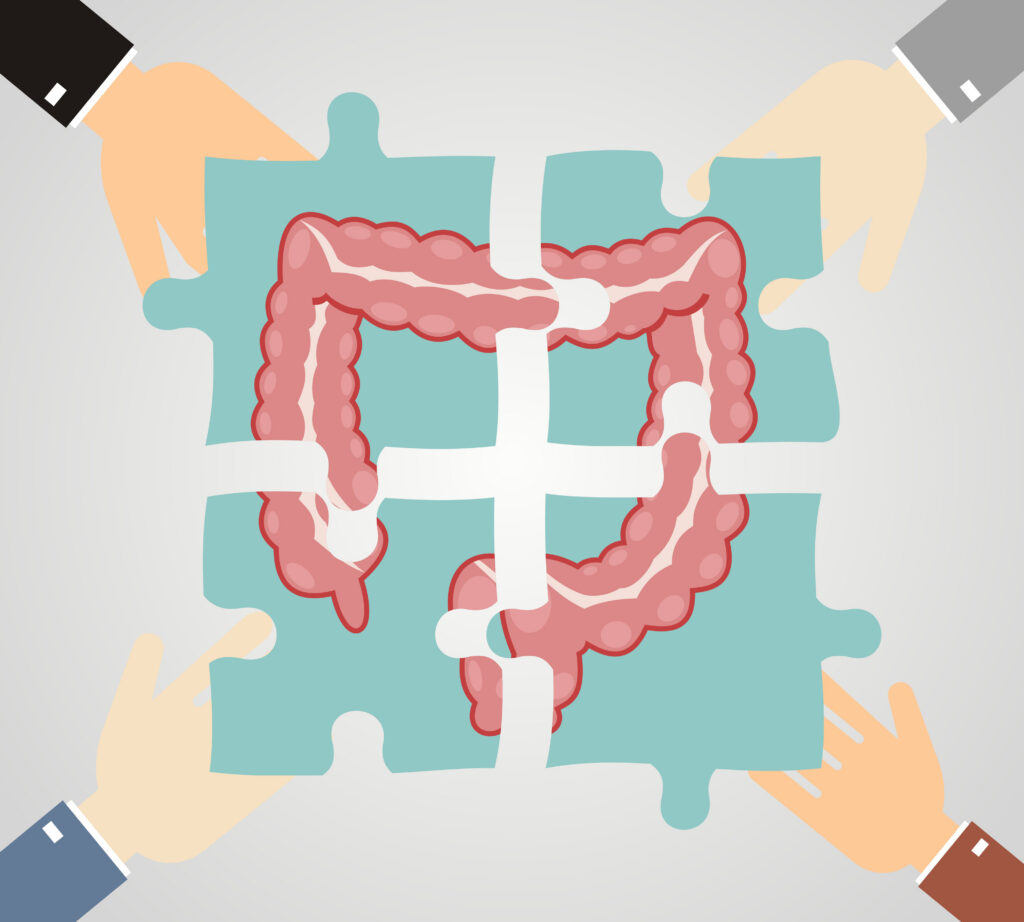
How to Assemble the Primate Microbiome
There are two main approaches to sequencing microbial communities, and the difference between them is best described with puzzles. Single genetic marker sequencing is like dumping the pieces of a puzzle onto a table, but you don’t know what the puzzle is supposed to look like. Your puzzle box is missing its picture. As you piece the puzzle together, you may look for single puzzle pieces as clues to give you a better idea of the whole picture. These are your single genetic markers: a puzzle piece with a flower on it may indicate a nature scene, which gives you a better idea of the whole picture without assembling the full puzzle.
Whole metagenomic shotgun sequencing, a more advanced approach, is even more challenging. This method is like combining pieces of many different puzzles, examining each piece and then assembling multiple puzzles at once to determine how many puzzles are present and what each puzzle looks like.
But before any of the puzzle assembly can begin, researchers need to make sure they’re starting with the right materials. To prepare the DNA fragments to ensure each sample contributes evenly, researchers complete a process known as library preparation. Think of library preparation as making sure each puzzle is a 500-piece puzzle before you start assembling. If one puzzle has 5,000 pieces and another has 50, the larger puzzle will take over the table and you’ll never complete the smaller ones.
In this primate microbe study, the researchers applied whole metagenomic shotgun sequencing to microbial samples in each region of the primate gut, allowing them to identify not just which microbes were present but also infer functional roles along the intestinal tract. Here, library quantification was performed using the QuantiFluor® dsDNA System (Promega) and GloMax® Discover Microplate Reader (Promega) prior to sequencing on NovaSeq platforms (Illumina).
The Familiar Faces of the Primate Gut
In this study, researchers found that the gut is not one uniform ecosystem. Microbial community composition differed significantly between the small intestine, caecum and colon. Species richness and evenness increased progressively as the researchers moved from the top of the intestinal tract (duodenum) to bottom (the distal colon). In terms of specific species, the large intestine harbored a more diverse community led by Segatella.Segatella, a genus of gut bacteria, are more commonly associated with non-Westernized human populations and captive primates than with wild ones. Previous research has shown that housing wild-born macaques in captivity for as little as one year can significantly shift their gut microbiome to more closely resemble that of humans2. But, like most microbiome research to date, the captivity comparison study relied on stool samples and single marker gene sequencing alone. By sampling six regions of the intestinal tract, the Purse et al. study maps not just which microbes live where along the gut, but what functional roles they may be playing in each region. This represents one of the most comprehensive characterizations of the primate intestinal microbiome to date.
Different regions of the gut serve different functions—from nutrient absorption in the small intestine to fermentation and immune regulation in the large intestine. A microbial shift in one region could have very different consequences for the host than the same shift somewhere else. This finding underscores a limitation that the authors are careful to highlight: fecal samples, while convenient, may not capture the full picture of intestinal microbial diversity.
Meeting the Unknown Residents
Sampling the whole gut with metagenomic sequencing allows researchers to infer the function of expected inhabitants like Segatella, and to uncover unexpected residents. Knowing what microbes are doing, not just that they’re present in the gut, is key to understanding how they contribute to processes like digestion, immune regulation and overall gut health. Here, researchers used post-analysis, reference-based profiling to identify microbes by comparing sequences to a database of known genomes—like assembling puzzles with a picture on the box to guide you. The only pitfall with reference genomes is that not all microbes have a reference genome readily available in databases. In this study, researchers could only characterize about 55% of the microbial genomes present. That means nearly half of the microbial community was a novel species, or a species without any isolated representatives.
To fill in the gaps, the team used an assembly-based approach, reconstructing microbial genomes directly from the sequencing data without relying on a reference database. This approach uncovered 156 novel species never formally described. The most commonly represented family among these novel species was Lachnospiraceae, one of the most functionally important bacterial groups in the gut. In humans, Lachnospiraceae are the main producers of short-chain fatty acids like butyrate. Butyrate serves as a key energy source for the cells lining the colon and plays a role in immune regulation and gut barrier integrity3. Finding dozens of previously unknown species within this same family in the macaque gut suggests there may be functional diversity in these primates that we’re only beginning to understand.
By pairing whole metagenomic shotgun sequencing with sampling along the primate intestinal tract, the researchers uncovered not just familiar faces but entirely new species. A stool sample is a reasonable and far less invasive starting point, but as this study shows, it’s just that: a starting point.’
References
- Purse, C. et al. Intestinal microbiota profiles of captive-bred cynomolgus macaques reveal influence of biogeography and age. Animal Microbiome 7:47 (2025). https://doi.org/10.1186/s42523-025-00409-9 ↩︎
- Sawaswong, V. et al. Alteration of gut microbiota in wild-borne long-tailed macaques after 1-year being housed in hygienic captivity. Sci. Rep. 13, 5842 (2023). https://doi.org/10.1038/s41598-023-33163-6 ↩︎
- Vacca, M. et al. The controversial role of human gut Lachnospiraceae. Microorganisms 8(4), 573 (2020). https://doi.org/10.3390/microorganisms8040573 ↩︎

Anna Bennett
Latest posts by Anna Bennett (see all)
- Midges on the Move: Tracking The Oropouche Virus Into New Territory - August 20, 2026
- The Calcium-Platelet Connection in Cancer Metastasis - July 14, 2026
- The Molecular Blueprint for Virus-Resistant Cowpea - June 9, 2026