At Grove Biopharma, the R&D team is advancing a rational design approach to drug discovery. Their Bionic Biologics™ Platform assembles custom-engineered peptides to target intracellular protein-protein interactions into stable, potent, cell permeable therapeutics. By combining the precision of biologics with the efficiency of synthesizing small molecules, Grove accelerates lead generation and optimization.
Grove’s technology enables targeting key proteins involved in cancer and neurodegenerative diseases for which effective therapeutics have historically been difficult to develop. Their candidate molecules focus on important targets such as the Androgen Receptor splice variant, SHOC2 within the RAS/RAF pathway, the MYC-regulator WDR5, a Tau isoform relevant to Alzheimer’s Disease, and the Keap1-Nrf2 interaction associated with neurodegeneration. These programs have made significant progress and now represent some of the most advanced agents in their pipeline.
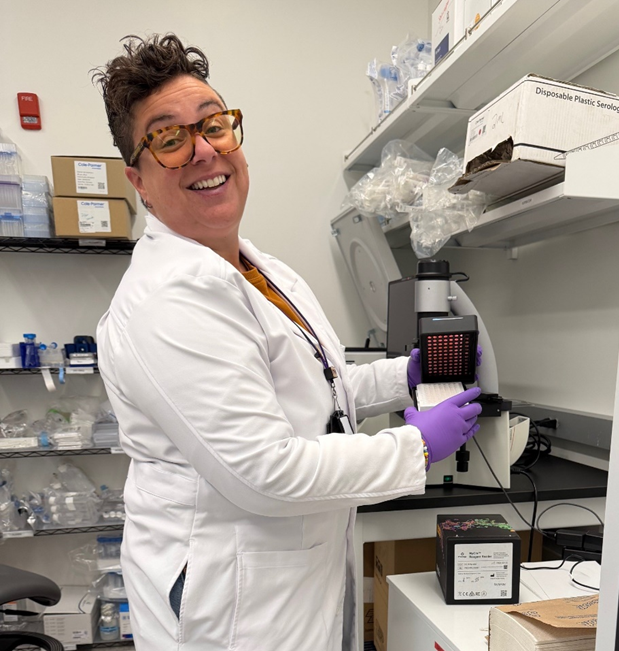
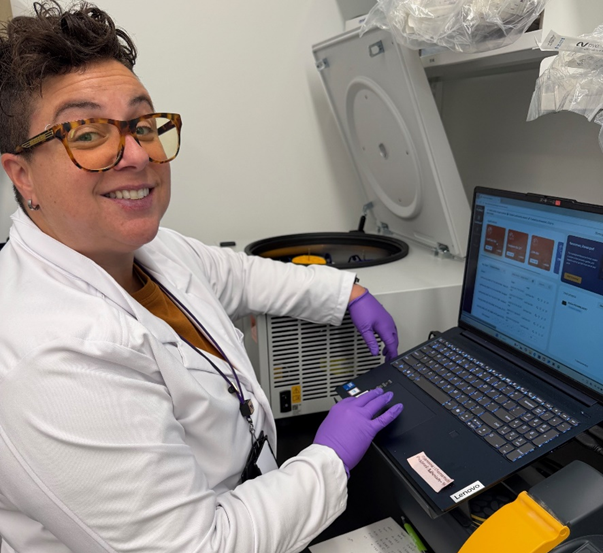
When Principal Scientist Fausta Fischietti, PhD and Scientist Candice Loitz, MS, and their colleagues moved into the company’s first independent lab after graduating from the Portal Innovations incubator in Chicago, they needed instrumentation that could support frequent screening within a small lab footprint. They selected the MyGlo® Reagent Reader to perform luminescence-based assays directly in their own lab instead of relying on shared equipment. Loitz, who uses MyGlo® most frequently, runs CellTiter-Glo® Cell Viability Assays twice a week to measure compound effects on cell health. The team values that MyGlo® connects seamlessly via Wi-Fi, can be run from any laptop, and that results can be accessed from anywhere through the ProNect® Data Platform. Dr. Fischietti appreciates that the software generates a graph of analyzed results right away after a read. Seeing the fitted dose response curve immediately after collecting data makes interpreting results fast and intuitive. The team described MyGlo® as user friendly, consistent, and “always working”, qualities that set it apart from other plate readers that occasionally fail during experiments.
Streamlining Data Collection and Analysis
As a growing biotech company, Grove values tools that combine precision, flexibility, and efficiency. MyGlo® and ProNect® Data Platform provide a seamless workflow from data collection to fully analyzed results. MyGlo® delivers sensitive luminescence detection across microplates, while ProNect® automatically aligns data with plate maps, applies curve fitting, and calculates EC₅₀ values for rapid analysis.
The team described the CellTiter-Glo® app’s curve-fitting as “spot-on” compared to GraphPad Prism, with comparable EC₅₀ results. Because data processing and visualization occur within one interface, the team can quickly incorporate results into presentations for internal discussions or stakeholder updates. Loitz mentioned that some of her experiments involve reading 30 individual plates at a time. MyGlo®’s short read time per plate (about 45 seconds for default integration time) helps her generate data quickly. Setting up plate maps in advance within ProNect® allows data to be paired instantly with reads, producing graphs of analyzed data in seconds, freeing up time to focus on interpreting results and next steps, rather than performing manual data analysis.
MyGlo®’s compact design fits easily into their lab space, and the ProNect® Data Platform supports access from any laptop, allowing assays to be run at any time without scheduling around shared instruments. MyGlo® has become a consistent workhorse in their lab. Beyond using CellTiter-Glo® assays, the team plans to use MyGlo® with other Promega luminescence-based assays to study the effects of their therapeutic leads on key cellular processes.
Collaboration to Support Scientists’ Needs
Feedback from Grove Biopharma’s experience with MyGlo® and ProNect® has informed ongoing ProNect® analysis software development. The team’s insights help ensure that future updates continue to align with how scientists actually work while focusing on clarity, flexibility, and data integrity.
For Grove Biopharma, MyGlo® and ProNect® have become integral to their research workflow. The combination of robust Promega luminescence chemistry with simplified data collection, analysis, and visualization supports faster, evidence-based decisions that keep discovery moving forward. Grove’s experience demonstrates how accessible, integrated technologies can enhance productivity and data quality across startups, academia, and established biopharma labs alike.
If your lab is ready to simplify data analysis, streamline workflows, and generate high-quality results in minutes, explore how the MyGlo® Reagent Reader and ProNect® Data Platform analysis apps can support your research.
CellTiter-Glo, ProNect, and MyGlo are registered trademarks of Promega Corporation.
For research use only. Not for use in diagnostic procedures.



Latest posts by Promega (see all)
- Internships at Promega: What Did You Learn? - September 1, 2026
- Under Pressure: The Nuclear Choreography upon Replicative Stress - August 11, 2026
- What Do Floods Leave Behind? Research on Waterborne Pathogens in Soil after Flooding - July 7, 2026