Royal Lessons for Scientific Discovery

rdeyes-2This Summer I had the chance to travel to Isle Royale (‘Royal Island’) in Lake Superior for what was a trip that would challenge me in more ways than one.  Our group, comprising 3 adults and 5 boys, drove up to Copper Harbor in the Michigan Upper Peninsula and then made the four hour ferry crossing to the Isle Royale National Park.   We spent the next 6 days hiking across the island, covering a total of 50 miles with backpacks and tents weighing us down every step of the way.

The sights were fantastic, the weather tremendous and the sheer thrill of being unreachable by text, email or phone thoroughly satisfying to say the least.  But, like any adventure of this nature, there was an element of fear that accompanied the trip.  What if anyone got hurt on the island?  How would we handle losing all our food if critters raided our camp during the night?  Might someone get seriously sick on the ferry crossing?  Had we brought enough food to keep us healthy while not overloading our back packs with unnecessary weight that would hinder our progress?  What if our portable water filters got clogged up? Continue reading “Royal Lessons for Scientific Discovery”

Making It Easier to Investigate PGTs

Introduction

Studying cellular molecules can be challenging. Some processes are troublesome to study due to the lack of an assay or a complicated assay exists but lacks sensitivity. Membrane proteins in particular are difficult to isolate and characterize. Phosphoglycosyltransferases (PGTs) are transmembrane proteins that transfer phosphosugars onto phospholipids, initiating the synthesis of oligosaccharides in bacterial cell walls. This transfer creates a diphosphate link between a lipid and a sugar and generates UMP as a byproduct. Once this lipid–P–P–sugar linkage occurs, more sugars can be added by glycosyltransferases, generating membrane-based polysaccharides (e.g., peptidoglycan) used for signaling, recognition and defense.

While PGTs have been studied biochemically and an X-ray structure of one member exists, much is still unknown about these enzymes. Overexpressing and purifying membrane proteins remains a challenge, and the conventional PGT assay requires isotope labeled-UDP-sugar donors and is based on the solubility difference between substrate and product to determine enzyme turnover using extraction-based or chromatographic methods. While there are other assays that use fluorescent modified substrates or multienzyme analysis, none of the methods can be applied to all of the diverse PGT enzymes.

All PGTs generate UMP as a byproduct of the transfer of a phosphosugar to a phospholipid. Based on the principle of the luminescent UDP-Glo™ Glycosyltransferase Assay where UDP released during the glycosyltransferase reaction was quantitated, a new luminescent assay called UMP-Glo™ Assay is able to measure the activity of PGT enzymes by adding a single reagent to detect UMP. Das et al. validated this assay by testing PglC, a PGT from Campylobacter jejuni, as well as PglC from Helicobacter pullorum and WecA from Thermatoga maritime and published the results in Scientific Reports. Continue reading “Making It Easier to Investigate PGTs”

Research Teams Demonstrate Bivalent Binding of a Novel Bromodomain Protein Inhibitor

13305818-cr-da-nanoluc-application_ligund

Today’s blog is written by guest blogger Kristin Huwiler from our Cellular Analysis and Proteomics Group.

Two research collaborations, one in Europe and a second in the US, have just published in Nature Chemical Biology (1,2) on the identification of BET inhibitors (bi-BETs) that bind via a bivalent mechanism to both bromodomains of BRD4. These bivalent chemical inhibitors exhibit high cellular potency and affinity relative to their monovalent predecessors. By developing high-affinity ligands that engage both bromodomains simultaneously within BRD4, the authors illustrate a concept that may be applicable in the development of selective, potent ligands for other multi-domain proteins. Here we review the work presented in the Waring et al. paper using the Promega NanoBRET™ Technologies to characterize the mechanism of action of their bivalent probe.

The bromodomain and extraterminal (BET) sub-family are some of the most studied bromodomain-containing proteins (3). The BET subfamily of proteins contain two separate bromodomains. BRD4 is one well studied member of the BET sub-family. Several small molecule inhibitors that target BRD4 have been developed as potential therapeutics for various cancers with promising initial studies, but to date are all monovalent, binding each bromodomain of the BET family members separately (2).

Continue reading “Research Teams Demonstrate Bivalent Binding of a Novel Bromodomain Protein Inhibitor”

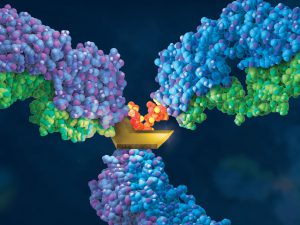
Improved Method for the Rapid Analysis of Monoclonal Antibodies Using IdeS

ides_ab

Therapeutic monoclonal antibodies (MAbs) are inherently heterogeneous due to a wide range of both enzymatic and chemical modifications, such as oxidation, deamidation and glycosylation which may occur during expression, purification or storage. For identification and functional evaluation of these modifications, stability studies
are typically performed by employing stress conditions such as exposure to chemical oxidizers, elevated pH and temperature.

To characterize MAbs, a variety of analytical techniques are chosen, such as size exclusion chromatography and ion exchange chromatography. However, due to the large size of the intact MAbs, these methods lack structural resolution. Often, the chromatographic peaks resolved by SEC and IEC methods are collected and further analyzed by peptide mapping to obtain more detailed information. Peptide mapping, in which antibodies are cleaved into small peptides through protease digestion followed by LC–MS/MS analysis, is generally the method of choice for detection and quantitation of site-specific modifications. However sample preparation and lengthy chromatographic separation make peptide mapping impractical for the analysis of large numbers of samples. In contrast to peptide mapping analysis, the middle-down approach offers the advantage of high-throughput and specificity for antibody characterization.

Limited proteolysis of IgG molecules by the IdeS enzyme has been introduced for antibody characterization due to its high cleavage specificity and simple digestion procedure.

Continue reading “Improved Method for the Rapid Analysis of Monoclonal Antibodies Using IdeS”

How’s That for Wellness?

Copyright: pavel1964 / 123RF Stock Photo

Whether you’re a seasoned runner or just trying to find a fun activity to do with a coworker, a 5K run/walk can be a fun event for all.  Promega recently hosted its 7th annual 5K run/walk and had more than 155 participants at the Madison, WI,  location.  The event was a fun activity for everyone to get out, get active and be social. The event also helped raise over 160 pounds of food and over $115 in cash that was donated to the Second Harvest Food Bank.

As a nation, we have become more focused on our health and wellness than ever before. Nearly everyone is trying to drink more water, be more mindful of what they eat, and it’s hard to look around the room without finding someone wearing a fitness tracker to keep track of their daily steps.  Health and wellness has also become increasingly popular in the workplace. According to Health Fitness Revolution, the top benefits of a Workplace Wellness Program are as follow:

  • Fun
  • Improved Productivity
  • Happiness
  • Sense of Community
  • Lower Healthcare Costs
  • Sense of Accomplishment
  • Improved Physical Fitness
  • Weight Loss
  • Less Stress
  • Healthier Habits

At Promega our focus on wellness as an organization is no different. We recognize that being active and taking care of your health, and your family’s health, has an impact beyond how you feel.  Because of that, we have a wellness or fitness center in each of our facilities to make staying active and fit more convenient. We also believe that wellbeing extends beyond physical health and have a campus that features native gardens with walking paths and dedicated meditative spaces to encourage total wellness. Promega strives to be a leader in health & wellness initiatives that enable our employees to become the best version of themselves. We don’t do this for a potential monetary return on the investment, but because we truly believe that by becoming the best version of yourself, our employees also become the most fulfilled.


Back to Basics: Organizing Your Writing like It’s a Hamburger

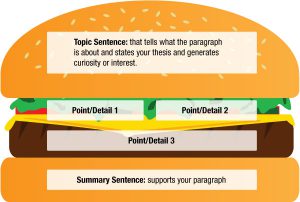
The "hamburger" scheme for organizing a paragraph.
The “hamburger” scheme for organizing a paragraph.

Last night I was helping my daughter, who is in fourth grade, with her homework. We had completed a math worksheet, a geography worksheet and had moved onto writing. For her paragraph assignment, she was supposed to write about a special place. So I began drawing the concept map that we typically use to help her organize her thoughts. She stopped me before I could get started.

“No Mom, wait,” she grabbed the pencil and paper from my hands, “I have a better idea.”

She drew five shapes on the paper.

“We should write the paragraph like it’s a hamburger. The first sentence is the topic—it’s the top of the burger, tells you what is inside—it makes you hungry to read more. Next comes the juicy, meaty part. Three details—three sentences. Then the bottom bun, the summary that supports the whole paragraph. It’s the hardest to write.” She proudly sat down with her drawing and pencil.

“I LOVE that,” I exclaimed. “That’s a great way to organize a paragraph.”

“Yeah,” my husband looked up from his Suduko that he had been working on, “and the cheese goes right here.” He pointed to one of the three boxes my daughter had drawn underneath the bun.

“And the lettuce over here,” my daughter giggled.

“Well, I like mine with lettuce and tomato,” I chanted with no apologies to Jimmy Buffett, “Heinz 57 and French-fried potato..,”

“A big kosher pickle,” my daughter joined in, and the evening’s homework activities degenerated from there. (Sometimes it’s the parents who are easily distracted.)

My daughter’s hamburger graphic was new to me, but the concept wasn’t. It is a solid method for organizing a piece of writing, and it can be applied all kinds of writing—from a paragraph, to an essay, to a speech and even to a scientific article.

Continue reading “Back to Basics: Organizing Your Writing like It’s a Hamburger”

Of Elephant Research and Wildlife Crime – Molecular Tools that Matter

Here at Promega we receive some interesting requests…

Take the case of Virginia Riddle Pearson, elephant scientist. Three years ago we received an email from Pearson requesting a donation of GoTaq G2 Taq polymerase to take with her to Africa for her field work on elephant herpesvirus. Working out of her portable field lab (a tent) in South Africa and Botswana, she needed a polymerase she could count on to perform reliably after being transported for several days (on her lap) at room temperature. Through the joint effort of her regional sales representative in New Jersey/Pennsylvania (Pearson’s lab was based out of Princeton University at the time) and our Genomics product marketing team, she received the G2 Taq she needed to take to Africa. There she was able to conduct her experiments, leading to productive results and the opportunity to continue pursuing her work.

Continue reading “Of Elephant Research and Wildlife Crime – Molecular Tools that Matter”

Next-Generation Genomics Education: Educating and Preparing the Next Generation

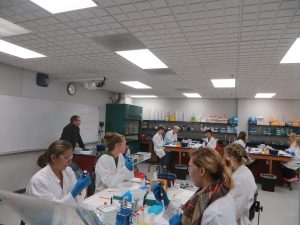
Students pursuing their interests wit h hands-on activities at BTC Institute.

The BTC Institute has many partners in creating educational opportunities in the molecular biosciences. In recent years, we have worked with the Dane County School to Work Consortium (DCSWC) to create a unique, one-semester class aimed at giving high school Juniors and Seniors interested in scientific research and health careers a chance to explore how concepts they have been learning about in their biology and biotechnology classrooms are used in the laboratory.

To take it one step further, these laboratory experiences are tied to the Gates Foundation Grand Challenges in Global Health. The Challenges provide a framework to help students understand worldwide concerns, including ways in which biotechnology can be applied to generate solutions to these problems. Students are encouraged to place scientific challenges within social and socioeconomic contexts which, in turn, make some solutions more appealing than others. This holistic approach provides the “real world” milieu that is so sought after in academic endeavors. Continue reading “Next-Generation Genomics Education: Educating and Preparing the Next Generation”

Friday Cartoon Fun: Take My Samples, Please!

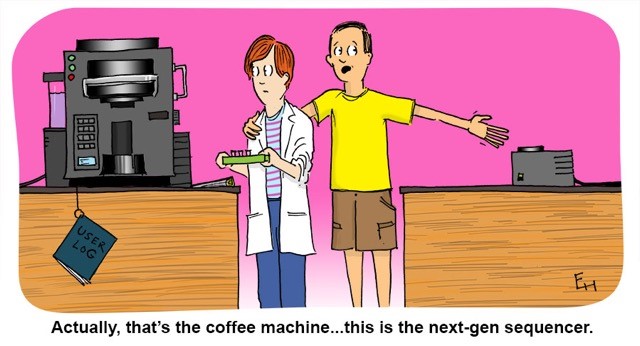
Instruments can make our lives easier in the lab. Place your samples inside an instrument and let it do all the work—isolating nucleic acids or reading and analyzing a multiwell plate—while you walk away to read a new research paper or prepare for the next step in your experiment. However, with the array of machines now available to scientists worldwide, some confusion may result in the laboratory. Has this ever happened to you?

eh_March2016
Copyright Ed Himelblau

The Birth of a Disease? A New Anthrax-Like Disease Found in Sub-Saharan Africa

Copyright
Copyright

It usually starts with one; one dead animal, one sick individual, one case that a doctor thinks is unusual. These are all ways that a new disease makes its presence known. In the case of Bacillus cereus biovar anthracis, it started with a dead chimpanzee (1).  

The wild western chimpanzee was found dead in Côte d’Ivoire in 2001. An investigation led by scientists from the Robert Koch Institute in Berlin identified the pathogenic cause of death to be an atypical B. cereus isolate that caused an anthrax-like disease. Continue reading “The Birth of a Disease? A New Anthrax-Like Disease Found in Sub-Saharan Africa”