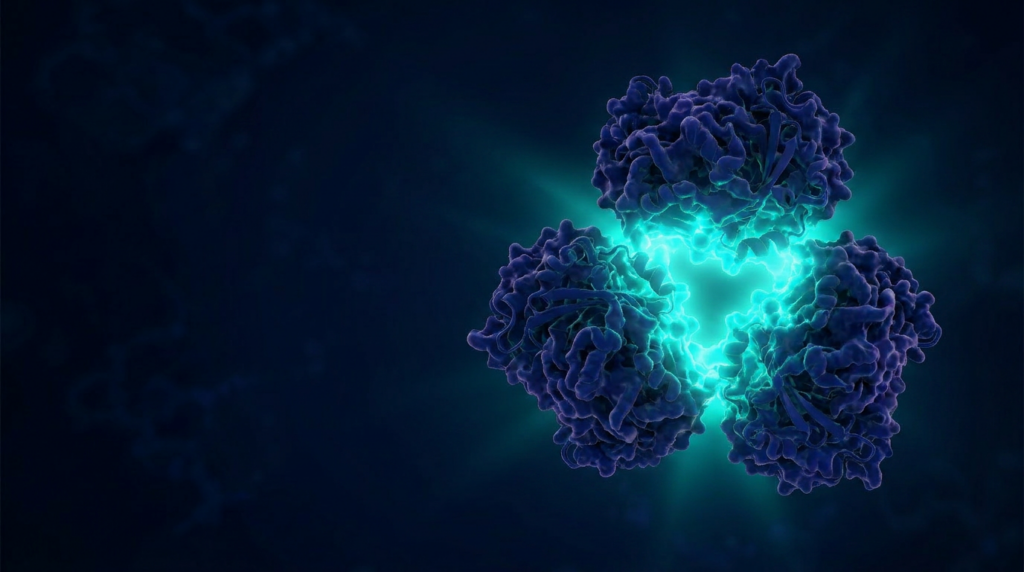
In late May 2026, a clinical trial result landed in the New England Journal of Medicine and immediately rewrote what oncologists believed was possible for patients with metastatic pancreatic cancer. Before the paper was published, people in the field were already calling it “transformative.” The data, when it came, agreed. In a disease where most second-line treatments offer months at best, a drug called daraxonrasib nearly doubled how long patients lived compared to those who received chemotherapy.¹
RAS proteins, which regulate cell growth and are mutated in more than a third of all human cancers,² had spent forty years resisting every attempt to drug them. The protein’s surface offered no obvious foothold for a small molecule. Once the word “undruggable” attached itself to the RAS protein family, most of the field moved on to more cooperative targets.
Some researchers stayed. And Promega stayed committed to the question that never goes away: does this new compound work inside a living cell? When the next chapter of the RAS story arrived, the tools were ready. Daraxonrasib is one culmination of a much longer story, one that matters for every researcher pursuing a target the field has written off.
The First Answer
To understand what daraxonrasib represents, it helps to see how an earlier chapter of the RAS story faced the same fundamental measurement challenge.
The first real opening in the RAS story came with sotorasib and adagrasib, two cancer drugs approved in 2021 and 2022.³ Both drugs targeted a single, specific RAS variant in its inactive state, a meaningful advance after decades of failure.
Like every advance in drug discovery, it came with a question that had to be answered. Does this compound actually engage its target inside a living cell? NanoBRET® target engagement assays gave researchers the clarity and precision that question requires: a direct measurement of whether sotorasib and adagrasib were engaging the right target across the full panel of RAS variants.⁴
The tools had done their job, and the next chapter would need them to do it again, because most RAS-driven cancers still remained out of reach.
The Question Again
Revolution Medicines, the company behind daraxonrasib, took a different approach to RAS. Instead of looking for a conventional binding pocket in a protein surface that didn’t have one, they recruited a molecular partner, a cellular protein called cyclophilin A, to form a three-way complex with the drug and the active form of RAS. Because the approach targets the active form of RAS, it works across a much broader range of RAS variants than earlier inhibitors could reach.⁵
The mechanism was new. The question was the same: did the complex actually form inside a living cell? Did it disrupt the right protein interactions? Did it work across the full panel of RAS variants, or just some of them? Answering those questions requires seeing what’s happening inside intact cells in real time.
NanoBRET® technology and NanoBiT® protein-protein interaction assays gave researchers something you can’t get outside a living cell: a direct, real-time view of whether the tri-complex was forming. The complex formed. CellTiter-Glo® assays tracked the downstream question: do the cancer cells actually die?⁶
This is how a mechanism gets proven. Every time.
The Question that Doesn’t Change
Daraxonrasib won’t be the last chapter. There are more RAS-driven cancers still to address. Beyond RAS, there are more targets the field is still learning to think about differently. For researchers working on any of them, the RAS story is a reminder that the measurement side is where we live.
The target changes. The tools evolve. The question of whether the mechanism works in living cells stays constant.
References
- O’Reilly EM, Wainberg ZA, Hendifar AE, et al. Daraxonrasib or chemotherapy in previously treated metastatic pancreatic cancer. N Engl J Med. Published May 31, 2026. DOI: 10.1056/NEJMoa2605555
- Li S, Balmain A, Counter CM. A model for RAS mutation patterns in cancers: finding the sweet spot. Nat Rev Cancer. 2018;18(12):767–777. DOI: 10.1038/s41568-018-0076-6
- Skoulidis F, Li BT, Dy GK, et al. Sotorasib for lung cancers with KRAS p.G12C mutation. N Engl J Med. 2021;384:2371–2381. DOI: 10.1056/NEJMoa2103695; Jänne PA, Riely GJ, Gadgeel SM, et al. Adagrasib in non–small-cell lung cancer harboring a KRAS G12C mutation. N Engl J Med. 2022;387:120–131. DOI: 10.1056/NEJMoa2204619
- Robers MB, et al. Application of NanoBRET target engagement cellular assay for measurement of inhibitor binding to wild type and mutant RAS in live cells. Cancer Res. 2022;82(12 Suppl):Abstract 379. https://aacrjournals.org/cancerres/article/82/12_Supplement/379/700997/
- Schulze CJ, Seamon KJ, Zhao Y, et al. Chemical remodeling of a cellular chaperone to target the active state of mutant KRAS. Science. 2023;381(6659):794–799. DOI: 10.1126/science.adg9652; Holderfield M, Lee BJ, Jiang J, et al. Concurrent inhibition of oncogenic and wild-type RAS-GTP for cancer therapy. Nature. 2024;629:919–928. DOI: 10.1038/s41586-024-07205-6
- Holderfield M, Lee BJ, Jiang J, et al. Concurrent inhibition of oncogenic and wild-type RAS-GTP for cancer therapy. Nature. 2024;629:919–928. DOI: 10.1038/s41586-024-07205-6

Elise Johnson
Latest posts by Elise Johnson (see all)
- ADC Development: The Questions Running in the Background - July 30, 2026
- Time Capsules in the Language of Science - July 23, 2026
- AI Identifies the Target. Someone Still Has to Validate It. - July 9, 2026