Writing Scientific Papers: Is There More To This Story?

science & storytelling

The tactic of “telling a good story” is nothing new within the business of selling, marketing and even educating about science. The word itself, “storytelling,” achieved buzzword status a few years ago in the corporate world, so it’s no surprise that it now touches industry scientists.  But the importance of telling a good story within the realm of peer-reviewed scientific papers?  That is something new, and it may impact how scientists write up their results from this point forward.

In a provocative scientific study published in PLOS ONE in December 2016, researchers from the University of Washington showed that “Narrative Style Influences Citation Frequency in Climate Change Science.” Perhaps the results they report are unique to climate change science—an area of science especially susceptible to public perception. But then again, perhaps not. This paper may be worth considering no matter what field of science you call your own.

The authors—Ann Hillier, Ryan Kelly, and Terrie Klinger—used metrics to test their hypothesis that a more narrative style of writing in climate change research papers is more likely to be influential, and they used citation frequency as their measure of influence. A sample of 732 abstracts culled from the climate change literature and published between 2009 and 2010 was analyzed for specific writing parameters. The authors concluded that writing in a more narrative style increases the uptake and influence of articles in this field of science and perhaps in scientific literature across the board.

Continue reading “Writing Scientific Papers: Is There More To This Story?”
A Big Protective Step Forward for A Rare Bee

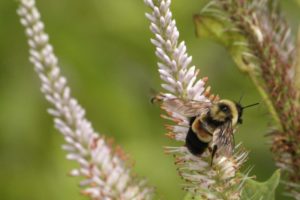
A rusty-patched bumblebee on Culver’s root in the UW–Madison Arboretum. Photo Copyright: SUSAN DAY/UW-MADISON ARBORETUM

Bees have been in the news many times over the past several years. Much of the concern has been focused on the collapse of honey bee colonies because these bees collect nectar to create honey and can be transported for use as pollinators for farmers. Alongside the plight of the honey bee are the declines in the population of native bees in the United States. These bees include insects like the big, fuzzy bumble bees, tiny, iridescent green sweat bees and dark blue mason bees. The native bees live in different conditions. They may be solitary, have a small colony or even nest close together in a communal arrangement, but never in the numbers likely to be seen for a honey bee colony. These lower-density populations can make seeing a change in native bee numbers more difficult. While honey bees have gained the majority of bee decline attention, native bees have suffered dramatic population loss with long-term consequences for the plants they pollinate and the animals that depend upon those plants.

On January 11, 2017, in a landmark decision by the United States Fish and Wildlife Service, the one of the rarest native bees called the rusty-patched bumble bee (Bombus affinis) has been listed as threatened, and this designation will go into effect February 10, 2017. This is the first bee in the U.S. that has been placed on the Endangered Species list. The rusty-patched bumble bee derived its name from the rust-colored patch found on its back.

Continue reading “A Big Protective Step Forward for A Rare Bee”

Did Dinosaurs Take Too Long to Hatch?

A different approach to dinosaur embryology has revealed another layer to our understanding of the demise of dinosaurs and rise of mammals as a result of the end-Cretaceous mass extinction event. In a 2017 Proceedings of the National Academy of Sciences paper, a group of researchers led by Gregory Erickson hypothesized that dinosaur eggs may have growth lines present on embryonic teeth that could be used to determine incubation times.

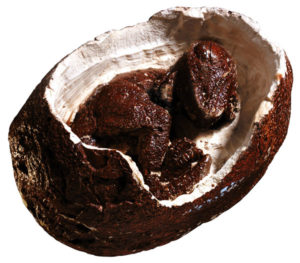
dinosaur-embryo

Not much is understood about dinosaur embryology, aside from what is known about birds. This is in part because fossils of dinosaur eggs, especially those containing embryonic skeletons, are among the rarest in the world. Despite this difficulty, using these fossils to refine estimated incubation times of dinosaur embryos can shed light on their development, life history and evolution.

Historically, paleontologists have assumed that dinosaur incubation periods were rapid based on their extant counterparts, birds. Considered living dinosaurs, birds are a logical surrogate from which to extrapolate dinosaur incubation times. It is important to note that embryonic incubation in birds is different from other living relatives of dinosaurs, modern reptiles. While reptile embryos develop slowly, birds differ by laying fewer, larger eggs with rapid incubation.

Continue reading “Did Dinosaurs Take Too Long to Hatch?”

Plumage Revealed: A 99 Million Year Old Feathered Coelurosaur Tail Trapped in Amber

Touching a Dinosaur—Almost

Imagine holding a 99 million year old feathered dinosaur tail in the palm of your hand. The only thing keeping you from actually touching its feathers? A few centimeters of petrified resin. This was reality for the group of scientists who published their findings about this discovery in the December issue of Current Biology (1).

It all began roughly ninety-nine million years ago when a young coelurosaur met an untimely death. Continue reading “Plumage Revealed: A 99 Million Year Old Feathered Coelurosaur Tail Trapped in Amber”

Deciding What to Share: Evaluating Content in a Self-Publishing World

A BuzzFeed News analysis of “news” stories during the final three months of the 2016 US presidential campaign revealed that on Facebook, the 20 top-performing fake-news stories from hoax sites and hyper partisan blogs generated 8,711,000 instances of engagement (shares, reactions, or comments) while the 20 top-performing stories from news web sites generated 7,367,000 instances of engagement (1). Basically fake news generated 1.5 million more responses than real news.

This is particularly concerning given that a Pew Research study from July 2016 indicated that 63% of Americans say that family and friends are an important way they get news—they get their news from their social networks (online or offline) rather than from vetted broadcast or print media (2), and 54% of people asked in this same study responded that they “sometimes” or “often” received news from social networking sites such as Facebook or Twitter.

I too must confess that quite often it’s a tweet or a Facebook post that alerts me to a news story or world event. Often it’s even a tweet or a post that leads me to the latest science news. I can’t remember the last time I deliberately watched the 6:00 news, though it was a staple in my house when I was growing up.

So what does all of this mean for science communication, science literacy and a basic understanding of what is really going on in the world?

Continue reading “Deciding What to Share: Evaluating Content in a Self-Publishing World”

To Seq, or Not to Seq

Seq—shorthand for “sequence”— has become a more recognizable term thanks to a novel and provocative genomics initiative called the BabySeq Project. The project, officially launched in May 2015, was designed to explore the impact of whole-exome sequencing (WES) on newborn infants and their families. A randomized, controlled trial to sequence healthy and sick infants and then provide sequencing information, it is the first of its kind. Those infants randomized to receive WES undergo genetic sequencing of all protein-coding genes and analysis of about 1,700 genes implicated in childhood health, along with 18 years of follow up genetic counseling.29813751-nov-2-blog-post-nicole-600x470-web

The project is directed by Robert C. Green, geneticist and physician at Brigham and Women’s Hospital, Harvard Medical School and the Broad Institute, and Alan H. Beggs of Boston Children’s Hospital and Harvard Medical School. Funding, totaling $25 million, comes from the National Institute of Child Health and Development and the National Human Genome Research Institute. Continue reading “To Seq, or Not to Seq”

Catching a Child Abuser in Five Days

ishi_27jpg

Next week, forensic analysts from all over the world will gather in Minneapolis for the 27th  International Symposium on Human Identification (ISHI). So today, we’d like to share one story from a forensics lab that highlights the importance of collaboration, knowledge-sharing and technology development–since that is what ISHI is all about. 

Crimes against children are especially heinous, and it is vitally important that the offenders are removed from the streets as soon as possible. In today’s blog, Sarah Chenoweth from the Anne Arundel County Crime Lab in Maryland describes a sexual assault case that was solved in just five days. Key to this speed were the collaboration between lab staff and state police, and the ability to quickly and reliably amplify DNA profiles from low-DNA samples. Thanks to the efforts of the investigators involved, parents in Maryland, and possibly nationwide, can sleep a little easier.

On Friday, February 5th, the Anne Arundel County Crime Lab was notified of a sex offense involving a 7-year-old victim. With our efficient DNA workflow, including use of the Fusion amplification kit with our 3500 Genetic Analyzer, we were able to identify the perpetrator in only five days. Continue reading “Catching a Child Abuser in Five Days”

The Cell Line Identity Crisis

29981164-Whistle

If you work with cell lines you may have paid attention to the dramatic headline published last month in the online journal STAT, Thousands of studies used the wrong cells, and journals are doing nothing.” In their column The Watchdogs (“Keeping an eye on misconduct, fraud, and scientific integrity”), Ivan Oransky and Adam Marcus call out the fact that scientists continue to publish research using cell lines that are contaminated or misidentified. Recent estimates have found that the percentage of misidentified cell lines used by scientists is as high as 20 to 36. The blame here is being placed on the peer reviewed journals for not blowing the whistle. The authors call for journals to put some “kind of disclaimer on the thousands of studies affected.”

This is not a new claim. The continuing problem of cell line misidentification, of lack of authentication, has been covered before in various channels. It’s easy to find news publicizing yet another retracted publication. In May 2015 the journal Nature required authors of all submitted manuscripts to confirm the identity of cell lines used in their studies and provide details about the source and testing of their cell lines.

Continue reading “The Cell Line Identity Crisis”

An Epizootic for the Ages: Revisiting the White-Nose Syndrome Story

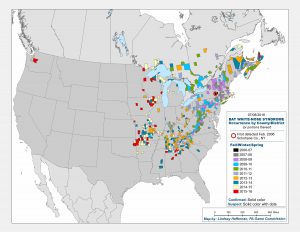
Map showing the spread of WNS across North America

In March 2016, two hikers on a trail east of Seattle, WA, found a little brown bat lying on the ground in obviously poor condition. The bat was taken to an animal shelter where it died two days later from White-Nose Syndrome (WNS).

This bat was the first case of WNS found west of the Rocky Mountains. It represented a jump in the spread of WNS, and a troubling one. WNS was first detected in a cave in Albany, New York, and since then it has been moving slowly westward at a rate of about 200 miles per year, according to David Blehert of the United States Geological Survey, the laboratory that confirmed the WNS diagnosis for the Washington bat. Before this year’s discovery outside of Seattle, the westward-most case detected was in eastern Nebraska.

WNS, caused by a cold-loving fungus, Psuedogymnoascus destructans (Pd), can kill 100% of the hibernating bats in a colony, and in the ten years since it has been detected and monitored has killed over 6 million bats in the United States and Canada. As of July 2016, bats infected with the fungus have been found in 29 states and 5 Canadian provinces.

According to Blehert, this is probably the “most significant epizootic of wildlife” ever observed; never before have we seen hibernating mammals specifically affected by a skin fungus. What does that mean? Are we looking at extinction for some bat species? What are the ecological consequences of rapidly losing so many individuals to disease so quickly? And, what, if anything, can be done to combat the disease and help bat populations recover?

Continue reading “An Epizootic for the Ages: Revisiting the White-Nose Syndrome Story”

A Crash Course in CRISPR

CRISPR is a hot topic right now, and rightly so—it is revolutionizing research that relies on editing genes. But what exactly is CRISPR? How does it work? Why is everyone so interested in using it? Today’s blog is a beginner’s guide on how CRISPR works with an overview of some new applications of this technology for those familiar with CRISPR.

Introduction to CRISPR/Cas9

27850283-June-13-CRISPR-image-WEB

Clustered Regularly Interspaced Short Palindromic Repeats (CRISPR) were discovered in 1987, but it took 30 years before scientists identified their function. CRISPRs are a special kind of repeating DNA sequence that bacteria have as part of their “immune” system against invading nucleic acids from viruses and other bacteria. Over time, the genetic material from these invaders can be incorporated into the bacterial genome as a CRISPR and used to target specific sequences found in foreign genomes.

CRISPRs are part of a system within a bacterium that requires a nuclease (e.g. Cas9), a single guide RNA (sgRNA) and a tracrRNA. The tracrRNA recruits Cas9, while sgRNA binds to Cas9 and guides it to the corresponding DNA sequence of the invading genome. Cas9 then cuts the DNA, creating a double-stranded break that disables its function. Bacteria use a Protospacer Adjacent Motif, or PAM, sequence near the target sequence to distinguish between self and non-self and protect their own DNA.

While this system is an effective method of protection for bacteria, CRISPR/Cas9 has been manipulated in order to perform gene editing in a lab (click here for a video about CRISPR). First, the tracrRNA and sgRNA are combined into a single molecule. Then the sequence of the guide portion of this RNA is changed to match the target sequence. Using this engineered sgRNA along with Cas9 will result in a double-stranded break (DSB) in the target DNA sequence, provided the target sequence is adjacent to a compatible PAM sequence.

Continue reading “A Crash Course in CRISPR”