Transfection is a core technique in molecular biology used to introduce foreign nucleic acids—such as DNA, RNA, or small RNAs like siRNA, shRNA, and miRNA—into eukaryotic cells. This enables researchers to manipulate gene expression and study cellular processes, disease mechanisms and therapeutic strategies (1).
Advances in transfection technology now support a range of nucleic acid types and cell models. Researchers can pursue transient or stable expression to achieve specific goals: knocking down transcripts, expressing proteins, or probing promoter activity in systems from immortalized lines to stem cells (1).
By enabling gene expression without permanent genomic changes, transfection is especially valuable for short-term studies like pathway mapping or immune response profiling. As research shifts toward more physiologically relevant models, the need for fast, efficient delivery methods continues to grow (1).
mRNA transfection offers a flexible alternative to plasmid DNA, providing rapid, promoter-independent expression with no risk of genomic integration. It’s increasingly favored for hard-to-transfect cells and time-sensitive workflows (2). This article explores how mRNA differs from DNA transfection, outlining its advantages, limitations and best-fit applications.
Transient vs. Stable Transfection: Understanding the Foundation
Transfection strategies can be classified into two main categories:
- Stable transfection integrates foreign DNA into the host’s nuclear genome or maintains an episomal vector in the host’s nucleus—known as an extra-chromosomal element. This enables long-term expression, even as cells divide, as it may then be constitutively expressed (1).
- Transient transfection does not integrate into the host genome and is typically performed using plasmids or oligonucleotides. In this case, foreign nucleic acids (DNA or RNA) express briefly before being degraded or diluted out by cell replication (1).
While stable transfection is ideal for protein production or creating engineered lines, transient transfection is often preferred for fast, reversible experiments—such as pathway analysis, reporter studies, or functional screening (1).
DNA vs. mRNA Transfection: Mechanisms and Implications
While both DNA and mRNA transfection deliver genetic material into eukaryotic cells, they rely on different cellular processes—differences that impact efficiency, timing and compatibility with certain cell types (1).
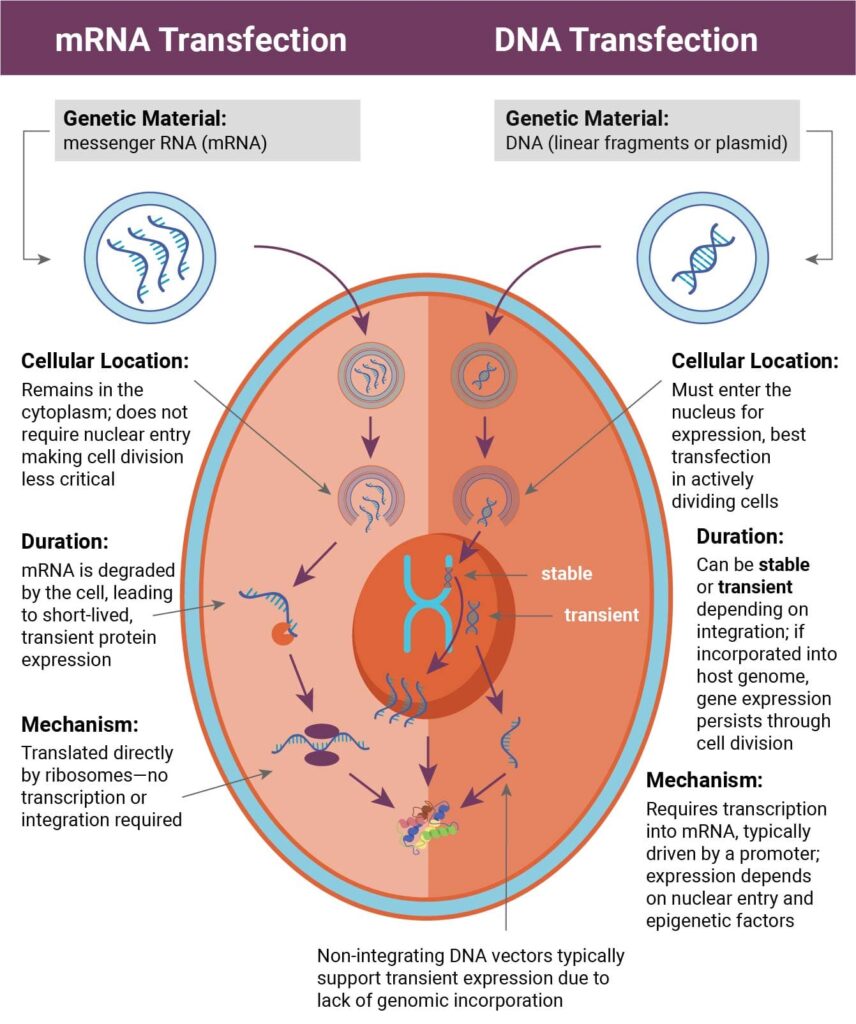
- DNA transfection typically involves plasmids or linear fragments that must traverse both the plasma membrane and the nuclear envelope. In dividing cells, the nuclear envelope breaks down during mitosis, enabling more efficient delivery. In contrast, non-dividing cells pose a challenge because DNA entry into the nucleus is limited. Once inside, gene expression is initiated from a promoter region, making expression levels heavily dependent on promoter strength, chromatin accessibility and epigenetic context. Expression may be transient or, if integrated into the genome, stable—though integration may carry risks such as insertional mutagenesis or silencing (1).
- mRNA transfection, on the other hand, bypasses the nucleus entirely. Synthetic or in vitro-transcribed mRNA is delivered directly to the cytoplasm, where it is translated into protein by ribosomes. No transcription is required, and there’s no need for promoter sequences or chromatin accessibility. Because expression is independent of the cell cycle, mRNA is ideal for non-dividing cells, including neurons, stem cells and other primary lines (1,2). mRNA delivery also offers more uniform expression and fine-tuned control: protein levels correlate directly with the amount of mRNA introduced (2).
mRNA’s non-integrating, transient nature makes it safer for therapeutic and gene editing applications—such as CRISPR or mRNA-based vaccines—while DNA is better suited for stable line creation, high-yield production, or complex multi-gene constructs (1).
| The table below summarizes the core differences between DNA and mRNA transfection (1,2): | Plasmid DNA | mRNA |
| Cell cycle dependence | Requires nuclear entry; best in dividing cells | Works in dividing and non-dividing cells |
| Onset of expression | 12–24 hours | 2–6 hours |
| Duration | Days to weeks; can generate stable lines | Hours to days; transient expression |
| Expression uniformity | Often mosaic | More even across cells |
| Titratability | Indirect (promoter strength) | Direct (mRNA dose) |
| Handling | Stable and easy to propagate | RNase-sensitive, requires careful storage |
| Integration risk | Possible | None |
Note: While mRNA expression is transient, it can support permanent changes in genome-editing workflows such as CRISPR (1,2).
Why Use mRNA? Top Advantages
- Speed and Control
- mRNA offers rapid protein expression—often within 2–6 hours. Because there is no transcription step, mRNA expression can be titrated based on the amount of RNA delivered, offering researchers control over protein output (2).
- Precision and Safety
- mRNA does not integrate into the genome, making it ideal for temporary applications. This is particularly advantageous in gene editing workflows, where limiting the duration of nuclease expression helps minimize off-target effects (2).
- Flexibility Across Cell Types
- mRNA is ideal for primary cells, non-dividing cells and hard-to-transfect models where nuclear delivery is inefficient (2).
- Ready-to-Use Format
- mRNA eliminates the need for stable line generation or viral packaging in many workflows (2).
- In Vivo Compatibility
- RNA transfection methods, particularly those involving lipid-based systems, have been successfully used in vivo to deliver genetic material in animal studies (2).
Challenges and Limitations of mRNA Transfection
Despite its advantages, mRNA transfection comes with some caveats:
- Transient Expression: mRNA expression typically lasts hours to a few days, limiting use in long-term studies (1,2).
- Handling Sensitivity: mRNA is susceptible to RNase degradation, requiring strict RNase-free handling and careful storage at –80°C (2).
- Lower Protein Yield per Cell: Because expression is proportional to the amount of mRNA delivered, yield may be lower than DNA in some contexts (1,2).
- Production and Cost: Unlike plasmid DNA, which can be easily propagated in bacteria and stored for repeated use, mRNA must be synthesized or purchased for each experiment—often at a higher initial cost (2).
Still, for many researchers, time savings, safety profile, and success in difficult cells make mRNA well worth it.
When to Use mRNA vs. DNA (1,2)
| Use Case | Choose mRNA if… | Use DNA if… |
| Cell type | Working with primary or non-dividing cells | Using immortalized, dividing lines |
| Speed | You need results in hours | You can wait 24+ hours |
| Expression Duration | You want short, controllable bursts | You need sustained or stable expression |
| Workflow | You want ready-to-use solutions without genome integration | You have plasmids and protocols ready |
| Safety | Avoiding genome integration is critical | Stable integration is desired |
A good rule of thumb: Start by asking, “What cells am I working with, and what do I need the expression to do?”
Practical Tips for mRNA Transfection
Handling Tips
- Keep it RNase-free: Use gloves, RNase-free tubes and filter tips (2).
- Optimize storage: Aliquot and store mRNA at –80°C. Avoid freeze-thaw cycles (2).
Optimization Tips
- Choose quality-modified mRNA: Look for transcripts with 5′ Cap 1, poly(A) tails, and chemically modified bases (e.g., pseudouridine, 5-methylcytidine) to enhance stability and translation efficiency (2).
- Titrate your dose: Start with a range of mRNA concentrations to find optimal expression (2).
- Use mRNA-specific reagents: For best results, use a reagent specifically optimized for mRNA delivery, such as the ViaScript™ mRNA Transfection Reagent from Promega (2).
Final Thoughts:
mRNA transfection offers a practical, flexible approach for applications where speed, safety and precise expression control matter most. With precise control, broad compatibility and faster timelines, mRNA opens doors to experimental designs that DNA alone can’t easily fulfill (1,2). With optimized solutions like ViaScript™ mRNA Transfection Reagent, Promega helps researchers bring the power of mRNA into their lab—safely, reliably and effectively.
Resources:
- Chong, Z. X., Yeap, S. K., & Ho, W. Y. (2021). Transfection types, methods and strategies: a technical review. PeerJ, 9. https://doi.org/10.7717/peerj.11165
- Transfection Guide | Overview of Transfection Methods | Promega. (n.d.). Www.promega.com. Transfection Guide | Overview of Transfection Methods | Promega

Latest posts by Shannon Sindermann (see all)
- The Parasite That Made Headlines This Summer: Cyclospora - September 29, 2026
- Why Antibiotic Resistance Is an Environmental Problem Too - July 28, 2026
- What Happens When You Delay an Ebola Vaccine Booster by 18 Months? - June 18, 2026