Every lab has it—that one thing that is always in short supply no matter how many you order. What is your lab’s “red sharpie”?
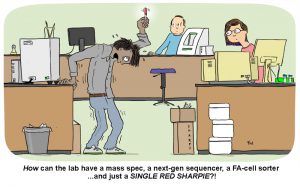
If you like this cartoon, there are more like it in our Cartoon Lab.
Every lab has it—that one thing that is always in short supply no matter how many you order. What is your lab’s “red sharpie”?
If you like this cartoon, there are more like it in our Cartoon Lab.
It began at a sink. Advancing from Dishwasher to Production Manager might seem like an unusual career path, but after speaking with Kris Pearson, the Custom/OEM Production Manager at Promega, it appears perfectly ordinary. I was thrilled to meet with her and discuss both the broad strokes and gritty details of working in Custom/OEM Manufacturing. Continue reading “Careers in Science: Kris Pearson, Custom/OEM Production Manager”
Not every lab has a tried and true transfection protocol that can be used by all lab members. Few researchers will use the same cell type and same construct to generate data. Many times, a scientist may need to transfect different constructs or even different molecules (e.g., short-interfering RNA [siRNA]) into the same cell line, or test a single construct in different cultured cell lines. One construct could be easily transfected into several different cell lines or a transfection protocol may work for several different constructs. However, some cells like primary cells can be difficult to transfect and some nucleic acids will need to be optimized for successful transfection. Here are some tips that may help you improve your transfection success.
Transfect healthy, actively dividing cells at a consistent cell density. Cells should be at a low passage number and 50–80% confluent when transfected. Using the same cell density reduces variability for replicates. Keep cells Mycoplasma-free to ensure optimal growth.
Transfect using high-quality DNA. Transfection-quality DNA is free from protein, RNA and chemical contamination with an A260/A280 ratio of 1.7–1.9. Prepare purified DNA in sterile water or TE buffer at a final concentration of 0.2–1mg/ml.
Continue reading “Improving the Success of Your Transfection”Antibiotic-resistant bacteria and their potential to cause epidemics with no viable treatment options have been in the news a lot. These “superbugs,” which have acquired genes giving them resistance to common and so-called “last resort” antibiotics, are a huge concern as effective treatment options dwindle. Less attention has been given to an infection that is not just impervious to antibiotics, but is actually enabled by them.
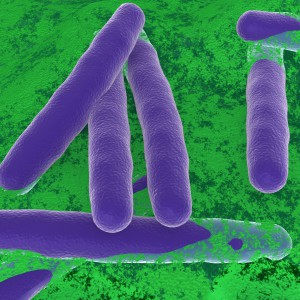
Clostridium difficile Infection (CDI) is one of the most common healthcare-associated infections and a significant global healthcare problem. Clostridium difficile (C. diff), a Gram-positive anaerobic bacterium, is the source of the infection. C. diff spores are very resilient to environmental stressors, such as pH, temperature and even antibiotics, and can be found pretty much everywhere around us, including on most of the food we eat. Ingesting the spores does not usually lead to infection inside the body without also being exposed to antibiotics.
Individuals taking antibiotics are 7-10 times more likely to acquire a CDI. Antibiotics disrupt the normal flora of the intestine, allowing C. diff to compete for resources and flourish. Once exposed to the anaerobic conditions of the human gut, these spores germinate into active cells that embed into the tissue lining the colon. The bacteria are then able to produce the toxins that can cause disease and result in severe damage, or even death.
Continue reading “Shining Light on a Superbug: Clostridium difficile” Another Independence Day is in the books, and for many of us in the U.S. it included spending time with friends, family, food and the traditional holiday fireworks. Around the world, fireworks add to the enjoyment of many annual celebrations and events. Their colorful visual and audio display has the ability to thrill us, no matter what age we are. Despite growing older I never seem to tire of fireworks; I’ve also noticed that with each passing year the show seems to get more sophisticated. Whether it be a new color or shape or design of firework, pyrotechnic technology seems to improve at an impressive rate.
That got me thinking… how do fireworks actually “work”? Basic chemistry and physics are clearly at play, so in the spirit of a science-related blog I decided to look into this and share what I’ve learned. Continue reading “The Science of Fireworks”
Forensic lab validations can be intimidating, so Promega Technical Services Support and Validation teams shared these tips for making the process go more smoothly.
Need more information about validation of DNA-typing products in the forensic laboratory? Check out the validation resources on the Promega web site for more information for the steps required to adopt a new product in your laboratory and the recommended steps that can help make your validation efforts less burdensome.
 Science is all around us— in everything we touch, smell, taste and see. It is in the flowers in our gardens, the molecules of pollen and oils that give those flowers scent, the crystals of sodium chloride that gives our food flavor and the way light is bent and changed to give our world color. There is science in the way we look like our great-great grandmother, and science in the way we are so different from each other. As the granddaughter of a forester and a botanist and the daughter of a science teacher, there has been science in my life for as long as I can remember. Recently my parents moved to a retirement home, and as I spent time helping them downsize, I took pictures of some of the ‘science’ that surrounded my as I grew up.
To start, there is “old brassy”, the first microscope I ever used. This microscope, and it’s slightly more modern cousin held places of honor on shelves in my father’s den.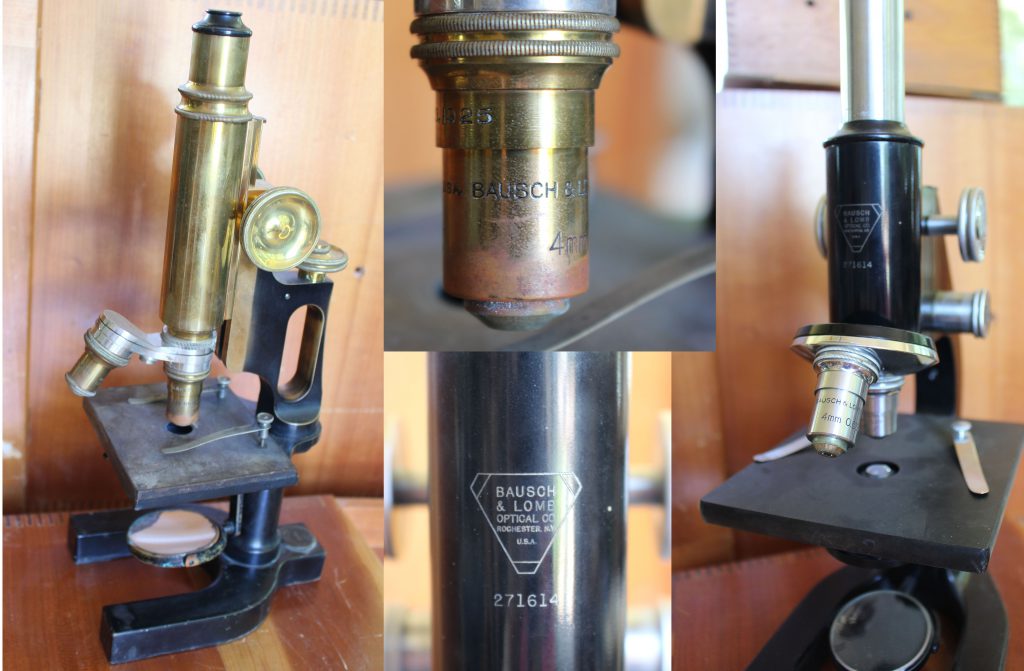
Held in wooden boxes next to the microscopes were test tubes containing all sorts of mysterious things, including samples gathered by my grandfather while he was a forester in Louisiana. Continue reading “Looking Back: Seeing the Science of My Childhood”
Today’s blog post is written by guest blogger Sarah Kolb, Marketing Coordinator for our North America Branch, and new employee at Promega.
As a new member to the North America Marketing team, I was unsure of what to expect going into my first national sales meeting with Promega, but what I took away from this meeting was incredibly eye opening. The North America Branch Sales meeting is an opportunity to get all of the members of the North American branch together to learn about new products, connect with the different strategic business units about product application and network with each other to learn how to better the lives of our customers. The year’s meeting occurred in May in the Ideation room at Promega Headquarters in Madison, Wisconsin.
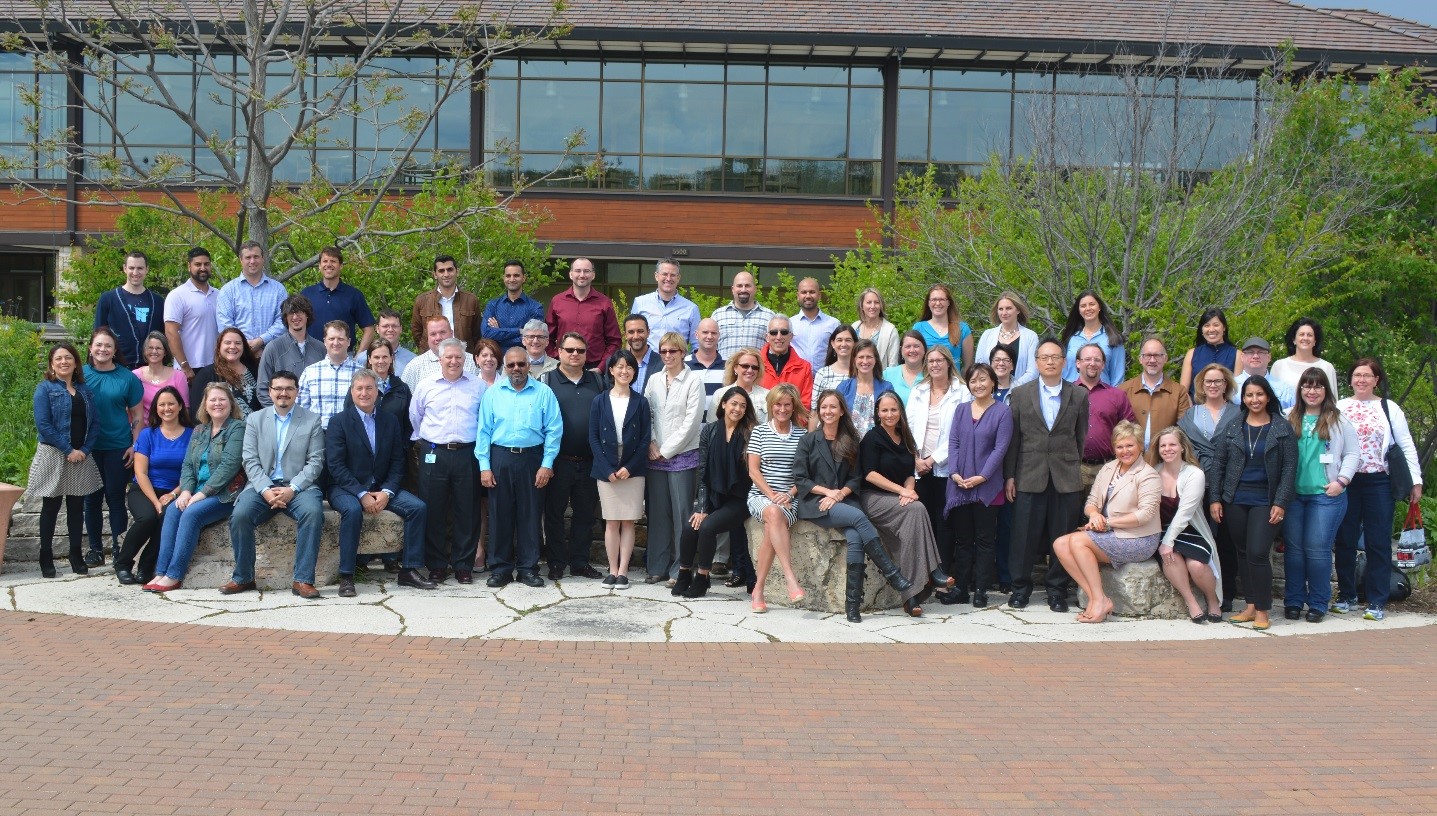
The room itself is not your typical conference space. An antique car resides in the space, and you can find art-work from all over world nestled in corners, and on the walls and shelves. All around the room, collections of unique furniture are arranged to stimulate conversation. Ideation created an atmosphere of creativity, community and collaboration, which contributed to the overall success of the meeting.
I felt excitement Monday morning as the 62 attendees gathered in the space. Everyone greeted each other with big smiles and hugs, asking about families, travels and already discussing business. Continue reading “What I Learned at My First Branch Meeting: Gratitude, Service and Collaboration”

Heteroplasmy is the presence of more than one mitochondrial genome within an individual. Perhaps the most famous example of the effect of mtDNA heteroplasmy on a forensic investigation is the identification of the remains of Tsar Nicholas II. mtDNA from bones discovered in a mass grave in 1991, was identical in sequence to known relatives of the Tsar except at one position, where there was a mixture of matching (T) and mismatching (C) bases. Lingering doubt caused by this result meant that confirmation of the authenticity of the remains was delayed. Ultimately mtDNA analysis provided the needed evidence for identification, showing that the same heteroplasmy was present in mtDNA extracted from bones of the Tsar’s brother, confirming the Tsar’s identity (Ivanov et al., (1996) Nature Genetics 12(4), 417-20).
Here is what Dr. Holland had to say about the work he will present at ISHI:
Continue reading “Previewing ISHI 27: Mitochondrial DNA Analysis in Forensic Investigations”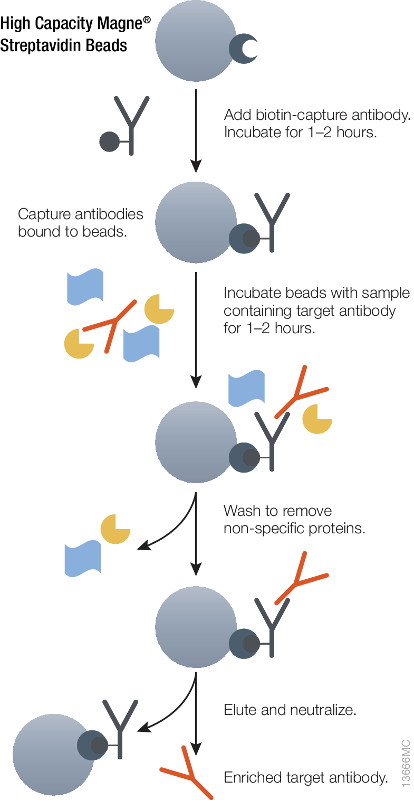
During preclinical research and development of therapeutic antibodies, multiple variants of each antibody are assessed for pharmacokinetic (PK) characteristics across model systems such as rodents, beagles and primates. Ligand-binding assays (LBA) or liquid chromatography coupled to tandem mass spectrometry(LC–MS/MS)-based methods represent the two most common technologies used to perform the PK studies for mAb candidates(1,2).
Using either method it is essential to ensure accurate quantitative results that the initial enrichment of the target therapeutic antibody from serum or plasma be optimal. Biotinylated antibodies or antigens (against the therapeutic targets) immobilized onto high capacity streptavidin beads will enrich therapeutic antibody from serum or plasma samples. The affinity of biotin for streptavidin (Kd = 10–15) is one of the strongest and most stable interactions in biology therefore the biotin-streptavidin interaction cannot be reversed under non-denaturing conditions. Hence, it is possible to perform extensive washing to remove nonspecifically bound protein and elute therapeutic antibodies without also eluting the biotinylated component, thus improving the detection limit.
Magnetic based separation techniques have several advantages in comparison with standard separation procedures. This process is usually very simple, with only a few handling steps. All the steps of the purification procedure can take place in one single test tube. The magnetic separation techniques are also the basis of various automated procedures. Learn more about the High Capacity Magne™ Streptavidin Beads (Cat # V7820) .
References