This guest blog post is written by Aisosa Omere, Product Marketing Intern at Promega.
Metabolic diseases fundamentally arise from disrupted cellular communication. In type 2 diabetes, cellular responsiveness to insulin is impaired. Within cancer, tumors alter their metabolic pathways to gain a proliferative advantage. In both conditions, dysfunction extends beyond individual molecules or pathways and involves a complex, interconnected network of metabolites, enzymes, and signaling molecules that dynamically respond to environmental changes. Traditional approaches to studying these networks often required a compromise: stopping experiments, lysing cells, and analyzing the resulting components. Although effective, this method is inherently limited. It captures a snapshot of what was present, rather than how the biology was actually behaving.
That compromise is becoming less necessary. The evolution of bioluminescent tools is changing what is possible. Some allow researchers to watch protein behavior and drug engagement directly in living cells in real time. Others offer faster, more sensitive detection of metabolites at physiologically relevant concentrations, and are compatible enough to run multiple assays from the same experiment, making coordinated, multi-pathway profiling practical in a standard lab setting.
An analysis of eighteen peer-reviewed publications from 2025 and 2026 shows just how quickly these approaches are taking hold across metabolic disease research. What follows explores the tools making this possible and why this shift represents one of the most consequential methodological changes in metabolic disease research in recent years.
This is the third post of three in a series leading up to the 16th annual International Forum on Consciousness, taking place in Madison this May. Hosted by the BTC Institute, Promega and Usona Institute, the forum gathers scientists, philosophers, and practitioners from dozens of different fields to investigate the nature of the mind. This year’s theme, “Unspoken Intelligence,” explores forms of perception and knowing that fall outside conventional cognition.
In 1845, mathematician Urbain Le Verrier calculated where an unseen planet had to be based on irregularities in Uranus’s orbit, wrote a letter to an observatory telling them where to point their telescope, and Neptune was there. He found a planet without ever looking up.
This is what third-person inquiry looks like at its best: observe from the outside, measure what anyone with the right instruments can measure, build a model precise enough to predict what no one has seen yet. Then look. The history of science is full of such moments, equations pointing to phenomena that hadn’t been detected, particles that hadn’t been observed, forces that hadn’t been measured. The method works because it is ruthlessly disciplined about what counts as evidence. The observer is removed, the conditions controlled, and the measurement trusted.
That discipline is not a limitation. It is the engine of over four centuries of extraordinary results. It gave us germ theory, the structure of DNA, and the sequenced human genome. Every time something seemed to resist physical explanation, the method eventually found the mechanism and the method held. The winning streak was long enough that the assumption underneath it stopped looking like an assumption. Outside-in, third-person, measurable evidence stopped looking like one way of knowing. It started looking like the definition of knowing itself.
The assumption felt safe because it had earned its confidence. Digestion, heredity, mental illness, each had seemed to resist physical explanation until it didn’t. The pattern was consistent enough that the method felt inevitable rather than chosen.
Then science turned toward consciousness, and the winning streak entered dangerous territory.
Here is the problem, what philosopher David Chalmers named the “hard problem” of consciousness in 1995.
To understand what Chalmers meant, it helps to start with his own illustration. When you see red, something measurable happens. Light hits the retina. Signals travel along the optic nerve. Specific regions of the visual cortex activate in patterns that neuroscientists can map with increasing precision. All of that is, in principle, fully describable by the third-person, outside-in approach. Given enough time and instruments, you can trace the whole sequence.
What you cannot describe from the outside is what red looks like. The redness of red, that specific quality of experience that exists only in the moment of seeing it, is not in the neural map. No better scanner will find it there, because the felt quality of the experience isn’t a physical thing hiding in the data. It exists only from the inside. The outside measurement, however precise, cannot reach it.
Chalmers used “hard” deliberately, in contrast to what he called the “easy problems” of consciousness: how the brain integrates information, focuses attention, produces behavior. Those are genuinely difficult, but the outside-in approach knows how to go after them. The hard problem is different in kind. It’s the question that remains even after you’ve solved all of the “easy” ones: why does any of it feel like anything at all?
Think of it this way: everything the brain does could, in principle, happen without any felt experience attached. Processing, responding, behaving, all of it could run like a machine in the dark, with no one home. The question Chalmers is asking is why it doesn’t. Philosophers ask it this way: why is there something it’s like to be you, right now, reading this?
No amount of outside-in evidence, however precise, touches that question, not because the science is insufficient but because the method was specifically designed to exclude first-person data. That exclusion was the whole point. It’s what made the outside-in approach so powerful everywhere else.
With consciousness, the method’s central design decision runs into a question it wasn’t built to answer: how do you study first-person experience when your method was built to exclude first-person data?
This is the second post in a series leading up to the 16th annual International Forum on Consciousness, taking place in Madison this May, hosted by the BTC Institute, Promega and Usona Institute. The Forum gathers scientists, philosophers, and practitioners from dozens of different fields to investigate the nature of the mind. This year’s theme, “Unspoken Intelligence,” explores forms of perception and knowing that fall outside conventional cognition.
When she thought about a dog, she saw a dog, more specifically, every dog she had ever encountered, cycling through her mind like a card catalog with pictures attached. She assumed everyone did this. When she discovered they didn’t, that most people access something more like an abstract concept hovering somewhere between language and image, she was genuinely surprised. Temple Grandin had always known her mind didn’t work the way people expected. What she didn’t know, until she was an adult, was the specific shape of the difference.
Most of us know this story, or one like it. We understand that some minds filter experience differently, but the science on this doesn’t stop where the conversation usually does.
For most of its history, the field that mapped minds like Grandin’s looked at those that didn’t fit the available systems and concluded the minds were broken. (It didn’t ask whether the systems were.) More recently, the conversation has been reframing those minds not as deficient but as different.
For many people, that reframing has been transformative, changing how educators teach, how clinicians diagnose, and how workplaces are designed. We are now more familiar with alternative cognitive profiles such as autistic pattern recognition (like that experienced by Grandin), ADHD-associated divergent thinking, and the hyper-focused depth of what researchers call monotropic attention. These are not broken versions of normal cognition. They are different architectures, each with genuine capabilities that other minds aren’t built to produce.
The terms most commonly used to describe these differences, neurotypical and neurdivergent, are useful shorthand but they describe a binary the underlying biology doesn’t support. Cognitive traits distribute across a population the way most biological traits do. “Neurotypical” minds are simply closer to the statistical center. What we call “neurodivergent” can be better understood as the part of that population that differs visibly enough from the statistical center to make the variation impossible to ignore.
This is the first post in a series leading up to the 16th annual International Forum on Consciousness, taking place in Madison this May, hosted by the BTC Institute, Promega and Usona Institute. The Forum gathers scientists, philosophers, and practitioners from dozens of different fields to investigate the nature of the mind. This year’s theme, “Unspoken Intelligence,” explores forms of perception and knowing that fall outside conventional cognition.
There’s a quote that travels well in some intellectual circles:
You don’t have a soul. You are a soul. You have a body.
There’s something genuinely relieving about that idea. It locates the real you somewhere above the fray, untouched by the body’s demands and indignities, the consciousness that thinks and persists while the body handles the inconvenient work of being hungry and tired and sick. The thinking part is what counts.
Plato thought something similar. So did Augustine. As did Descartes. Kant, too. The idea that the thinking self is separate from and superior to the body is Western civilization’s default setting.
It sounds like wisdom. It is also, I’ve come to think, exactly the wrong way to understand what we are.
Here’s a different text, one most millennials can recite from memory. In the opening verse of “Lose Yourself,” Eminem rattles off a visceral catalog of physical symptoms: sweaty palms, weak knees, heavy arms, vomiting. The body staging a complete revolt while the mind tries to execute a plan, until the moment on stage when the mouth opens and nothing comes out. The mind wanted to perform, but the body said no.
Nobody who has memorized those lyrics thinks of them as a description of embodied cognition. They file it under music, or nostalgia, or just a song they played too loud in a car they didn’t own. But the nervous system doesn’t care what you call it, because the body doesn’t catalogue in words.
This is the thing the soul-body quote gets wrong: the body isn’t a vehicle the self rides around in. It’s already thinking, already keeping score, already running a process the mind is only partially aware of. The question is what to do about that.
Despite its many mysteries, a chrysalis is one of the most familiar transformations in nature. We know what goes in. We know what comes out. For a long time, what happened in between was essentially invisible to us. Not because we weren’t curious, but because the mechanism was sealed inside something the size of a thumbnail, and we had no way in.
This same invisibility exists on a much older and much larger scale.
Sometime around two billion years ago, a cell swallowed a bacterium and, instead of digesting it, kept it alive inside itself. This process, called endosymbiosis, is arguably the single most consequential event in the history of complex life. The bacterium became a permanent resident, and over billions of years of co-evolution, it became something else entirely: the mitochondria that power every complex cell on earth. Without it, the living world as we know it doesn’t exist.
Scientists have known for decades that this kind of cellular acquisition had to have occurred. What has proved harder to explain is not that it happened, but how it started. What did the earliest molecular steps actually look like from the inside?
In the ocean, there is a microscopic single-celled organism called Rapaza viridis. It hunts algae by propelling itself through the water on whip-like appendages called flagella. That hunt may be showing us the beginning of a modern endosymbiosis: the same process that gave every complex cell its mitochondria and every plant its chloroplasts.
Kierkegaard observed that one of humanity’s enduring tensions is that while life can only be understood backwards, it must be lived forwards. It’s a truth medicine knows intimately: in the treatment that worked until it didn’t, the resistance that arrived without warning, the moment a doctor has to tell a patient that the drug that was helping has stopped. Not because anyone made a mistake, but because the critical knowledge that would have mattered arrived too late, if at all.
A recent paper from the National Cancer Institute is, in a small but meaningful way, science’s pursuit of that elusive foresight: an understanding that emerges early enough, for once, to change what happens next.
The Elegant Idea
For decades, chemotherapy has worked by brute force, flooding the body with toxins designed to kill rapidly dividing cells. The problem is that rapid division isn’t unique to cancer. Hair follicle cells, gut lining cells and immune cells also divide rapidly, which is why patients lose hair, lose energy and become susceptible to infection. Chemotherapy targets a behavior, but the drug has no way to tell a healthy cell from a cancerous one.
Antibody-drug conjugates (ADCs) change that. Instead of targeting what cancer cells do, they target what cancer cells are. Cancer cells tend to display certain proteins on their surface in far greater numbers than healthy cells do. The antibody is engineered to seek out those proteins specifically. It navigates to its target, binds and waits for the cell to do what cells routinely do: pull it inside. Once there, the cell’s own digestive machinery (the lysosome) breaks down the chemical tether holding the toxin to the antibody, releasing the toxin to kill the cell from within. More than a dozen ADCs have received FDA approval in recent years, and the field is evolving fast.
What the Cell Does Next
But cancer cells don’t simply accept their fate. Even when an ADC delivers its payload perfectly—the antibody finds its target, the cell pulls it inside, the lysosome cuts the tether—a pump embedded in the cell membrane can grab the released toxin and throw it back out before it causes damage.
The delivery worked. The package got ejected anyway.
These pumps—ATP-binding cassette transporters, or more plainly, efflux pumps—are a normal feature of cell biology. Their job is cellular housekeeping, clearing out unwanted or toxic substances before they cause damage. Under the pressure of drug treatment, cancer cells do what life has always done under pressure: the ones best equipped to survive do. The same mechanism that has shaped living things for billions of years now works against the treatment. Not all cancer cells are identical, and the ones that happen to produce more pumps survive while others don’t, gradually shifting the tumor toward resistance.
When people talk about places where science and technology tend to flourish, a few names surface almost immediately. Silicon Valley, Boston, Seattle, Houston. Cities associated with density, competition and speed.
For many people outside the state, Wisconsin still collapses into a short list of associations: beer, cheese, cold winters, maybe a football team. Biotechnology rarely makes that list.
That hesitation usually has less to do with science itself and more to do with assumptions about where innovation is supposed to live. National Wisconsin Day, celebrated February 15, is a good moment to look past those assumptions and consider what Wisconsin has quietly offered for a long time: an environment and culture that is well-suited for scientific advances.
If you’ve ever played The New York Times game Connections, you know the feeling. You’re staring at a grid of words, knowing the solution is there, but unable to see how the pieces fit together. All you can do is work with the words in front of you. There are no extra clues, no new information coming. The only option is to shuffle, to look at the same information in a different arrangement until patterns begin to appear.
Nothing about the problem changes. Then something about how you see it does.
In 2014, a third-year medical student named David Fajgenbaum checked himself into the emergency room mid-exam. He felt off. By the time anyone understood why, he was in the ICU with multiple organ failure from a disease so rare it wasn’t taught in medical school: Castleman disease. The only approved drug didn’t work. A priest came to his bedside and read him his last rites. He was 25.
Fajgenbaum survived that relapse, and four more after it. As he recounted in a recent episode of NPR’s Radiolab, he understood that chemotherapy was keeping him alive without curing him, and that waiting for a new drug to be developed (a process that typically takes 10 to 15 years and billions of dollars) wasn’t an option he had. So he did something unusual. He started asking his doctors to save his blood samples, and he ran experiments on himself.
What he found was that a specific signaling pathway in his immune system, mTOR, was in overdrive. When he searched the existing pharmacological literature for something that could block it, he found an answer that had been sitting in pharmacies for 25 years. Sirolimus, a drug approved in 1999 to prevent organ transplant rejection, had never been used for Castleman disease. The biology of his disease hadn’t changed. The drug had always existed. The connection simply hadn’t been made.
He took it. It worked. He has been in remission for over a decade.
The detail worth holding onto isn’t the drug or the disease. It’s the instinct. Fajgenbaum didn’t wait for new knowledge to arrive. He looked differently at what already existed.
As science advances, its most meaningful moments often come not in a single breakthrough, but in the accumulation of insights that reshape how we understand our world. As we close the door on 2025 it is worth pausing to reflect on some of the discoveries of the past year that stood out—not just for their technical achievement, but for what they reveal about our planet, our past and ourselves. From dismantling so-called “forever chemicals” to reading molecular histories written millions of years ago, these five stories offer a snapshot of the breadth, creativity and impact of modern scientific inquiry.
In 2022, Luiza Abdo traveled from her home in Rio de Janeiro, Brazil, to the United States to visit the Promega campus in Madison, WI. A PhD student at the time, Luiza was one of ten finalists for the inaugural Young Researchers Award sponsored by Promega Brazil.
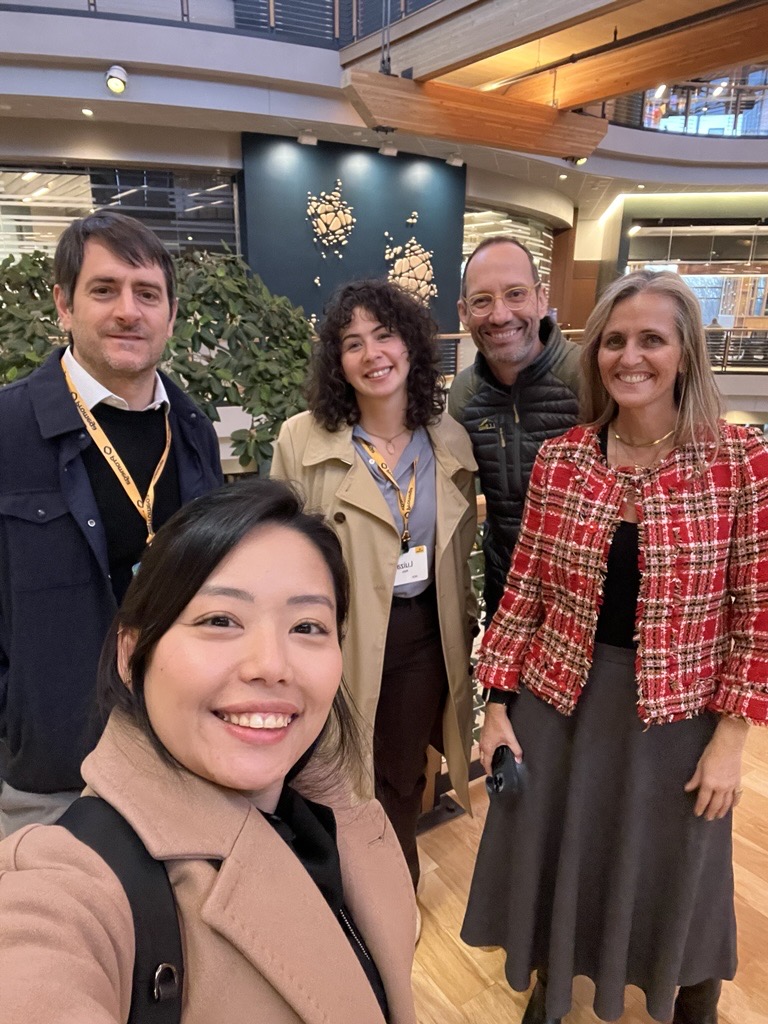
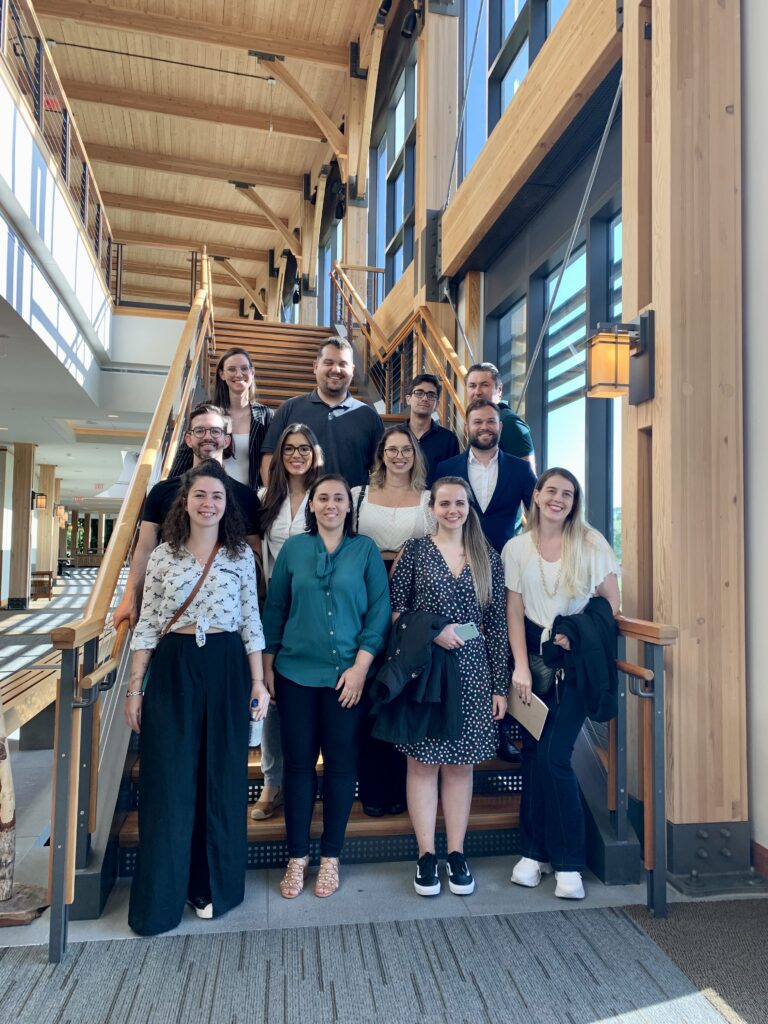
Luiza (center) visited Promega Madison in 2025 with Martin Bonamino (far left).
In 2025, Luiza was invited to Promega Madison once again, but this time she came as a customer and collaborator. Now a postdoctoral researcher at the Brazil National Cancer Institute, she was excited to return to Madison to discuss technologies that may help advance her project.
“Once I saw the Kornberg Center, I remembered everything from my last visit,” Luiza says. “It was one of the best travels I’ve ever had, and I made great friends.”
Luiza studies immunotherapy in the lab of Martin Bonamino, Head of Cell and Gene Therapy, at the National Cancer Institute. When she visited Promega in 2022, Luiza presented her project aimed at producing CAR-T cell therapies in under 24 hours. She and the other nine award finalists toured Promega facilities, networked with industry researchers, and went on adventures around the Madison area. They went to a baseball game, played sand volleyball against Promega employees and manipulated giant molecules in virtual reality.
“This was a different kind of visit. I’m here with my PI, and we learned several ways Promega technology can make our lives and research easier,” Luiza says in 2025. “The conversations are more specific to our field of work.”
Luiza (front row, left) visited Promega Madison in 2022 with 9 other Young Researchers Award finalists.
Today, she’s working on translating her CAR-T production methods into clinical applications. This visit introduced her to new technologies like cell fitness and metabolism assays that may help with this new phase. Promega researchers such as Julia Gilden joined to talk through challenges and solutions in cell therapy research.
“We’re making a new kind of product, which is very innovative, but we also have to prove a lot of different things to translate it to the clinic. We have many challenges, but we’ve found several ways Promega can help us solve our problems.”
Three years after her initial visit, Luiza says that visiting Promega has impacted not only her research, but also how she looks at her research field and potential career paths.
“My first visit was very good for me because I come from academic research, and we don’t have many interactions with industry. After touring Promega, I started to look at industry with new eyes. Even if I’m not working in an industry position, I see how there are people who can help with your needs, and work with you to solve problems.”
“I’m very happy to be here again,” she laughs. “I’m thankful to have this opportunity twice.”
XWe use cookies and similar technologies to make our website work, run analytics, improve our website, and show you personalized content and advertising. Some of these cookies are essential for our website to work. For others, we won’t set them unless you accept them. To learn more about our approach to Privacy we invite you to Read More
By clicking “Accept All”, you consent to the use of ALL the cookies. However you may visit Cookie Settings to provide a controlled consent.
We use cookies and similar technologies to make our website work, run analytics, improve our website, and show you personalized content and advertising. Some of these cookies are essential for our website to work. For others, we won’t set them unless you accept them. To find out more about cookies and how to manage cookies, read our Cookie Policy.
If you are located in the EEA, the United Kingdom, or Switzerland, you can change your settings at any time by clicking Manage Cookie Consent in the footer of our website.
Necessary cookies are absolutely essential for the website to function properly. These cookies ensure basic functionalities and security features of the website, anonymously.
Cookie
Duration
Description
cookielawinfo-checbox-analytics
11 months
This cookie is set by GDPR Cookie Consent plugin. The cookie is used to store the user consent for the cookies in the category "Analytics".
cookielawinfo-checbox-functional
11 months
The cookie is set by GDPR cookie consent to record the user consent for the cookies in the category "Functional".
cookielawinfo-checbox-others
11 months
This cookie is set by GDPR Cookie Consent plugin. The cookie is used to store the user consent for the cookies in the category "Other.
cookielawinfo-checkbox-advertisement
1 year
The cookie is set by GDPR cookie consent to record the user consent for the cookies in the category "Advertisement".
cookielawinfo-checkbox-necessary
11 months
This cookie is set by GDPR Cookie Consent plugin. The cookies is used to store the user consent for the cookies in the category "Necessary".
cookielawinfo-checkbox-performance
11 months
This cookie is set by GDPR Cookie Consent plugin. The cookie is used to store the user consent for the cookies in the category "Performance".
gdpr_status
6 months 2 days
This cookie is set by the provider Media.net. This cookie is used to check the status whether the user has accepted the cookie consent box. It also helps in not showing the cookie consent box upon re-entry to the website.
lang
This cookie is used to store the language preferences of a user to serve up content in that stored language the next time user visit the website.
viewed_cookie_policy
11 months
The cookie is set by the GDPR Cookie Consent plugin and is used to store whether or not user has consented to the use of cookies. It does not store any personal data.
Analytical cookies are used to understand how visitors interact with the website. These cookies help provide information on metrics the number of visitors, bounce rate, traffic source, etc.
Cookie
Duration
Description
SC_ANALYTICS_GLOBAL_COOKIE
10 years
This cookie is associated with Sitecore content and personalization. This cookie is used to identify the repeat visit from a single user. Sitecore will send a persistent session cookie to the web client.
vuid
2 years
This domain of this cookie is owned by Vimeo. This cookie is used by vimeo to collect tracking information. It sets a unique ID to embed videos to the website.
WMF-Last-Access
1 month 18 hours 24 minutes
This cookie is used to calculate unique devices accessing the website.
_ga
2 years
This cookie is installed by Google Analytics. The cookie is used to calculate visitor, session, campaign data and keep track of site usage for the site's analytics report. The cookies store information anonymously and assign a randomly generated number to identify unique visitors.
_gid
1 day
This cookie is installed by Google Analytics. The cookie is used to store information of how visitors use a website and helps in creating an analytics report of how the website is doing. The data collected including the number visitors, the source where they have come from, and the pages visted in an anonymous form.
Advertisement cookies are used to provide visitors with relevant ads and marketing campaigns. These cookies track visitors across websites and collect information to provide customized ads.
Cookie
Duration
Description
IDE
1 year 24 days
Used by Google DoubleClick and stores information about how the user uses the website and any other advertisement before visiting the website. This is used to present users with ads that are relevant to them according to the user profile.
test_cookie
15 minutes
This cookie is set by doubleclick.net. The purpose of the cookie is to determine if the user's browser supports cookies.
VISITOR_INFO1_LIVE
5 months 27 days
This cookie is set by Youtube. Used to track the information of the embedded YouTube videos on a website.
Performance cookies are used to understand and analyze the key performance indexes of the website which helps in delivering a better user experience for the visitors.
Cookie
Duration
Description
YSC
session
This cookies is set by Youtube and is used to track the views of embedded videos.
_gat_UA-62336821-1
1 minute
This is a pattern type cookie set by Google Analytics, where the pattern element on the name contains the unique identity number of the account or website it relates to. It appears to be a variation of the _gat cookie which is used to limit the amount of data recorded by Google on high traffic volume websites.