When I first learned about Mendel and his garden peas, I was fascinated. I was amazed that Mendel developed the proposals of dominant and recessive inheritance of traits from a single “factor” called a gene simply from looking at the segregation patterns of traits like flower and pea pod color. I probably also romanticized the idea of a monk peacefully crossing garden peas.
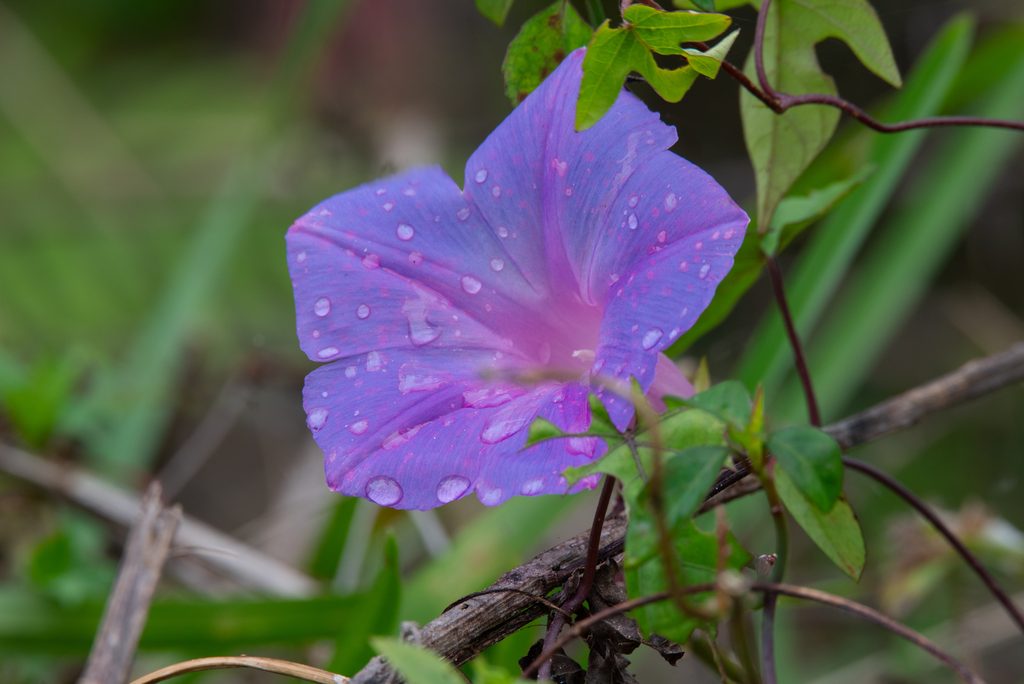
Recently, I encountered a plant genetics paper that investigated anthocyanin-based pigmentation in the Ivy-leaf morning glory, published by Hernandez and colleagues in Heredity (1). This study began with an observation of one family of the Ivy-leaf morning glory that had white flowers and had no visible anthocyanin-derived pigments on any part of the plant (2). Now, this one white-flowered Ivy-leaf morning glory has allowed the description of a mutation that eliminates the production of anthocyanins without affecting upstream branches of the anthocyanin pathway, giving scientists a way to understand the role of anthocyanins in plants.
The Role of Anthocyanins
Anthocyanins are more than just purple-blue pigments contributing to the landscape. They promote tolerance to high levels of UV radiation, and genes involved in anthocyanin synthesis are often upregulated in plants in drought conditions. Loss of anthocyanins in an entire plant is typically rare in plant populations. Most known “white flower” mutations disrupt the synthesis pathway at an early step and affect other branches from the anthocyanin synthesis pathway, such as flavonol biosynthesis. Because multiple synthetic pathways are affected by these early mutations, scientists cannot ask what effect losing only anthocyanins has on the plant. To look specifically and only at the loss of anthocyanins, a mutation is needed that affects the final step of the anthocyanin pathway and not anything upstream.
Investigating a Rare Mutation
To investigate the rare find of an Ivy-leaf morning glory that had no visible anthocyanin pigmentation, the researchers first performed traditional Mendelian crosses. They started with parental strains, one pigmented line and the one unpigmented line described above. The immature anthers from the pigmented plant were removed from an unopened flower bud, and pollen from the unpigmented parent was transferred to the pigmented parent’s stigma. Thirteen successful crosses produced F1 generation seeds. The F1 plants were allowed to self-pollinate, and F2 seeds collected. In the F2 population, 28.5% of the offspring were unpigmented, suggesting that the unpigmented phenotype is a homozygous, recessive trait.
Molecular Biology Supports the Hypothesis
To find which gene is responsible for the recessive white flower trait, the researchers turned to RNA-seq to look at differential expression between white and purple flowers. They found that expression of the g2417 gene of the Ivy-leaf morning glory was absent in white flowers and present in purple flowers, and it was the only gene in the anthocyanin biosynthesis pathway that was differentially expressed between white and purple flowers. This gene most closely matches the anthocyanidin 3-O-glucosyltransferase gene, IhUF3GT1, in tomato. Genomic analysis confirmed that the parental, unpigmented line has an up to 7kb deletion in the region within and upstream of the IhUF3GT1 gene, suggesting complete loss of function.
Tying the Mutation to the Phenotype
To determine if the deletion mutation of IhUF3GT1 (g2417) co-segregated with the unpigmented phenotype, the researchers performed endpoint PCR of unpigmented plants in an F3 population of plants. No unpigmented plants contained the wildtype IhUF3GT1 sequence, and all 36 pigmented plants carried the gene.
Summary
Mendel worked out the rules of inheritance by counting peas. More than 150 years later, counting offspring was still the first step in solving the mystery of a white morning glory. The F2 ratio revealed that the researchers were probably looking for a single recessive gene. RNA-seq and genome sequencing then pointed to the gene and the deletion. Finally, a straightforward PCR on the next generation showed that the deletion and the white phenotype travel together.
The result is more than curiosity. Because this mutation blocks only the final step of anthocyanin production, these plants give researchers a way to study what anthocyanins do on their own, from UV protection to drought tolerance. That knowledge could matter for related plants, including sweet potato.
It turns out the romance of a monk in a garden isn’t just nostalgia. Careful observation and simple crosses still have a place alongside our newest tools.
Promega Products Used in This Work
GoTaq® Green Master Mix was used for the endpoint PCR confirmation experiment.
Literature Cited
- Hernandez, D.J., Glasgow, E., Li, M.C. et al. (2026) A rare deletion of IhUF3GT1 in the Ivy-leaf morning glory eliminates anthocyanin-based pigmentation. Heredity. https://doi.org/10.1038/s41437-026-00898-7
- Henry GA, Stinchcombe JR (2023) G-matrix stability in clinally diverging populations of an annual weed. Evolution 77:49–62. https://doi.org/10.1093/evolut/qpac005
Drafted by a human writer, human and AI assistance with review.



Michele Arduengo, PhD
Latest posts by Michele Arduengo, PhD (see all)
- What a Rare White Morning Glory Reveals about Anthocyanin Genetics - November 19, 2026
- Can GLP-1 RAs Help Me Live Longer? Well… - September 17, 2026
- What Can We Do to Make Your Work Easier? Addressing the Challenges of Working with Primary Antibodies - September 15, 2026
