Introduction
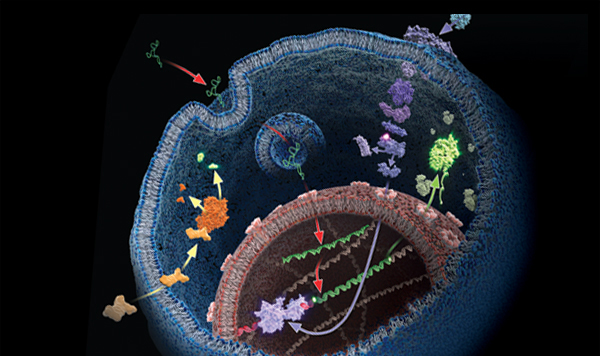
Detecting and isolating proteins is challenging when they’re expressed at low native abundance, lack good antibodies, or localize to complex subcellular compartments. Promega developed HaloTag® technology to address these challenges. The system is quite simple. A HaloTag® protein fusion tag is added to your protein of interest, which can be paired with one of many interchangeable ligands to form a highly specific covalent bond. The range of synthetic ligands includes chemical probes, affinity handles, and fluorescent dyes.
Beyond the ligand binding, HaloTag itself functions as a powerful foothold for protein isolation studies. The Magne® HaloTag® Beads enable magnetic capture and isolation of a protein of interest with minimal non-specific binding, supporting clean downstream pull-downs and purification.
Below I highlight an exciting publication that demonstrates the power of HaloTag in enriching phosphotyrosine peptides, a classically challenging area of proteomics.
Utilizing HaloTag for Phosphotyrosine Enrichment
Tyrosine phosphorylation is an important regulator of proliferation, differentiation, migration, and tissue organization, despite being far less abundant than serine and threonine phosphorylation. Its importance is reflected in the success of tyrosine kinase inhibitors as cancer therapies. However, enrichment for phosphotyrosine has historically been very challenging. The most successful prior approach used a recombinant Src SH2 superbinder (sSrc), expressed in E. coli, that enables mapping of phosphotyrosine in a variety of contexts. Beads conjugated with sSrc require multi-step conjugation chemistry and a complicated workflow that takes days of hands-on effort.
To address these workflow challenges, Chang et al. developed a method called rapid robotic Halo-sSrc peptide-level phosphotyrosine enrichment (R2HaPpy) (Chang et al., 2026). This approach integrated HaloTag to enable single-step covalent conjugation directly from E. coli lysate. The authors fused HaloTag to the N-terminus of the Src SH2 superbinder in an E. coli expression vector, combining sSrc purification and conjugation into a single step. The simple workflow included mixing Magne® HaloTag® beads with crude E. coli lysate containing overexpressed Halo-sSrc, then washing away unbound material with PBS.
More Enrichment and Faster Workflow with R2HaPpy
The authors found that their R2HaPpy conjugation was successful. Bead prep took only 1–2 hours compared to the standard 3-day process. R2HaPpy also yielded much more phosphotyrosine enrichment compared to NHS-sSrc beads, which the authors attributed to the improved stabilization of sSrc by fusing to HaloTag, along with the site-specific, single-point conjugation attained through HaloTag.
The streamlined process also meaningfully lowered costs. Preparing 96 enrichments cost a little over $500, compared to $2,600 to as high as $30,000 for other approaches. Part of these savings were attributed to the lower cost of the Magne® HaloTag® beads relative to other magnetic beads. Additionally, they found their Halo-sSrc beads were stable for over four months, giving more confidence in their longevity as a tool.
When it came to analyzing phosphotyrosine sites, the authors used EGF signaling as a model system. EGFR (the receptor for EGF) is a prominent cancer drug target, so a large library of previously mapped phosphotyrosine sites was available as a reference. HeLa cells were stimulated with EGF and harvested after 1, 3, 5, or 15 minutes. Enriched phosphopeptides were then analyzed by mass spectrometry (LC-MS/MS). Using R2HaPpy the authors were able to identify 1651 unique phosphotyrosine sites, which the authors noted was the largest temporal phosphotyrosine dataset of EGF stimulation at the time of publication. R2HaPpy required less input peptide (1.3 mg vs. 2–5 mg for label-free data acquisition), quantified time-resolved EGF signaling at the protein level , being 8 quantified sites compared to 4 with FE-IMAC (Fe3+ immobilized metal affinity chromatography) and identified 10 times more sites per replicate compared to the EasyAb antibody-based enrichment method. The authors also noted that they found 70 phosphotyrosine sites in total that had not been previously reported in any public database, demonstrating novel insights from their methodology.
The Flexibility of HaloTag
This paper highlights some of the key advantages of integrating HaloTag into experimental workflows. The authors largely attributed their success to the site-specific, single-point conjugation that HaloTag provides. That’s a meaningful differentiator in a market with many tagging platforms. This paper demonstrates the value of HaloTag in protein purification and mass spectrometry workflows. Further highlighting its flexibility and strength as a multifunctional protein tagging technology.
HaloTag has capabilities beyond just protein purification. For example, the use of fluorescent ligands enables imaging of proteins tagged with HaloTag. Promega offers a suite of fluorescent ligands for imaging, including Janelia Fluor® ligands for advanced imaging techniques, such as super resolution microscopy. Learn more about HaloTag® technology.
Citations
Chang, A. T., Rodriguez-Mias, R. A., Berg, M. D., Moggridge, S., & Villén, J. (2026). Scalable phosphotyrosine enrichment with SH2 superbinder enables deep profiling of EGF responses. EMBO Journal, 45(15), 5556–5579. https://doi.org/10.1038/s44318-026-00843-8

Latest posts by Simon Moe (see all)
- Simplifying Protein Purification with HaloTag® Technology - October 29, 2026
- New Approach Methodologies: Guidelines for Biological Ground Truths - July 16, 2026
- Beyond the Liver: How Liposomal LNPs Are Expanding the Reach of mRNA Delivery - May 5, 2026
