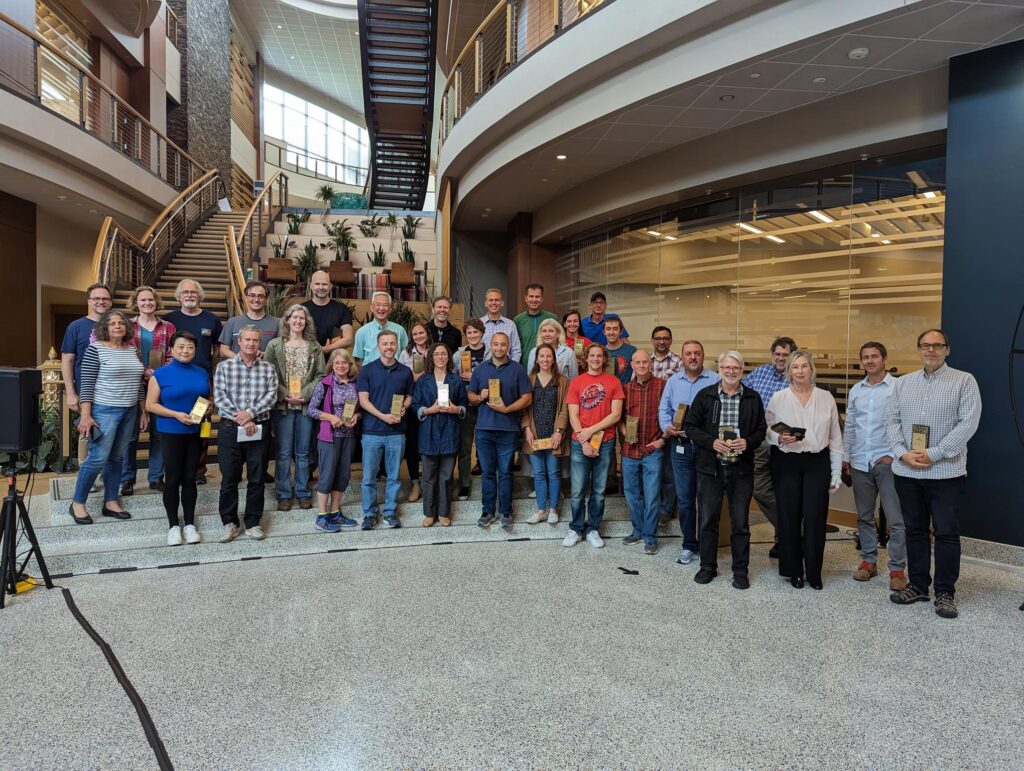
“We are a company that is built upon innovation, and R&D is one of the main drivers of that,” says Frank Fan, Director of Biology at Promega.
Promega Research and Development is focused on developing reliable tools that address the biggest problems facing life scientists. However, our R&D scientists do much more than just develop products. Promega scientists regularly pursue basic research to curate new skills and knowledge and collaborate extensively with researchers across academia and industry. This work fuels major advancements in areas like targeted genome editing, drug discovery, and genetic identity.
In June 2023, our Research and Development department gathered to recognize Promega scientists who have published peer-reviewed papers or patents. This was the first time the department had held this event since 2019, and in that time 71 scientists have published research in journals like Nature and Cell. 16 of those scientists published 10 or more times, and several were also invited to contribute review articles and book chapters.
In addition, Promega also recognized seven researchers with the title “Distinguished Scientist.” This award was intended to recognize scientists who are at the top of their game in both advancing and communicating science. Their work includes protein engineering, chemical biology, neuroscience and much more.
The Distinguished Scientists were selected for having an i10 index above 25 since 2018. This indicates that the scientist has more than 25 publications that have been cited 10+ times in the past five years, as measured by Google Scholar. As VP of R&D Poncho Meisenheimer said, “This award is truly from the scientific community. This is a recognition that your scientific peers see your work as valuable.”
Here is the list of Promega researchers recognized as Distinguished Scientists and some of their recent high-impact papers.
Lance Encell
Lance Encell is a Senior Research Scientist in the Advanced Technology Group. His research focuses on protein design and engineering, and he was a co-author on the original papers describing HaloTag Protein labeling and NanoLuc Luciferase alongside others from this list.
Recent Papers:
- “Novel NanoLuc substrates enable bright two-population bioluminescence imaging in animals” Nature Methods, 2020
- “Evaluating brightness and spectral properties of click beetle and firefly luciferases using luciferin analogues: identification of preferred pairings of luciferase and substrate for in vivo bioluminescence imaging” Molecular Imaging and Biology, 2020
- “Click beetle luciferase mutant and near infrared naphthyl-luciferins for improved bioluminescence imaging” Nature Communications, 2018
Learn more about NanoLuc technology
Jim Cali
Jim Cali is a Director of Research in the Assay Design group. His research focuses on cell health, metabolism, cell signaling, and much more. In 2006, he co-authored a paper describing the use of luminogenic substrates to measure Cytochrome P450 activity, which led to the launch of P450-Glo.
Recent Papers:
- “A direct capture method for purification and detection of viral nucleic acid enables epidemiological surveillance of SARS-CoV-2” Science of the Total Environment, 2023
- “A real-time, bioluminescent annexin V assay for the assessment of apoptosis” Apoptosis, 2019
- “Time- and dose-dependent toxicity studies in 3D cultures using a luminescent lactate dehydrogenase assay” Detection of Cell Death Mechanisms: Methods and Protocols, 2021
Inhong Hwang
Inhong Hwang is a Research Scientist at Promega Biosciences, Inc. in San Luis Obispo, CA. A recent addition to Promega R&D, Inhong brings experience and expertise in chemistry and chemical biology.
Recent papers:
- “Fluorescent copolymer aggregate sensor for lithium chloride” Chemical Science, 2023
- “Strapped calix[4]pyrroles: From syntheses to applications” Chemical Society Reviews, 2020
- “Determinants of ion-transporter cancer cell death” Chem, 2019
Thomas Kirkland
Thomas Kirkland is a Senior Scientific Investigator in the Advanced Technology Group. His broad scope of research includes enzyme design, bioluminescence imaging and organic chemistry.
Recent papers:
- “An optimized bioluminescent substrate for non-invasive imaging in the brain” Nature Chemical Biology, 2023
- “Fatal neurodissemination and SARS-CoV-2 tropism in K-18-hACE2 mice is only partially dependent on hACE2 expression” Viruses, 2022
- “Toward a point-of-need bioluminescence-based immunoassay utilizing a complete shelf-stable reagent” Analytical Chemistry, 2021
Hear Thomas talk about his recent publication in Nature Chemical Biology
Matt Robers
Matt Robers is a Senior Research Scientist in the Integrated Biology Group. His research primarily focuses on target engagement and endogenous biology, and he has many significant publications on kinase drug discovery.
Recent papers:
- “KRAS is vulnerable to reversible switch-II pocket engagement in cells” Nature Chemical Biology, 2022
- “NanoClick: A high throughput, target-agnostic peptide cell permeability assay” ACS Chemical Biology, 2021
- “Quantifying target occupancy of small molecules within living cells” Annual review of biochemistry, 2020
Hear Matt talk about revealing new strategies for targeting undruggable proteins in cancer
Thomas Machleidt
Thomas Machleidt is the Director of the Advanced Technology Group. His work spans many fields including bioinformatics, enzyme design, proteomics and in vivo biology.
Recent papers:
- “Streamlined target deconvolution approach utilizing a single photoreactive chloroalkane capture tag” ACS Chemical Biology, 2021
- “A simple and scalable strategy for analysis of endogenous protein dynamics” Scientific Reports, 2020
- “The luminescent HiBiT peptide enables selective quantitation of G protein-coupled receptor ligand engagement and internalization in living cells” Journal of Biological Chemistry, 2020
Marjeta Urh
Marjeta Urh is the Director of the Protein and Nucleic Acid Analysis Group. She is involved in research including reporters, surface technologies, mass spec, proteomics, purification and more. She has recently co-authored several important papers on targeted protein degradation including PROTAC analysis.
Recent papers:
- “Trivalent PROTACs enhance protein degradation via combined avidity and cooperativity” Nature Chemical Biology, 2021
- “CDK family PROTAC profiling reveals distinct kinetic responses and cell cycle-dependent degradation of CDK2” SLAS Discovery, 2021
- “Targeted protein degradation phenotypic studies using HaloTag CRISPR/Cas9 endogenous tagging coupled with HaloPROTAC3” Current Protocols in Pharmacology, 2020
Stevens Rehen
Stevens Rehen is a visiting researcher in Kornberg Center. He is a Brazilian neuroscientist who is a Professor at the Institute of Biology at the Federal University of Rio de Janeiro (UFRJ) and a researcher at the D’Or institute. He is a pioneer in developing neurospheres and brain organoids to study diseases like Zika virus as well as the effects of psychedelic compounds such as psilocybin.
Recent papers:
- “Morphological, cellular, and molecular basis of brain infection in COVID-19 patients” Proceedings of the National Academy of Sciences, 2022
- “Zika virus infection leads to mitochondrial failure, oxidative stress and DNA damage in human iPSC-derived astrocytes” Scientific Reports, 2020
- “hiPSC-derived neural stem cells from patients with schizophrenia induce an impaired angiogenesis” Translational Psychiatry, 2018