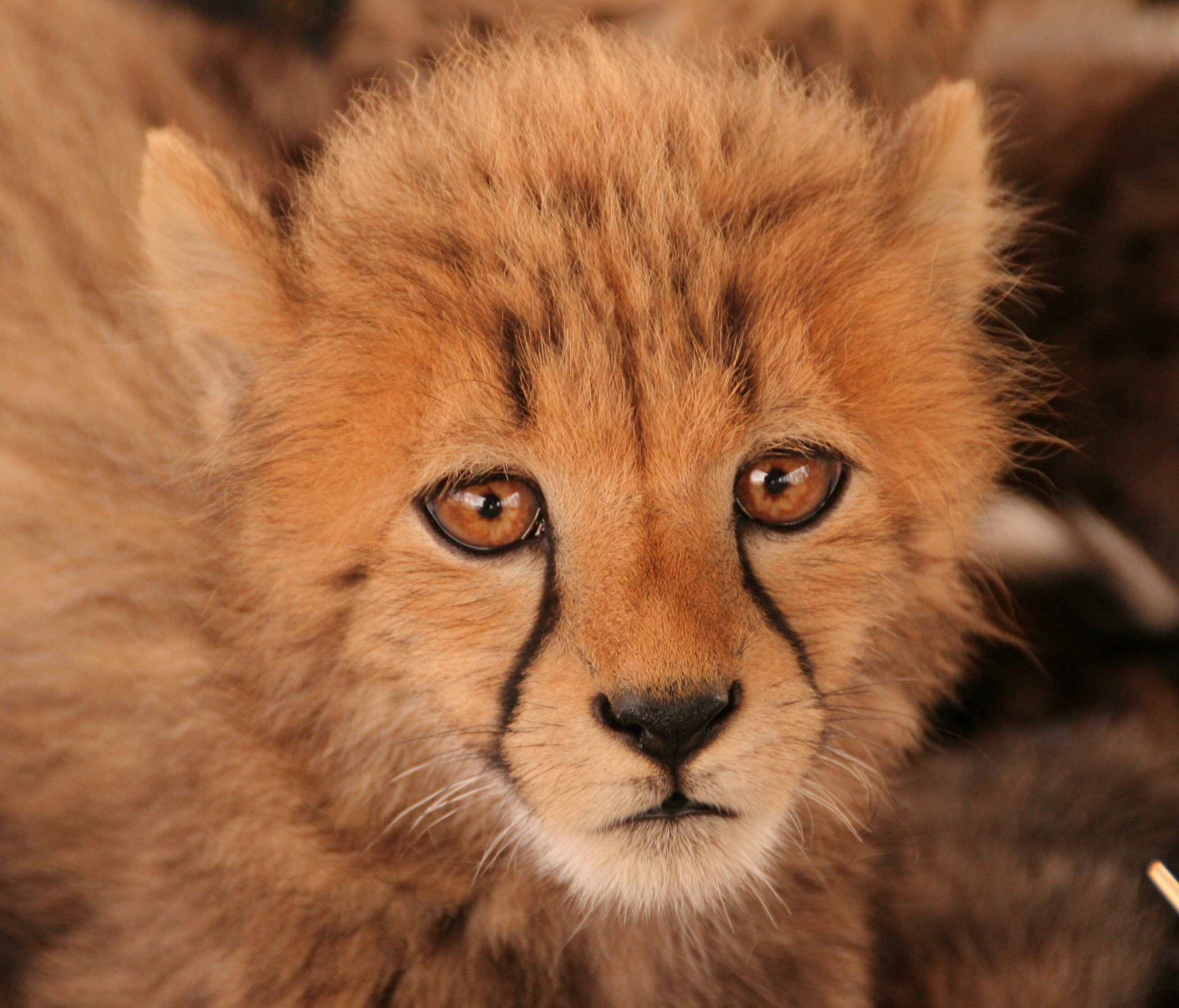
Don’t Judge a Cheetah by Its Spots: New Insights into the Genetics and Evolutionary History of African and Asiatic Cheetahs

The genetics of wild cheetah (Acinonyx jubatus) populations has a special significance for me. In fact, it could be said that the population genetics of cheetahs changed my life.  I first learned about the low genetic variability in cheetahs in a darkened lecture hall at Iowa State University in 1988. I was so fascinated by what I learned in those lectures about genetics and its importance in conservation efforts that I eventually changed my major to Genetics.  “The Cheetah Papers” as a colleague calls them, were, and perhaps still are, common teaching tools for biology and genetics classes. And why not? The results were amazingly cool, if a bit disturbing. Imagine a population that, through a series of natural events over thousands of years, had become so genetically similar to one another as to be almost clonal.

Still, if science teaches us nothing else, it teaches us that there is always more to the story. Continue reading “Don’t Judge a Cheetah by Its Spots: New Insights into the Genetics and Evolutionary History of African and Asiatic Cheetahs”

Recycle or Compost? Sorting Out the Cornstarch from the Plastic

This image generated by AI.

Environmental concerns have driven people to seek products that are not derived from petroleum. This has translated into people using products from renewable resources for serving food and beverages. Now you are drinking iced tea out of corn plastic cups or coffee from paper cups labeled as ecofriendly. What does this label mean and what do you do with them when you have consumed your beverage?

Continue reading “Recycle or Compost? Sorting Out the Cornstarch from the Plastic”

Lab Equipment Today: Kitchen Gadget Tomorrow?

The Latest in Cooking Equipment

My husband likes to cook and he also likes to collect kitchen gadgets. Mushroom slicers, blenders, numerous graduated vials and measuring devices, meat thermometers, etc., our kitchen drawers are overflowing with the essentials for precision cooking. For each culinary process, there is a unique device, and he uses them all. I do not even know what some of them are for. I only use knives and measuring cups. But his cooking is way better than mine so there is obviously some benefit to using the right tools well.

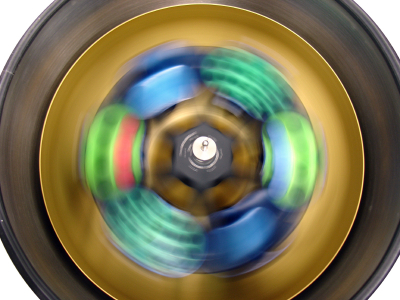
Some of the most sophisticated kitchen tools come straight from the laboratory. I was interested to read an article in the March 2011 issue of Scientific American describing how high-speed centrifuges are among the newest trends in fancy kitchen equipment. They are being used in restaurants to separate ingredients into their component parts and create potent flavorings. It turns out that centrifugation is a fast and convenient way to purify fat from various vegetables and nuts, creating interesting flavored butters and dairy-free creams (think pea butter or essence of carrot). Centrifugation is a fast alternative to straining or filtering as a means of separating components.

Continue reading “Lab Equipment Today: Kitchen Gadget Tomorrow?”

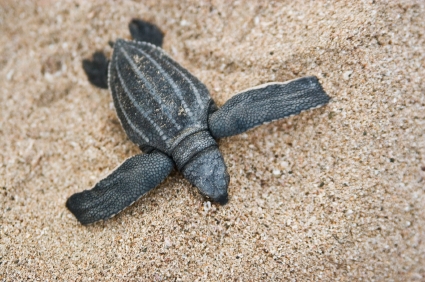
Satellites and Sea Turtles: Can We Save the Last Member of the Genus Dermochelys?

Let me start out by saying: I love sea turtles.  I can’t explain why, but they fascinate me. I have sweatshirts, bags and artwork with sea turtles on them. I even make jewelry with sea turtle themes. Ask anyone who knows me; I have a thing for sea turtles. So when I came across the article “Tracking leatherback turtles from the world’s largest rookery: Assessing threats across the South Atlantic” in the Proceedings of the Royal Society B (1), all thoughts of writing about anything else were readily dismissed. How could I NOT write about leatherback sea turtles? Continue reading “Satellites and Sea Turtles: Can We Save the Last Member of the Genus Dermochelys?”

Sailing: Relaxing Pastime or Dangerous Sport?

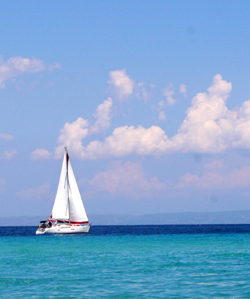
SailboatSailing has always struck me as a civilized, relaxing way to spend a beautiful summer day. I imagine sitting on the boat’s deck in a sundress with a big floppy hat to keep the sun off of my face, a cold beverage in hand and perhaps a picnic basket of sandwiches at my feet. What could be more tranquil than gently gliding along the water’s rippling surface, with just enough of a breeze to keep you cool on a hot sunny day?

That’s how I envision sailing, and it will be obvious to many of you from this description that I do not sail. However, my husband and many of my friends do, and they tell a very different account, especially during a race: Sailors quickly moving around the deck, tackling and subduing unruly spinnakers, dodging booms and other hazards, and in general just trying not to fall overboard, especially on those days when it is blowing 20 (translation for us nonsailors: days with 20-mile-per-hour winds). Thus, a recent paper in the December issue of the journal Wilderness & Environmental Medicine caught my attention (1). In it, the authors report the frequency and types of injuries sustained by sailors while sailing. Those of you who sail will not be surprised by the findings, but I was. Sailing is more dangerous than I imagined. Continue reading “Sailing: Relaxing Pastime or Dangerous Sport?”

When a Cold, Wet, White Nose Isn’t a Good Thing

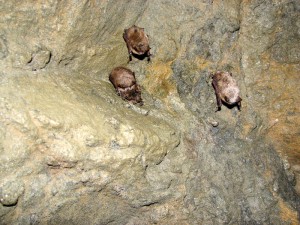
Affected bats in a cave in MA. Image courtesy of the U.S. Geological Survey.

On February 16, 2006, a recreational caver exploring Howes Cave in Albany, New York, photographed a bat with an unusual white growth on its muzzle. In the few years since that picture was snapped, hundreds of thousands of bats in North America have died from White-Nose Syndrome (WNS; 1,2).

The disease affects hibernating populations of bats, and has been found in the northeastern and eastern United States, as far south as Tennessee, as well as in the Canadian provinces of Quebec and Ontario (2).

Some suffering bats are emaciated with little or no body fat and have a characteristic white fungal growth on their wing membranes, ears and muzzles, hence the name “White-Nose Syndrome.” Instead of hibernating all winter, these bats can be seen active in the snow, when there is virtually no food available for them (1,2).

The white fungal growth observed on the bats is the result of infection with a previously undescribed cold-loving fungus,

Continue reading “When a Cold, Wet, White Nose Isn’t a Good Thing”

Mate Selection at Frog Cocktail Parties: Keep it Short, Low, Loud, and Stand Out from the Crowd (Oh, and have a colorful vocal sac, too)

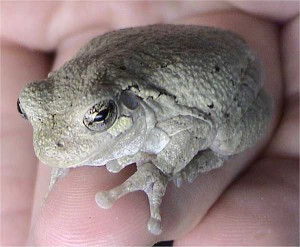
Hyla versicolor (Copes grey treefrog) Photo credit: LA Dawson wikipedia

When I lived in Sioux City, IA, I had the opportunity of hanging out with a zoologist who studied the Plains Spadefoot Toad (Spea bombifrons). I would go out with her on nighttime listening surveys, and we would slowly drive the gravel farm roads in the middle of nowhere, weaving from one side to the other as we dodged hopping frogs and toads, and I would be amazed as the clamor of these calling anurans rattled my eardrums.

Just last week in Madison, as I took my lunchtime walk, I passed by a roadside wetland, and my ears filled with the calls of Chorus frogs, singing with all their one-inch might in hopes of attracting a mate. And, later that evening, as my daughter and I weeded our garden at home, I heard the crisp bell trill of two American toads carrying over the chorus frogs in the neighborhood.

Congresses of snoring Spadefoot Toads. In-your-face Copes Gray Tree Frogs. Peepers, Chorus Frogs and and Leopard Frogs. The evenings are noisy when the temperatures moderate and these frogs and toads come out to call. The din of the local roadside wetland begins to resemble the din of the local roadside bar, in more ways than one as it turns out.

Continue reading “Mate Selection at Frog Cocktail Parties: Keep it Short, Low, Loud, and Stand Out from the Crowd (Oh, and have a colorful vocal sac, too)”

An Interview with Ed Himelblau, Scientist and Promega Cartoonist

Self portrait by Ed Himelblau

Many visitors to the Promega Web site enjoy the Cartoon Lab, the repository of the creative illustrations of Ed Himelblau updated several times a year. Recently, I had a chance to gain some insight about the man behind the cartoons.

Sara Klink: Could you give some background information about yourself?
Ed Himelblau: I was born in Chicago but grew up in San Diego. I went to UCSD [University of California at San Diego] and majored in biology and minored in art. I liked molecular biology and working in labs so I decided to go to grad school. I went to the University of Wisconsin at Madison to get a Ph.D. in the Cell and Molecular Biology program. My first academic job was teaching biology at Southampton College in New York. After several years on Long Island, I moved to my current job teaching and doing research in the Biological Sciences Department at Cal Poly [California Polytechnic State University] in San Luis Obispo, CA.

S.K.: Why did you decide to become a scientist?
E.H.: Playing in tidepools as a kid had something to do with it. As an undergraduate I thought working in a lab sounded cool. When I started working in a lab, I thought the work was interesting and the people were a lot of fun to be around. Then I started to appreciate what it really meant to do experiments and learn about how plants grow and develop.

Continue reading “An Interview with Ed Himelblau, Scientist and Promega Cartoonist”

Use Parallel Structure to Guide the Reader

computer_keyboard

Parallel construction signals to the reader that two ideas are of equal importance. If two or more ideas or items are connected by a coordinating conjunction such as “and”, “but” or “or”, then those ideas should be expressed in parallel or equivalent grammatical constructs. Items and ideas of equal importance should be presented using equivalent grammatical structures. Items in a list should be parallel: all verbal phrases, all nouns, etc. Parallel construction guides your reader and helps your reader organize concepts on a first read of your text.

Continue reading “Use Parallel Structure to Guide the Reader”

Analogues

People who know me well have, at some point, heard me hold forth on the subject of Antarctica. It’s a passion of mine, though I’ve never been there. The forgotten continent is like the Sirens, pulling those who dare to trespass upon the ice back to one of the bleakest places on Earth.

I have consumed many accounts of life there, and have configured my internet services to deliver me news reports that deliver little crumbs of information. Anything that mentions Antarctica crosses my screen.

My fascination derives from boyhood dreams of space. Young visions of piloting starships and traversing Martian landscapes – visions of adventure, glory, and alien encounters – shattered in daylight on a January day in 1986 as I sat cross-legged on an elementary school gymnasium floor. It would be years before I saw 2001: A Space Odyssey, but watching the Challenger disintegrate into a fiery end, I immediately understood one of its central lessons: space is not glamorous, glorious, or any more alien than many of the places on our planet. Space is cold, unemotional, and unforgiving. It is intolerant of error, and it is lonely. And despite these things, it is where any future humans can hope to have must lie.

I will never go into orbit, but Antarctica, that’s the next best thing. Cold. Unforgiving. Intolerant of error. Nearly devoid of life except that which we import and resupply, it is where we troubleshoot the logistical problems of sustaining remote and isolated human colonies. Having spread across six other continents, it is our last terrestrial frontier.

No, I will never float among celestial bodies and listen to the low murmur of the universe rippling deep in the dark silence of space. But there is another place where we pursue science, a place closer to home, where I can be cold and alone and maybe catch a stray shard of a broken childhood dream.