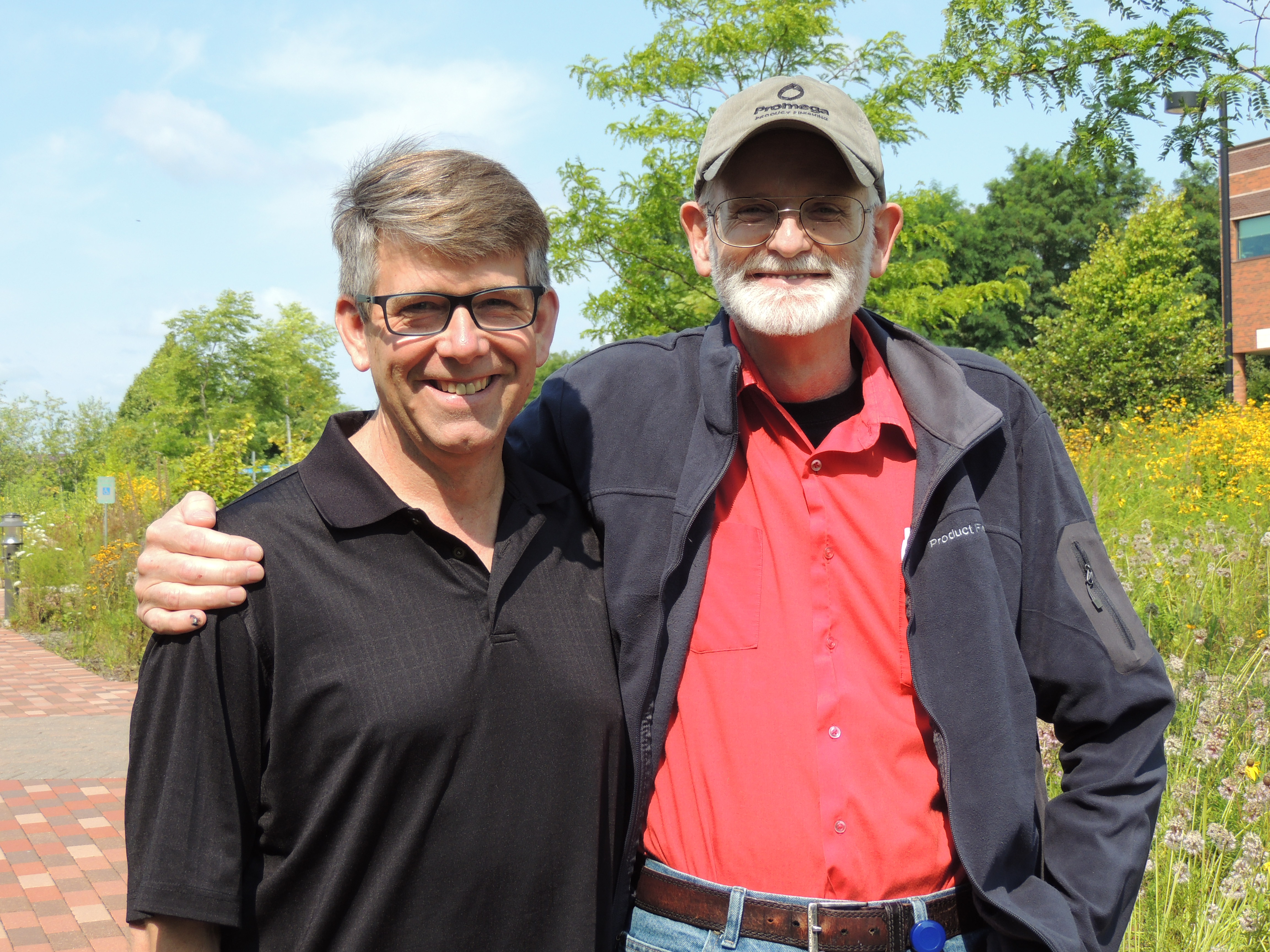
John Van Herwynen, Promega Senior Production Scientist, and Jim Stevens, Product Finishing Project Coordinator, on the Promega Madison campus one year after John donated one of his kidneys to Jim.
This article was jointly written by science writer, Nicole Sandler, and Corporate Affairs Communication Specialist, Karen Burkhartzmeyer.
One year ago, on September 14, 2016, two people once connected only through the common denominator of their workplace began sharing a bond that very few people ever experience. That was the day that Jim Stevens, Product Finishing Project Coordinator at Promega Madison, received a kidney from living donor John Van Herwynen, a Promega Senior Production Scientist. The last year, full of emotional successes but also some challenging setbacks, is one that has transformed both of their lives. Organ donor and organ recipient are marking today’s important milestone by sharing their remarkable story. Continue reading “One Year Later: Living Organ Donor & Recipient Share Their Story”
Promega has become the first major forensic manufacturer to achieve third party certification of the published ISO 18385 standard to minimize the risk of human DNA contamination in products used to collect, store and analyze biological material for forensic purposes.
On February 2, 2016, ISO 18385:2016 was published as the first international standard specific to the forensic manufacturing community. Since the standard was published, companies have begun to self-declare that they comply with the ISO standard. Some companies have gone a step further and reached out to Certification Bodies to provide an unbiased and independent assessment their compliance to ISO18385 through a third-party audit.
When consumers see an ‘ISO 18385 Forensic Grade’ labeled product, it should inspire confidence that the product was produced in accordance with a minimum set of criteria common to all manufacturers.
Fascinating bioluminescent organisms floating on dark waters of the ocean. Polychaete tomopteris.
Today’s blog comes to you from the Promega North America Branch Office.
In nature, the ability to “glow” is actually quite common. Bioluminescence, the chemical reaction involving the molecule luciferin, is a useful adaptation for many lifeforms. Fireflies, mushrooms and creatures of the ocean deep use their internal lightshows to cope with a variety of situations. Used for hunting, communicating, ridding cells of oxygen, and simply surviving in the darkness of the ocean depths, bioluminescence is one of nature’s more flashy, and advantageous traits.
In new research published in April in the journal Scientific Reports, MBARI researchers Séverine Martini and Steve Haddock found that three-quarters of all sea animals make their own light. The study reviewed 17 years of video from Monterey Bay, Calif in oceans that descended to 2.5 miles, to determine the commonality of bioluminescence in the deep waters.
Martini and Haddock’s observations concluded that 76 percent off all observed animals produced some light, including 97 to 99.7 cnidarians (jellyfish), half of fish, and most polychaetes (worms), cephalopods (squid), and crustaceans (shrimp).
Most of us are familiar with the fabled anglerfish, the menacing deep-sea creature known for attracting ignorant prey with a glowing lure attached to their head. As you descend below 200 meters, where light no longer penetrates, you will be surprised at the unexpected color display of the oceans’ sea life. Bioluminescence is not simply an exotic phenomenon, but an important ecological trait that the oceans’ sea creatures have wholeheartedly adopted to cope with complete darkness.
While many proteases are used in bottom-up mass spectrometric (MS) analysis, trypsin (4,5) is the de facto protease of choice for most applications. There are several reasons for this: Trypsin is highly efficient, active, and specific. Tryptic peptides produced after proteolysis are ideally suited, in terms of both size (350–1,600 Daltons) and charge (+2 to +4), for MS analysis. One significant drawback to trypsin digestion is the long sample preparation times, which typically range from 4 hours to overnight for most protocols. Achieving efficient digestion usually requires that protein substrates first be unfolded either with surfactants or denaturants such as urea or guanidine. These chemical additives can have negative effects, including protein modification, inhibition of trypsin or incompatibility with downstream LC-MS/MS. Accordingly, additional steps are typically required to remove these compounds prior to analysis.
Each luminescent assay plate represents precious time, effort and resources. Did you know that there are three things about your detection instrument that can impact how much useful information you get from each plate? Instruments with poor sensitivity may cause you to miss low-level samples that could be the “hit” you are looking for. Instruments with a narrow detection range limit the accuracy or reproducibility you needed to repeat your work. Finally, instruments that let the signal from bright wells spill into adjacent wells allow crosstalk to occur and skew experimental results, costing you time and leading to failed or repeated experiments.
Today’s Promega Connections blog is written by guest blogger Rachel H. Oefelein, QA Manager/Senior DNA Analyst at DNA Labs International.
Shakespeare said, “The evil that men do lives after them; the good is oft interred with their bones.” This is continually true in the case of unidentified remains throughout the United States. The action of a person going missing or the events leading to an individual’s demise are frequently the memory that haunts a town or the media for years to come. However, for each such case, somewhere lies a set of skeletal remains not yet found, or just as tragic, recovered but still unidentified. The National Missing and Unidentified Persons System (NamUs) estimates approximately 40,000 sets of unidentified skeletal remains linger in morgues around the country or that have been cremated and buried as Jane and John Does.
Many crime labs do not have protocols in place for the extraction of DNA from skeletal remains or have outdated protocols for bone extraction that are not sensitive enough for poor quality bones. Bones are often recovered from harsh environments and have been exposed to extreme heat, time, acidic soil, swamp, chemicals treatment, etc. These harsh environmental conditions degrade the DNA present in the remains which further complicates the already difficult procedure of releasing the DNA in cells buried deep within the bone matrix. Another challenge is that cases often involve recovery of skeletal remains in areas with animal activity, water recoveries and scenes involving explosions or fires; these case types may require re-association of dozens if not hundreds of bones and bone fragments.
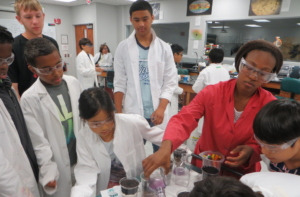
The On the Road (OTR) BTC Institute Biotechnology Field Trips (BFT) program is rolling right along! We are doing our best to brave the winter weather to take hands-on science activities all over the state of Wisconsin.
The BTC Institute BFT program served over 3,400 students last year, most of them here at the BTC in Fitchburg. That said, each year the OTR part of the program is growing in order to serve schools that cannot travel here for various reasons, such as distance, bus costs and the need to minimize out-of-school time.
In 2014, Promega created a special incentive to reward field science consultants who help the scientific community take advantage of our on-site stocking program. The winners had to meet ambitious criteria to receive 2 round-trip tickets to anywhere in the world, a week of paid vacation and spending money. Our four winners will share photos and stories about their journeys on the Promega Connections Blog.
Today’s travelogue is Part II of the adventures of Amy Parman, a regional sales manager, who used her award to travel to Ecuador and the Galapagos Islands.
Day 7: Urbina Bay, Isabela Island & Punta Mangle, Fernandina Island – Today was another early morning wake up, this time to the soothing strains of Journey. We had a quick breakfast and jumped in the dinghy for an exploratory ride. We passed a tree full of so many pelicans covering the branches that they looked as though they could be fruit, ripe for the picking. Our dinghy slowly passed many more sea turtles, golden cownose rays, small eagle rays, marine iguanas and Sally Lightfoot crabs (stunningly red against the black lava).
We also came across several sea lions sleeping away the morning in a comfy mangrove branch bed. More striated herons were perched in the mangroves hunting fish below and three playful sea lion pups swam right up to our feet dangling over the dinghy as if to say, “jump out and play with us.” Bayron said they are likely around ten months old and their mother has left them in the protected bay while she goes out to fish.
Sea lion pup in Urbina Bay, Isabela Island.
After the ride, we had a chance to snorkel for a couple of hours and did, in fact, swim right along with a very fast and playful sea lion. The sea lions were pretty big, and seemed even more so when we were in the water with them. It was quite the experience to have him dart all around us while we swam. Marine iguanas were also swimming with us and clinging to the lava eating seaweed off the rocks about eight feet deep. There were loads of fish all around and by now we’ve had a few shark sightings among the group. Interestingly, the shark species around the Galapagos, while numerous, do not regard humans as a food source. It has become a tour goal to find as many as we can and, while a challenge, we do catch glimpses of the hammerheads and reef sharks that are never too far away. Continue reading “Travelogue Galapagos Part II: An Incredible Experience in Paradise”
Researchers and clinicians are fairly certain that all cervical cancers are caused by Human Papillomavirus (HPV) infections, and that HPV16 and HPV18 are responsible for about 70% of all cases. HPV16 and HPV18 have also been shown to cause almost half the vaginal, vulvar, and penile cancers, while about 85% of anal cancers are also caused by HPV16.
E6 is a potent oncogene of HR-HPVs, and its role in progression to malignancy continues to be explored. The E6 oncoprotein of HPV can promote viral DNA replication through several pathways. It forms a complex with human E3-ubiquitin ligase E6-associated protein (E6AP), which can in turn target the p53 tumor-suppressor protein, leading to its ubiquitin-mediated degradation. In particular, E6 from HR-HPVs can block apoptosis, activate telomerase, disrupt cell adhesion, polarity and epithelial differentiation, alter transcription and G-protein signaling, and reduce immune recognition of HPV-infected cells.
Today’s blog is from BTCI Instructor and guest blogger Jackie Mosher.
Shoot for the moon. Even if you miss, you’ll land among the stars. —Norman Vincent Peale
This motivational quote has echoed throughout my life from childhood. It has inspired me to be fearless in dreaming, to be ambitious and to reach for those goals without fearing failure. So, naturally at the ripe age of 10, my goal was to become a scientist and discover a cure to both AIDS and cancer with a secondary plan of becoming this nation’s first female President. However, as I grew older, I realized my genuine interest and excitement for science and that I enjoyed not only learning about various scientific concepts but also sharing this information with others. Therefore, I completed a Bachelor’s of Science degree with a major in Molecular Biology and minor in Chemistry and decided to continue my studies as a graduate student at UW-Madison in the Cancer Biology graduate program. My goal was to graduate and aid in disseminating scientific knowledge.
XWe use cookies and similar technologies to make our website work, run analytics, improve our website, and show you personalized content and advertising. Some of these cookies are essential for our website to work. For others, we won’t set them unless you accept them. To learn more about our approach to Privacy we invite you to Read More
By clicking “Accept All”, you consent to the use of ALL the cookies. However you may visit Cookie Settings to provide a controlled consent.
We use cookies and similar technologies to make our website work, run analytics, improve our website, and show you personalized content and advertising. Some of these cookies are essential for our website to work. For others, we won’t set them unless you accept them. To find out more about cookies and how to manage cookies, read our Cookie Policy.
If you are located in the EEA, the United Kingdom, or Switzerland, you can change your settings at any time by clicking Manage Cookie Consent in the footer of our website.
Necessary cookies are absolutely essential for the website to function properly. These cookies ensure basic functionalities and security features of the website, anonymously.
Cookie
Duration
Description
cookielawinfo-checbox-analytics
11 months
This cookie is set by GDPR Cookie Consent plugin. The cookie is used to store the user consent for the cookies in the category "Analytics".
cookielawinfo-checbox-functional
11 months
The cookie is set by GDPR cookie consent to record the user consent for the cookies in the category "Functional".
cookielawinfo-checbox-others
11 months
This cookie is set by GDPR Cookie Consent plugin. The cookie is used to store the user consent for the cookies in the category "Other.
cookielawinfo-checkbox-advertisement
1 year
The cookie is set by GDPR cookie consent to record the user consent for the cookies in the category "Advertisement".
cookielawinfo-checkbox-necessary
11 months
This cookie is set by GDPR Cookie Consent plugin. The cookies is used to store the user consent for the cookies in the category "Necessary".
cookielawinfo-checkbox-performance
11 months
This cookie is set by GDPR Cookie Consent plugin. The cookie is used to store the user consent for the cookies in the category "Performance".
gdpr_status
6 months 2 days
This cookie is set by the provider Media.net. This cookie is used to check the status whether the user has accepted the cookie consent box. It also helps in not showing the cookie consent box upon re-entry to the website.
lang
This cookie is used to store the language preferences of a user to serve up content in that stored language the next time user visit the website.
viewed_cookie_policy
11 months
The cookie is set by the GDPR Cookie Consent plugin and is used to store whether or not user has consented to the use of cookies. It does not store any personal data.
Analytical cookies are used to understand how visitors interact with the website. These cookies help provide information on metrics the number of visitors, bounce rate, traffic source, etc.
Cookie
Duration
Description
SC_ANALYTICS_GLOBAL_COOKIE
10 years
This cookie is associated with Sitecore content and personalization. This cookie is used to identify the repeat visit from a single user. Sitecore will send a persistent session cookie to the web client.
vuid
2 years
This domain of this cookie is owned by Vimeo. This cookie is used by vimeo to collect tracking information. It sets a unique ID to embed videos to the website.
WMF-Last-Access
1 month 18 hours 24 minutes
This cookie is used to calculate unique devices accessing the website.
_ga
2 years
This cookie is installed by Google Analytics. The cookie is used to calculate visitor, session, campaign data and keep track of site usage for the site's analytics report. The cookies store information anonymously and assign a randomly generated number to identify unique visitors.
_gid
1 day
This cookie is installed by Google Analytics. The cookie is used to store information of how visitors use a website and helps in creating an analytics report of how the website is doing. The data collected including the number visitors, the source where they have come from, and the pages visted in an anonymous form.
Advertisement cookies are used to provide visitors with relevant ads and marketing campaigns. These cookies track visitors across websites and collect information to provide customized ads.
Cookie
Duration
Description
IDE
1 year 24 days
Used by Google DoubleClick and stores information about how the user uses the website and any other advertisement before visiting the website. This is used to present users with ads that are relevant to them according to the user profile.
test_cookie
15 minutes
This cookie is set by doubleclick.net. The purpose of the cookie is to determine if the user's browser supports cookies.
VISITOR_INFO1_LIVE
5 months 27 days
This cookie is set by Youtube. Used to track the information of the embedded YouTube videos on a website.
Performance cookies are used to understand and analyze the key performance indexes of the website which helps in delivering a better user experience for the visitors.
Cookie
Duration
Description
YSC
session
This cookies is set by Youtube and is used to track the views of embedded videos.
_gat_UA-62336821-1
1 minute
This is a pattern type cookie set by Google Analytics, where the pattern element on the name contains the unique identity number of the account or website it relates to. It appears to be a variation of the _gat cookie which is used to limit the amount of data recorded by Google on high traffic volume websites.
 Promega has become the first major forensic manufacturer to achieve third party certification of the published ISO 18385 standard to minimize the risk of human DNA contamination in products used to collect, store and analyze biological material for forensic purposes.




 This motivational quote has echoed throughout my life from childhood. It has inspired me to be fearless in dreaming, to be ambitious and to reach for those goals without fearing failure. So, naturally at the ripe age of 10, my goal was to become a scientist and discover a cure to both AIDS and cancer with a secondary plan of becoming this nation’s first female President. However, as I grew older, I realized my genuine interest and excitement for science and that I enjoyed not only learning about various scientific concepts but also sharing this information with others. Therefore, I completed a Bachelor’s of Science degree with a major in Molecular Biology and minor in Chemistry and decided to continue my studies as a graduate student at UW-Madison in the Cancer Biology graduate program. My goal was to graduate and aid in disseminating scientific knowledge.
