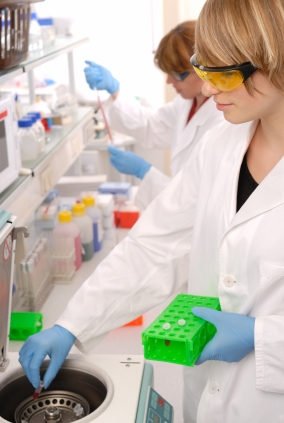
I wondered what “thanksgiving” looks like to the research scientist. So I asked:
What are the things you are thankful for in science?
The answers have been as varied as the people I talked to ranging from little things like water bath floats to really big things, like the renewal of your research funding or achieving tenure.
Here are some of the answers from my informal inquiries:
“Tube floaties for water baths.”
—E.V., genomics product manager
“I was always thankful for Geiger counters.”
—K. G., science writer
“Thermal cyclers and Taq Polymerase. As an undergrad I watched someone sit with a timer and move their tubes between water baths at 3 different temperatures, opening tubes and adding polymerase at the end of each cycle. Modern PCR is SOOO much easier.”
—M.M., research scientist
“I am thankful for competent cells. I remember preparing the CaCl2 and doing slow centrifugation. Also thankful for serum-compatible transfection, rapid ligations and online journal access (no longer have to traipse over to the university library to get papers photocopied- uuurrrgggghhh).”
—R.D., technical services scientist
“How about T-vectors for cloning? I was no molecular biologist, but could make a T-vector work.”
—K.K., science writer
“I am thankful for open-access journals and the ability to read the full article without an institutional subscription.”
—S.K., science writer
“I am ever so thankful for ONLINE ORDERING! So awesome. Throw in online technical manuals, on-line support tools, on-line calculators – all are awesome!!”
—A.P., director, scientific courses
“I am thankful for automated sequencing- manual sequencing was laborious and hazardous!!!”
—R.G., technical services scientist
Do any of these resonate with you? What are you thankful for as a scientist? Let us know in the comments.



Michele Arduengo, PhD
Latest posts by Michele Arduengo, PhD (see all)
- Can GLP-1 RAs Help Me Live Longer? Well… - September 17, 2026
- What Can We Do to Make Your Work Easier? Addressing the Challenges of Working with Primary Antibodies - September 15, 2026
- From Chromosomes to the Brain: How HaloTag Is Expanding What We Can See - August 25, 2026