Whether it’s Home Alone’s booby-trapped icy steps, Bambi learning his legs have zero traction, or an Ice Age chase scene defying gravity, ice has been comedy gold for decades. In real life, the joke lands a little harder (sometimes literally).
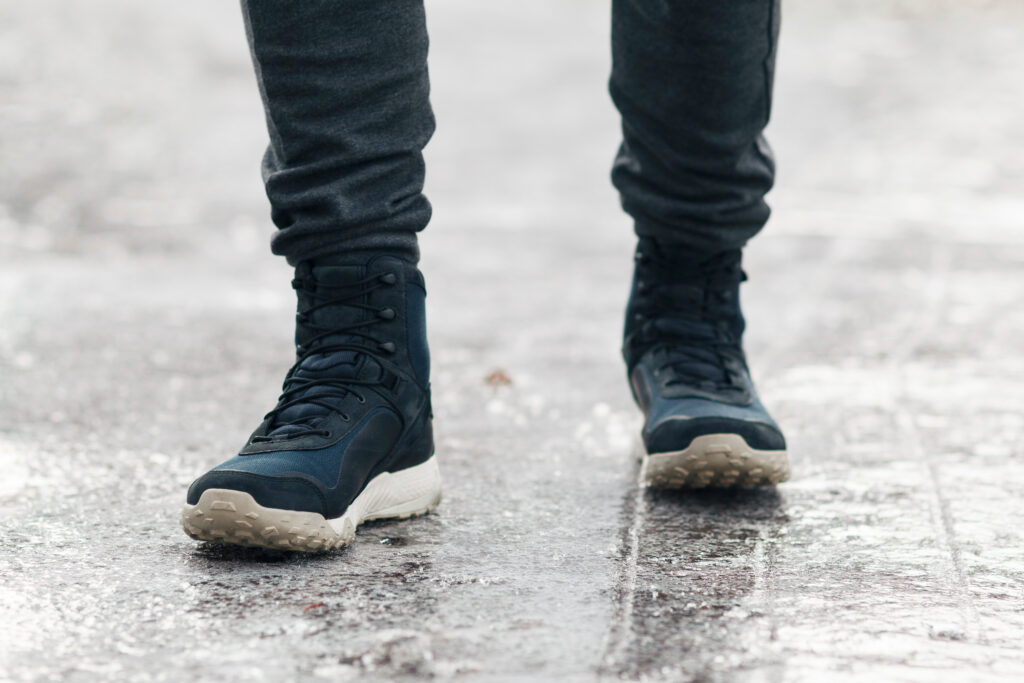
We all know ice is slippery. The more surprising part is why it’s slippery and how long it took scientists to start agreeing on something closer to an answer. Researchers have long known the surface of ice behaves like it’s wearing a microscopic “wet” layer that lubricates motion. What they’ve argued about for nearly 200 years is what creates that layer in the first place (3,4).
So, let’s treat this like a mystery. Ice is the crime scene. Your dignity is the victim. Here are the main suspects.
The Suspects:
Suspect #1: Pressure – “squish it into water”
In the 1850s, engineer James Thomson proposed that pressure from a skate blade or boot could melt ice’s surface. The logic relies on thermodynamics: because liquid water is denser than ice, squeezing it lowers its melting point. Thomson’s brother, William Thomson (Lord Kelvin) helped confirm the pressure–melting point relationship experimentally (3).
But here’s the problem: pressure melting can only contribute close to 0°C. When John Joly later applied the idea to skating (1886), he estimated skate-blade pressures could depress the melting point to around −3.5°C. That might explain glide on relatively “warm” ice, but it doesn’t account for slipperiness well below freezing. For example: hockey ice is often closer to about −9°C, and people can ski in much colder conditions. At those temperatures, the pressure required to melt the surface would be unrealistically high. So, pressure may be a supporting actor near the melting point, but it can’t be the main culprit across typical winter conditions (3,4).
Suspect #2: Friction – “rub until it melts”
In the 1930s, Frank Bowden and T.P. Hughes proposed that sliding creates frictional heat, which melts the surface and leaves a thin film you can glide on. They even tested friction on ice and argued the effect depended on how well the sliding material conducts heat (3,4).
The problem is timing: ice can feel slippery the instant you step onto it, before you’ve generated meaningful frictional heat (4). And even when you are moving, frictional heating has a logic gap: it tends to warm the ice behind you, not necessarily the ice you’re about to slide onto (4).
That said, friction isn’t off the hook completely. In colder conditions, when any naturally “soft” surface layer is thinner, motion can still add heat and change the interface, making the slippery layer thicker or more mobile. So, friction may be a supporting actor, especially once you’re already sliding, but it can’t be the whole story (3,4).
Suspect #3: Premelting – “surface molecules have fewer rules”
Long before anyone had molecular simulations, Michael Faraday was doing very Victorian science experiments on ice cubes. He noticed that two ice pieces can freeze together when touched (regelation) and suggested a thin liquidlike film exists on ice surfaces even below freezing. Faraday couldn’t fully explain why, but the idea aged well (3).
Later scientists proposed a reason: molecules at a surface have fewer neighbors to bond with, so they’re less locked into the rigid crystal lattice. That creates a quasi-liquid layer (QLL): not a puddle you can see, more like a molecular-thin “soft zone” that’s easier to shear (3,4).
Premelting is widely supported near the melting point, but it doesn’t always explain slipperiness at very low temperatures where that surface mobility should shrink (3,4).
Plot twist: the “wet layer” isn’t one texture
- Even if we accept a quasi-liquid layer exists, it turns out it’s not uniform. Simulations suggest the QLL can be only a few angstroms thick (a few molecular layers) and its properties can change dramatically across that tiny distance. In one study, the layer near solid ice behaved much more viscously than the layer near air, meaning the surface can act like a gradient from “sticky-ish” to “slick-ish” over a space smaller than a cell (2).
- That helps explain why ice friction isn’t one simple number. Depending on temperature, load, surface chemistry and motion, you can shift between “barely any lubrication” and “more film-like glide” (2,3,4).
Suspect #4: Dipoles + Disorder – “cold self-lubrication”
Now for the newest suspect, backed by recent simulations and a 2025 Physical Review Letters paper from Achraf Atila, Sergey Sukhomlinov and Martin H. Müser at Saarland University. Their central claim: ice can become slippery without classic melting being the main driver (1,5).
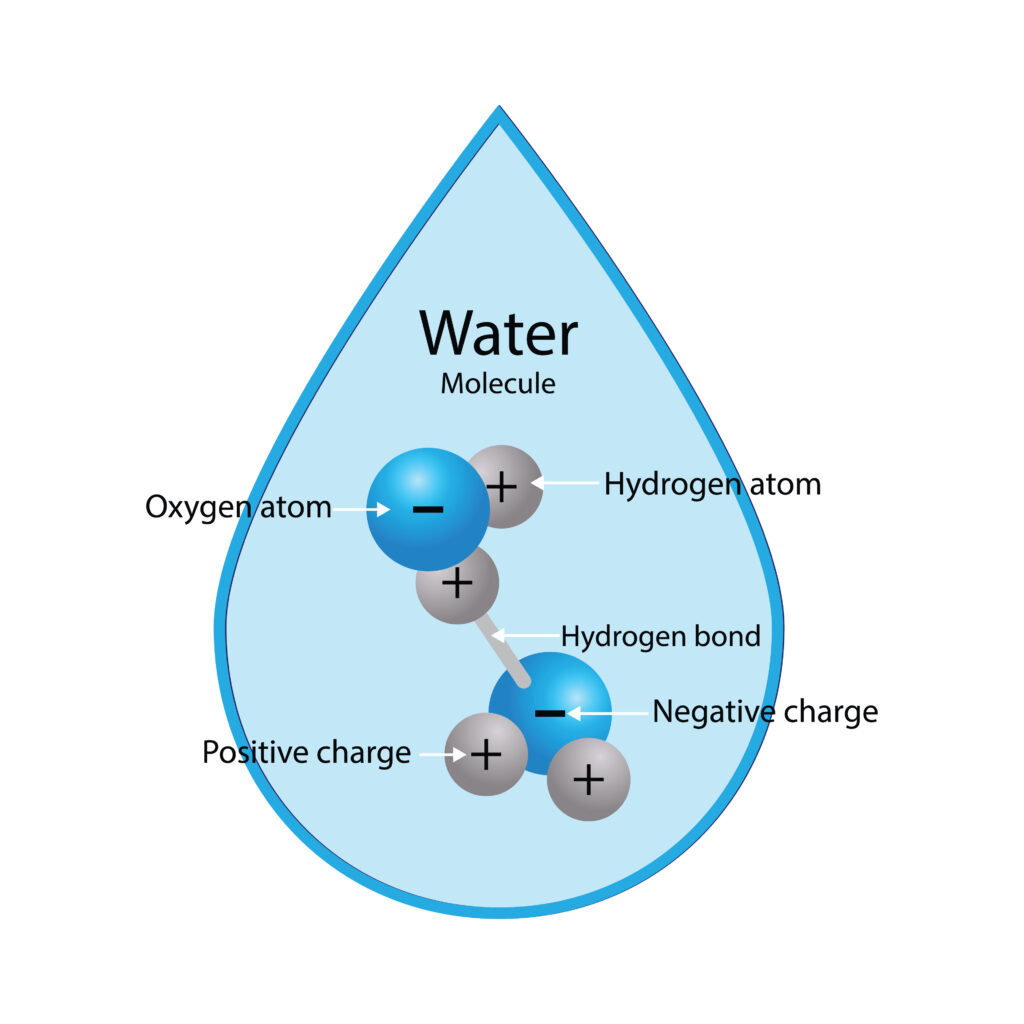
Water molecules are dipoles (they have slightly positive and slightly negative ends). When ice touches another surface (like a shoe sole or ski base), dipoles in the ice interact with charges or dipoles in that material. Those electrostatic tugs can “frustrate” the orderly crystal arrangement at the interface, mechanically disordering it into an amorphous, liquidlike layer as sliding continues. Think: not “ice warmed into water,” but “ice jostled into molecular chaos” (5).
This mechanism is especially interesting because it explains slippery behavior in colder conditions where simple “it melted” stories struggle. The Saarland team’s materials emphasize that this interfacial film can form even at extremely low temperatures, though it becomes so viscous it wouldn’t feel like normal water (1,5).
So… Who Did It?
If you were hoping for a neat, one-line explanation: sorry. Ice is a pretty slick suspect — it’s less ‘one villain’ and more ‘several accomplices.’ A recent overview of the debate frames it as a multi-mechanism problem where pressure, frictional heating and premelting may each contribute depending on conditions, while newer work argues the interface can also “self-lubricate” through disordering and amorphization during sliding (1,3,4,5).
A takeaway: ice is slippery because its surface is unusually easy to soften or disorder into a thin, mobile layer and there may be more than one way to trigger that, depending on how warm, cold, fast and chemically “friendly” the contact is (1,3,4,5).
So, the next time you panic-shuffle, blame the molecules (and their accomplices).
References
- Atila, A., Sukhomlinov, S. V., & Müser, M. H. (2025). Cold self-lubrication of sliding ice. Physical Review Letters, 135, 066204. https://doi.org/10.1103/1plj-7p4z
- Louden, P. B., & Gezelter, J. D. (2018, July 5). Why is ice slippery? Simulations of shear viscosity of the quasi-liquid layer on ice. The Journal of Physical Chemistry Letters, 9(13), 3686–3691. https://doi.org/10.1021/acs.jpclett.8b01339
- Rosenberg, R. (2005, December). Why is ice slippery? Physics Today, 58(12), 50–55. https://doi.org/10.1063/1.2169444
- Rowińska, P. (2025, December 8). Why is ice slippery? A new hypothesis slides into the chat. Quanta Magazine.
- Saarland University. (2025, September 12). The real reason ice is slippery, revealed after 200 years. ScienceDaily. Retrieved January 29, 2026 from www.sciencedaily.com/releases/2025/09/250912081323.htm