This post is written by Kai Hillman, PhD, Promega Corporation.
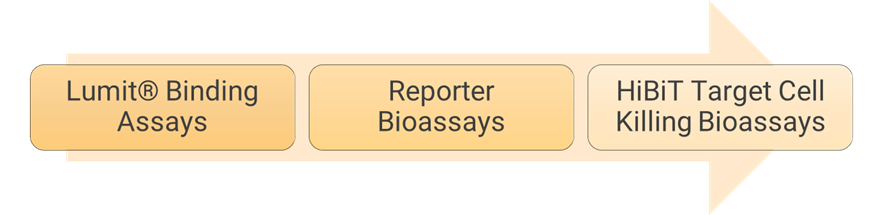
Every day, scientists push the boundaries of what’s possible with monoclonal antibodies (mAbs)—from targeting cancer cells to calming autoimmune-driven inflammation. These therapies rely not only on binding but on engineering the desired immune response. The suite of Promega Fc Effector Assays helps you understand these interactions from receptor binding and function, through bridging studies. With consistency, sensitivity, and scalability, these assays support teams from early discovery through lot release.
This article draws on real-world publications and product insights to show how Promega assays are powering next-generation immunotherapies—and redefining how we measure immune engagement.
Why Should I Understand Fc Function?
The immune system’s response to a therapeutic antibody depends heavily on its Fc region and specifically, how well that region engages Fc receptors, such as FcRn and FcγRs on immune cells. Mechanisms like antibody-dependent cellular cytotoxicity (ADCC), antibody-dependent cellular phagocytosis (ADCP), and complement-dependent cytotoxicity (CDC) are vital to clinical success, yet difficult to measure in a comprehensive manner.
Promega solves this with a standardized, binding, complement, reporter, and primary killing suite of assays that eliminates variability and offers quantitative insight into Fc effector function—enabling faster, more confident decisions.
How Do These Assays Improve Precision and Reproducibility?
Precision starts with removing sources of noise early. Lumit® Fc receptor (FcγR and FcRn) and C1q binding assays deliver rapid, no-wash, binding measurements across all key receptor variants. By avoiding immobilization, they eliminate common artifacts seen in ELISA or SPR, and their automatable, scalable format standardizes execution across runs and labs. The result is a fast, reliable method for early-stage screening and ranking of candidates.
Reproducibility is a key benefit in functional testing with Promega thaw-and-use Reporter Bioassays for ADCC and ADCP. These assays use effector cells expressing individual FcγR alleles to reduce cellular variability to provide quantitative readouts that have been qualified for precision, linearity, and reproducibility to align with ICH Q2(R2), USP <1033> guidelines. That combination makes them well-suited for drug characterization, optimization, and potency testing — supporting consistent lot release across methods, sites, and phases.
Finally, HiBiT® Target Cell Killing (TCK) Bioassays layer in physiologic relevance without sacrificing consistency. A co-culture of HiBiT-expressing target cells with ADCC-qualified PBMCs or ADCP-qualified macrophage reduce donor-to-donor variability using primary effector cells. The direct luminescent readout of target-cell lysis simplifies quantitation and provides orthogonal confirmation of reporter data for regulatory bridging studies.
How Are Researchers Using Promega Fc Effector Assays?
Promega Fc effector assays have been cited in a growing body of peer-reviewed literature. Here’s how scientists are using them to advance discovery and development:
| Study Title | Application | Promega Assay Role |
| A homogeneous bioluminescent immunoassay for parallel characterization of binding between a panel of antibodies and a family of Fcγ receptors (Sci. Rep., 2022) | Rank-ordering antibody and FcyR interactions | Screening antibody panel using Lumit FcyR Immunoassays |
| FCGR2A-HH Gene Variants Encoding the Fc Gamma Receptor for the C-Reactive Protein Are Associated with Enhanced Monocyte CD32 Expression and Cardiovascular Events’ Recurrence after Primary Acute Coronary Syndrome (Biomedicines, 2022) | Inflammation biomarker characterization | ADCP Reporter Bioassays to quantify bioactivity |
| An Engineered Oncolytic Virus Expressing PD-L1 Inhibitors Activates Tumor Neoantigen-Specific T Cell Responses (Nat. Comm., 2020) | Immunotherapy validation | Validated Fc-mediated enhancement of ADCC activity |
| A Citrullinated Histone H3 mAb for Immune Modulation in Sepsis (Nat. Comm., 2025) | mAb safety screening | Showed absence of FcγR activation, supporting safety claims. |
| The newly engineered monoclonal antibody ON104, targeting the oxidized Macrophage Migration Inhibitory Factor (oxMIF), ameliorates clinical and histopathological signs of collagen-induced arthritis (Eur. J. Immun., 2021) | Antibody engineering | HiBiT Target Cell Killing showed CDC silencing |
These studies reflect a broad spectrum of applications, from early discovery through IND-supportive safety assessments.
How Do Promega Fc Effector Assays Support Antibody Development Across the Full Pipeline?
| Stage | How It Helps |
| Discovery | Quickly screen and rank candidates for receptor binding. |
| Optimization | Engineer Fc domains with defined functional profiles. |
| Preclinical | Reporter bioassays qualified for precision, linearity, and reproducibility |
| Regulatory | Bridging studies for orthogonal confirmation of effector function |
| Manufacturing | Use in lot-release assays for potency testing. |
Whether you’re developing a first-in-class mAb or comparing a biosimilar to its reference, Promega provides assays you can trust—validated, scalable and designed to give you clarity at every step. You’re building the next generation of immune therapies. We’re here to support that work—every step of the way. Explore Promega Fc Effector Function Assays



Latest posts by Promega (see all)
- Where Science Meets Art: 30 Years of the Promega Art Showcase - October 8, 2026
- Internships at Promega: What Did You Learn? - September 1, 2026
- Under Pressure: The Nuclear Choreography upon Replicative Stress - August 11, 2026