Piecing the Puzzle Together: Using Multiple Assays to Better Understand What Is Happening with Your Cells

You often need several pieces of information to really understand what is happening within a cell or population of cells. If your cells are not proliferating, are they dying? Or, are you seeing cytostasis? If they are dying, what is the mechanism? Is it apoptosis or necrosis? If you are seeing apoptosis, what is the pathway: intrinsic or extrinsic?

If you are measuring expression of a reporter gene and you see a decrease in expression, is that decrease due to transfection inefficiencies, cytotoxicity, or true down regulation of your reporter gene?

To investigate these multiple parameters, you can run assays in parallel, but that requires more sample, and sample isn’t always abundant.

Multiplexing assays allows you to obtain information about multiple parameters or events (e.g., reporter gene expression and cell viability; caspase-3 activity and cell viability) from a single sample. Multiplexing saves sample, saves time and gives you a more complete picture of the biology that is happening with your experimental sample.
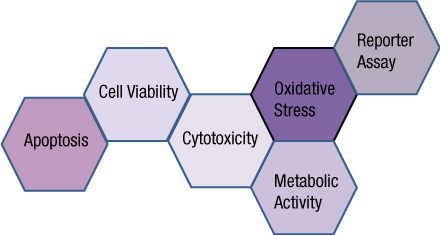
What information do you need about your cells to complete the picture?

Multiplexing assay reagents to measure biomarkers in the same sample has often been considered an application only accomplished with antibodies or dyes and sophisticated detection instrumentation. However, Promega has developed microwell plate based assays for cells in culture that allow multiplexed detection of biomarkers in the same sample well using standard multimode multiwell plate readers. Continue reading “Piecing the Puzzle Together: Using Multiple Assays to Better Understand What Is Happening with Your Cells”
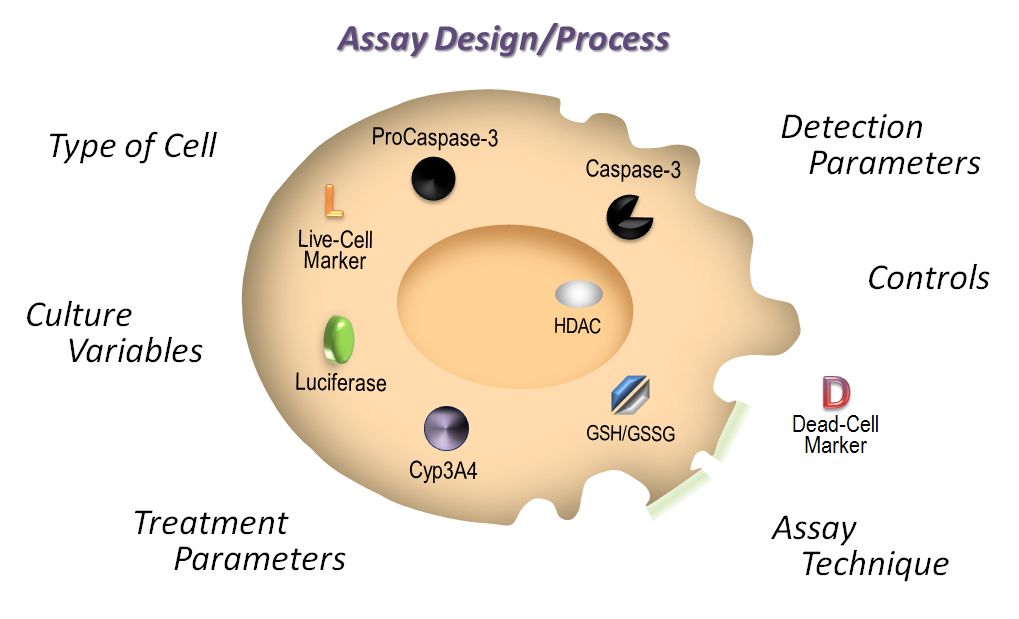
Considerations for Successful Cell-Based Assays III: Treatment Parameters

Welcome to the third installment of our series on cell-based assays; in this post we talk about treatment parameters for cell-based assays. Designed for the newbie to the world of cell-based assays, we have covered the topics of choosing your cell type and basic cell culture tips in the previous posts. In this post, we will discuss how decisions about test compound treatment: how much and how long can affect assay results and interpretation.

Continue reading “Considerations for Successful Cell-Based Assays III: Treatment Parameters”

Tips for Multiplex Cell-Based Assay Success

Performing a multiplex cell based assay save you time and help you get the most from your critical samples.
Analyzing more than one biomarker can save you time and help you get the most from your critical samples.

Analyzing more than one cellular biomarker (multiplexing) in a single sample is advantageous for a number of reasons. Multiplexing allows researchers to save money and time, while conserving critical samples. In addition, understanding the relationship between cell biomarkers can provide a more complete picture of cell health, leading to improved predictive models for drug discovery. Understanding biomarker relationships can also minimize ambiguity in the data set and validate if a treatment effect is real or an artifact of the system. To avoid repeat experiments and extract the most physiologically relevant data from multiplex cell-based assays, we discuss considerations around assay choices, cell type, cell culture, treatment parameters, detection and appropriate experimental controls.

Continue reading “Tips for Multiplex Cell-Based Assay Success”

Variations on the Two-Hybrid Assay

two-hybrid assays help fit molecules together like puzzle pieces image shows a puzzle

The use of reporter genes for simple analysis of promoter activity (promoter bashing) is a well known practice. However, there are many other elegant applications of reporter technologies. One such application is illustrated in the paper by Zheng et al., published in the Sept. 2008 issue of Cancer Research. These researchers from the Hormel Institute at the University of Minnesota showed that the cyclin-dependent kinase cdk3 phosphorylates the transcription factor ATF1 and enhances its transcriptional and transactivation activity. The observed cdk/ATF1 signaling was shown to have an important role in cell proliferation and transformation. To do this they used several variations of a reporter-based two-hybrid assay.

Continue reading “Variations on the Two-Hybrid Assay”