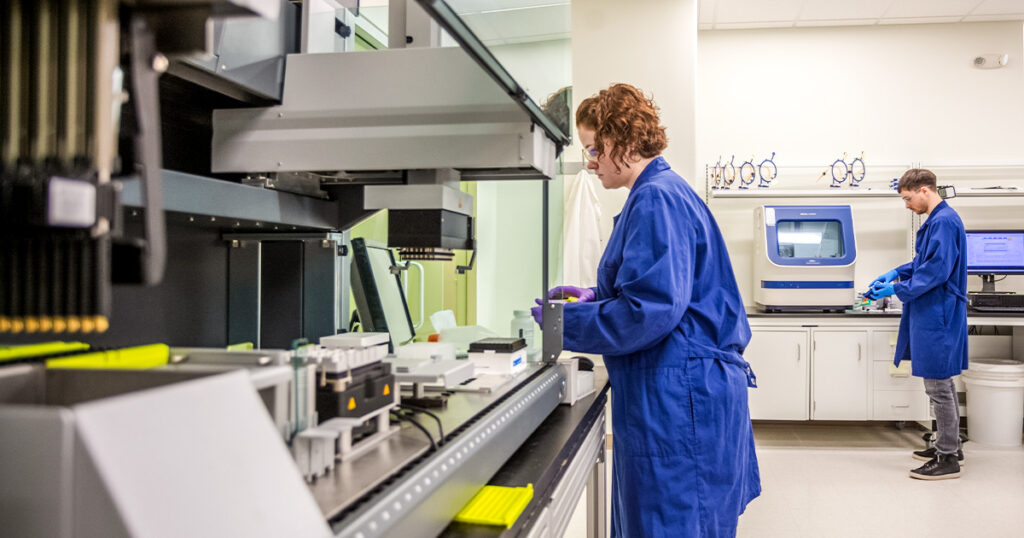
The WSPCP works to provide seed potato growers with healthy planting stock
The mighty potato—the Midwest’s root vegetable of choice—is susceptible to a variety of diseases that, without proper safeguards, can spell doom for your favorite side dishes. Founded in 1913 and housed in the Department of Plant Pathology at the University of Wisconsin-Madison, the Wisconsin Seed Potato Certification Program (WSPCP) helps Wisconsin seed potato growers maintain healthy, profitable potato crops year-to-year through routine field inspections, a post-harvest grow-out and laboratory testing.
While WSPCP conducts visual inspections for various seed potato pathogens, their diagnostic laboratory testing is primarily focused on viruses such as Potato virus Y (PVY), which can cause yield reduction and tuber defects, along with select bacteria such as Dickeya and Pectobacterium species that cause symptoms like wilting, stem rot and tuber decay.
“It was just a sea of Promega everywhere,” says Rebecca Roberts, a Promega Field Applications Scientist. “Floor to ceiling, piled up with Maxwell instruments, Maxprep Liquid Handlers, all the accessories and consumables…”
In her role on the Field Application Scientists team, Rebecca travels the United States installing the Maxprep Liquid Handler in customer labs and training scientists to operate the system and incorporate it into their workflow. This instrument automates the pre- and post-processing steps in a nucleic acid purification workflow. It’s a large and sophisticated instrument that takes up roughly four feet of lab bench space and weighs up to 220 pounds. It is intended for research use only, but during the COVID-19 pandemic, the Maxprep Liquid Handler, Maxwell RSC 48 Instrument, and several Maxwell purification kits were recommended for nucleic acid extraction protocols in the CDC 2019-Novel Coronavirus Real-Time RT-PCR Diagnostic Panel Emergency Use Authorization (EUA).
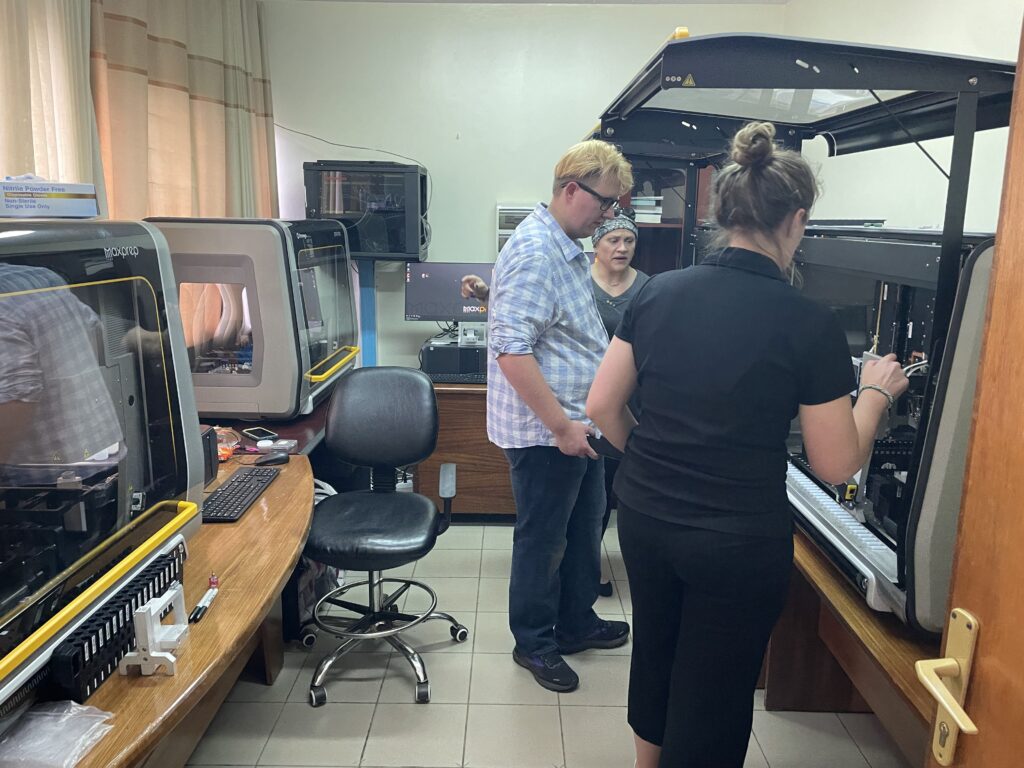
When an instrument is sold, Rebecca and a Service Engineer spend three days on-site installing it and training a small group of staff to use it. One Maxprep instrument at a time is typical. On rare occasions, Rebecca might install two on a single trip. However, in 2022, Rebecca joined a multinational team of Promega scientists and engineers in Kigali, Rwanda for an order that was anything but typical.
Field Application Scientists Rebecca Roberts, Ben Cooley and Lucy Swithenbank install a Maxprep Liquid Handler in Kigali, Rwanda
“We knew a large order from this customer was a possibility,” Rebecca says, “But I certainly wasn’t expecting an order of ten.”
This was the largest installation of Maxprep instruments Promega has ever seen from a single order. The customer also had a hard deadline that required delivery, installation and training to be complete in only six weeks – half the time usually quoted for a single instrument.
In the end, ten Maxprep instruments were installed at the National Reference Laboratory in Kigali, and more than twenty people were trained to use the systems for RNA extraction to support COVID-19 testing at a major international meeting. The order was a success, but that six week journey was a wild ride that depended on the hard work and dedication of Promega teams on both sides of the Atlantic.
The thought of an expensive instrument falling out of use and gathering dust on the shelf is enough to bring a tear to any lab manager’s eye. An instrument that once served a key purpose and now functions only as a “paperweight” is a tragic waste of valuable resources. Fortunately, it is sometimes possible to breathe new life into neglected tools and to retrofit or repurpose equipment to meet the new needs that will inevitably arise in a changing lab environment.
In 2022, our bloggers wrote on topics ranging from monkeypox outbreaks to cultured meat in biotech labs to preventing the next pandemic. Our top three most-viewed blog posts this year have the commonality of Promega products helping to advance important research in different fields and push science a step forward in the world. Take a look at Promega’s top three most-viewed blog posts of 2022.
Roses, the universal symbol of love and affection, are one of the most popular ornamental flowering shrubs used by landscapers and home gardeners and account for almost half of the billion-dollar ornamental plant market. The growing prevalence of rose rosette disease poses a significant threat to these industries. This lethal disease is caused by the Rose rosette emaravirus (RRV) and transmitted by the tiny eriophyid mite, Phyllocoptes fructiphilus. Infection by RRV results in prolific growth of clustered and bunched plant shoots (witches’ broom), malformed flowers and leaves, malformed shoots and enlarged stems and abundant leaf growth and thorniness. This excessive growth depletes the plant’s energy, eventually causing death.
Emerging and Devastating Plant Viruses of the Genus Emaravirus
RRV is a single-stranded, segmented, negative-sense RNA virus belonging to the genus Emaravirus, a relatively new genus that was established in 2012. These emerging viruses can be devastating to trees, herbaceous woody plants and vines. At Texas A&M University, Dr. Jeanmarie Verchot’s lab is working to better characterize and understand these new viruses. In addition to threatening roses, these viruses cause damage to important agriculture crops such as wheat and pigeon peas. They also endanger sensitive ecosystems when they infect plants specialized to a particular habitat, as is the case with Palo verde broom virus infection of palo verde trees of the Sonoran Desert (1).
Whether you are working with cells, tissues or blood—making sure you use the correct assay system is critical for success.
In Technical Services, we frequently answer questions about whether a kit will work with a particular type of sample. An easy way to find out if other researchers have already tested your sample type of interest is to search a citation database such as Pub Med for the name of the kit and your specific sample type. We also have a searchable peer-reviewed citations database on our web site for papers that specifically cite use of our products. And on many of our product pages, you can find a list of papers that cite use of those products. In Technical Services, we are happy to help you in this search and let you know if scientists here at Promega have tested a particular application or sample type. This information provides a good starting point to optimize your own experiments.
One common question is “can the Caspase-Glo® Assays be used with tissue homogenates?” While Promega has not tested the Caspase-Glo® Assays with tissue homogenates, scientists outside of Promega have used the assays with tissue homogenates with success. As with almost all of our kits, Resources are provided on the catalog page including a list of Citations. As an example, here is a link to the Citations for the Caspase-Glo® 3/7 Assay Systems. We also have an article highlighting a citation on detecting caspase activities in mouse liver. A variety of lysis buffers have been used to make tissue homogenates for this application. To avoid nonspecific protein degradation, it is useful to include a protease inhibitor cocktail in the lysis buffer. The use of protease inhibitors doesn’t usually affect our assay chemistries. Additionally, many commercially available protease inhibitor sets can be used that do not contain caspase inhibitors. It is important to consider the specificity of the kit being used and include proper controls to ensure that the luciferase reaction is performing as expected. For more information on citations and example protocols, feel free to contact us here at Technical Services and we can help get you started with your sample type.
XWe use cookies and similar technologies to make our website work, run analytics, improve our website, and show you personalized content and advertising. Some of these cookies are essential for our website to work. For others, we won’t set them unless you accept them. To learn more about our approach to Privacy we invite you to Read More
By clicking “Accept All”, you consent to the use of ALL the cookies. However you may visit Cookie Settings to provide a controlled consent.
We use cookies and similar technologies to make our website work, run analytics, improve our website, and show you personalized content and advertising. Some of these cookies are essential for our website to work. For others, we won’t set them unless you accept them. To find out more about cookies and how to manage cookies, read our Cookie Policy.
If you are located in the EEA, the United Kingdom, or Switzerland, you can change your settings at any time by clicking Manage Cookie Consent in the footer of our website.
Necessary cookies are absolutely essential for the website to function properly. These cookies ensure basic functionalities and security features of the website, anonymously.
Cookie
Duration
Description
cookielawinfo-checbox-analytics
11 months
This cookie is set by GDPR Cookie Consent plugin. The cookie is used to store the user consent for the cookies in the category "Analytics".
cookielawinfo-checbox-functional
11 months
The cookie is set by GDPR cookie consent to record the user consent for the cookies in the category "Functional".
cookielawinfo-checbox-others
11 months
This cookie is set by GDPR Cookie Consent plugin. The cookie is used to store the user consent for the cookies in the category "Other.
cookielawinfo-checkbox-advertisement
1 year
The cookie is set by GDPR cookie consent to record the user consent for the cookies in the category "Advertisement".
cookielawinfo-checkbox-necessary
11 months
This cookie is set by GDPR Cookie Consent plugin. The cookies is used to store the user consent for the cookies in the category "Necessary".
cookielawinfo-checkbox-performance
11 months
This cookie is set by GDPR Cookie Consent plugin. The cookie is used to store the user consent for the cookies in the category "Performance".
gdpr_status
6 months 2 days
This cookie is set by the provider Media.net. This cookie is used to check the status whether the user has accepted the cookie consent box. It also helps in not showing the cookie consent box upon re-entry to the website.
lang
This cookie is used to store the language preferences of a user to serve up content in that stored language the next time user visit the website.
viewed_cookie_policy
11 months
The cookie is set by the GDPR Cookie Consent plugin and is used to store whether or not user has consented to the use of cookies. It does not store any personal data.
Analytical cookies are used to understand how visitors interact with the website. These cookies help provide information on metrics the number of visitors, bounce rate, traffic source, etc.
Cookie
Duration
Description
SC_ANALYTICS_GLOBAL_COOKIE
10 years
This cookie is associated with Sitecore content and personalization. This cookie is used to identify the repeat visit from a single user. Sitecore will send a persistent session cookie to the web client.
vuid
2 years
This domain of this cookie is owned by Vimeo. This cookie is used by vimeo to collect tracking information. It sets a unique ID to embed videos to the website.
WMF-Last-Access
1 month 18 hours 24 minutes
This cookie is used to calculate unique devices accessing the website.
_ga
2 years
This cookie is installed by Google Analytics. The cookie is used to calculate visitor, session, campaign data and keep track of site usage for the site's analytics report. The cookies store information anonymously and assign a randomly generated number to identify unique visitors.
_gid
1 day
This cookie is installed by Google Analytics. The cookie is used to store information of how visitors use a website and helps in creating an analytics report of how the website is doing. The data collected including the number visitors, the source where they have come from, and the pages visted in an anonymous form.
Advertisement cookies are used to provide visitors with relevant ads and marketing campaigns. These cookies track visitors across websites and collect information to provide customized ads.
Cookie
Duration
Description
IDE
1 year 24 days
Used by Google DoubleClick and stores information about how the user uses the website and any other advertisement before visiting the website. This is used to present users with ads that are relevant to them according to the user profile.
test_cookie
15 minutes
This cookie is set by doubleclick.net. The purpose of the cookie is to determine if the user's browser supports cookies.
VISITOR_INFO1_LIVE
5 months 27 days
This cookie is set by Youtube. Used to track the information of the embedded YouTube videos on a website.
Performance cookies are used to understand and analyze the key performance indexes of the website which helps in delivering a better user experience for the visitors.
Cookie
Duration
Description
YSC
session
This cookies is set by Youtube and is used to track the views of embedded videos.
_gat_UA-62336821-1
1 minute
This is a pattern type cookie set by Google Analytics, where the pattern element on the name contains the unique identity number of the account or website it relates to. It appears to be a variation of the _gat cookie which is used to limit the amount of data recorded by Google on high traffic volume websites.