Accelerating Drug Discovery at Grove Biopharma with MyGlo® and ProNect®

At Grove Biopharma, the R&D team is advancing a rational design approach to drug discovery. Their Bionic Biologics™ Platform assembles custom-engineered peptides to target intracellular protein-protein interactions into stable, potent, cell permeable therapeutics. By combining the precision of biologics with the efficiency of synthesizing small molecules, Grove accelerates lead generation and optimization.

Grove’s technology enables targeting key proteins involved in cancer and neurodegenerative diseases for which effective therapeutics have historically been difficult to develop. Their candidate molecules focus on important targets such as the Androgen Receptor splice variant, SHOC2 within the RAS/RAF pathway, the MYC-regulator WDR5, a Tau isoform relevant to Alzheimer’s Disease, and the Keap1-Nrf2 interaction associated with neurodegeneration. These programs have made significant progress and now represent some of the most advanced agents in their pipeline.

Continue reading “Accelerating Drug Discovery at Grove Biopharma with MyGlo® and ProNect®”

From Mt. Fuji to the Lab Bench: A UW-Madison Student’s Summer in Japan

This blog is guest-written by Lucy Kneeley, a 2025 recipient of the Promega International Internship Scholarship. The scholarship is granted annually to University of Wisconsin-Madison students traveling abroad for internship opportunities.

Lucy Kneeley poses at the summit of Mt Fuji.

Last summer, I completed an internship at the Institute of Science Tokyo in the lab of Professor Satoshi Kaneko. As someone who has never been out of the United States for more than a 10-day vacation, I gained a lot of valuable communication experience by navigating a language barrier, but more importantly, across different social norms. Immersing myself in a new country with a new language and culture has led me to think differently and realize how quickly a group of strangers can become a new community. By the end of the three months, I had formed a network of colleagues and friends at the university and within the local community.

Continue reading “From Mt. Fuji to the Lab Bench: A UW-Madison Student’s Summer in Japan”

Promega Fc Effector Assays: Measure Every Mechanism

This post is written by Kai Hillman, PhD, Promega Corporation.

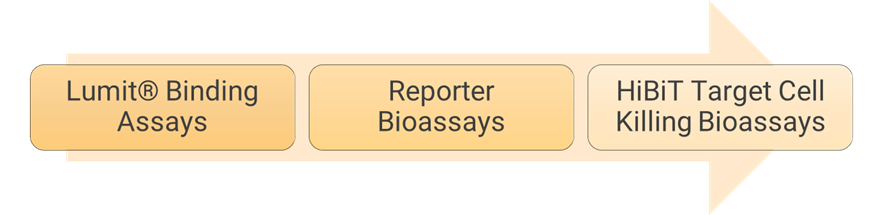
Every day, scientists push the boundaries of what’s possible with monoclonal antibodies (mAbs)—from targeting cancer cells to calming autoimmune-driven inflammation. These therapies rely not only on binding but on engineering the desired immune response. The suite of Promega Fc Effector Assays helps you understand these interactions from receptor binding and function, through bridging studies. With consistency, sensitivity, and scalability, these assays support teams from early discovery through lot release.

This article draws on real-world publications and product insights to show how Promega assays are powering next-generation immunotherapies—and redefining how we measure immune engagement.

Schematic diagramming the suite of Promega Fc effector assays in one seamless workflow to support antibody development across the pipeline.
Figure 1. Promega delivers the most comprehensive suite of Fc effector assays in one seamless workflow to support antibody development across the pipeline.
Continue reading “Promega Fc Effector Assays: Measure Every Mechanism”

Residence Time: The Impact of Binding Kinetics on Compound-Target Interactions

This blog was written by guest contributor Tian Yang, Associate Product Manager, Promega, in collaboration with Kristin Huwiler, Manager, Small Molecule Drug Discovery, Promega.

During the development of chemical probes or small-molecule drugs, compound affinity (Kd) or potency (IC50) is used to characterize compound-target interactions, to guide structure-activity relationship analysis and lead optimization and to assess compound selectivity.

However, neither parameter provides information on how quickly a compound engages with and dissociates from the target. The dissociation constant Kd reflects the relative concentrations of unbound and bound state of the compound at thermodynamic equilibrium, and while IC50 is an empirical metric that measures the concentration at which a biochemical or cellular process is reduced to half of the maximum value, IC50 values are typically determined when the process is assumed to be at equilibrium or steady-state. For a closed system, like cells in a culture dish, these thermodynamic parameters are quite informative. In an open system like the human body, where compound-target interactions often do not reach equilibrium, the kinetic parameters, in addition to the thermodynamic parameters, are needed to better understand and characterize compound target engagement over time (1,2).

Continue reading “Residence Time: The Impact of Binding Kinetics on Compound-Target Interactions”

Bringing Industry-Relevant Lab Experience to Undergraduate Life Sciences Majors with MyGlo®

When Dr. Rebecca Miles retired from her 25-year career in pharmaceutical research at Eli Lilly, she refocused her passion for science on a new challenge. Having worked her way from the bench to Senior Director, she knew first-hand the technical skills required to successfully advance genetic medicine programs. Now, she leverages her industry experience and the latest technologies at Taylor University, a liberal arts institution in Indiana known for its strong emphasis on education and practical training for students’ future careers. As a Visiting Assistant Professor of Biology, Dr. Miles trains her students to develop real-world skills and provides them exposure to technologies that impacted her own career. “I wanted to redesign the lab so that students could come out of the semester with some job skills if they wanted to be a technician in a lab,” she explains.

Dr. Rebecca Miles undergraduate class with their MyGlo®

Teaching Students Modern Technologies

Dr. Miles structures her lab courses to incorporate techniques that scientists would routinely use in an industry setting. Students learn cell culture, plating, luminescent assays, and data analysis in ways that mirror the workflows used in biotech and pharmaceutical labs. She encourages her students to analyze their raw data to learn how the calculations work. “I want the students to calculate it in Excel and do it themselves and see the standard deviation,” she says.

Continue reading “Bringing Industry-Relevant Lab Experience to Undergraduate Life Sciences Majors with MyGlo®”

Compact Design, Big Impact: Tridek-One Therapeutics Leverages MyGlo® to Accelerate Discovery of Immunomodulating Treatments

In today’s biotech landscape, speed and precision are essential. For Tridek-One Therapeutics, a Paris-based spin-off from INSERM founded in 2018, these qualities drive their mission to develop first-in-class CD31 checkpoint agonist therapies for autoimmune and inflammatory diseases. By leveraging CD31’s ITIM motifs to modulate ITAM signaling, their approach targets immune cells selectively, reducing the risk of broad immunosuppression.

Operating in a biotech incubator with limited space and shared equipment, the team—including Trang Tran, PhD, Preclinical Research Director, and Guillaume Even, Senior Laboratory Technician—depends on luminescent assays requiring both sensitivity and precise timing. Relying on a shared plate reader often delayed extracellular ATP assays that needed rapid measurement. Walking between lab spaces and potentially waiting for access to the plate reader was not feasible.

Tridek-One needed a dedicated, reliable luminometer that could support their time-sensitive workflow and fit into their small lab space. That’s when Tridek-One discovered the MyGlo® Reagent Reader, Promega’s compact, portable 96-well luminometer and transformed their workflow. Even noted that, when they first tried MyGlo®, they “directly saw the power of this small machine.” Tran and Even found that MyGlo®’s performance and sensitivity were comparable to more expensive multi-mode readers, which gave them confidence in choosing MyGlo® as a reliable and cost-effective solution. Because they prefer to use 96-well microplates, MyGlo® fit their experimental setup perfectly.

Continue reading “Compact Design, Big Impact: Tridek-One Therapeutics Leverages MyGlo® to Accelerate Discovery of Immunomodulating Treatments”

One Health in Action: Integrated Solutions for Animal Health Pathogens

For research use only

Introduction: Diagnostic Innovation for Zoonotic Threats

When a veterinarian detects influenza A in pigs, they’re not just protecting a herd; they’re helping safeguard public health through broad ongoing surveillance.

To support rapid, biosafe detection of Influenza A viruses (H5N1, H3N2, H1N1) in animal populations, Promega and Longhorn Vaccines and Diagnostics have partnered to create a workflow that doesn’t require BSL-3 containment. It’s scalable, field-ready, and designed with One Health in mind.

This work is part of our broader commitment to enabling real-time disease surveillance—across species and borders. Together with Longhorn, we’re building molecular diagnostics that meet the moment, and the future.

Want the technical details? Read the press release. 

Why It Matters: Influenza A and Diagnostic Bottlenecks

Influenza A viruses—including highly pathogenic strains like H5N1—pose a dual threat to animal health and human safety. Yet despite the urgency, many surveillance and research efforts stall at the lab bench. Why? Because working with zoonotic pathogens often requires high-containment (BSL-3) facilities—especially when dealing with real-world samples like cow milk, poultry swabs, or pig oral fluids.

To help overcome this barrier, Promega and Longhorn set out to design a complete diagnostic workflow that does more than just detect. It needed to:

Continue reading “One Health in Action: Integrated Solutions for Animal Health Pathogens”

Measure Engagement to Target Proteins within Complexes: Why Context Matters

This blog was written by guest contributor Tian Yang, Associate Product Manager, Promega, in collaboration with Kristin Huwiler, Manager, Small Molecule Drug Discovery, Promega.

For target-based drug discovery programs, biochemical assays using purified target proteins are often run for initial hit discovery, as these assays are target-specific, quantitative and amenable for high-throughput screens, allowing for precise characterization of target-compound interactions. However, proteins do not act in isolation inside the cells. Instead, proteins form complexes with other cellular components to drive cellular processes, signaling cascades, and metabolic pathways. Just as the interactions between a target protein and its binding partners can influence the target function, compound engagement with target proteins can vary depending on the protein complex formed.

Continue reading “Measure Engagement to Target Proteins within Complexes: Why Context Matters”

Cellular Selectivity Profiling: Unveiling Novel Interactions and More Accurate Compound Specificity

This blog was written by guest contributor Tian Yang, Associate Product Manager, Promega, in collaboration with Kristin Huwiler, Manager, Small Molecule Drug Discovery, Promega.

Determining the selectivity of a compound is critical during chemical probe or drug development. In the case of chemical probes, having a clearly defined mechanism of action and specific on-target activity are needed for a chemical probe to be useful in delineating the function of a biological target of interest in cells. Similarly, optimizing a drug candidate for on-target potency and reducing off-target interactions is important in the drug development process (1,2). A thorough understanding of the selectivity profile of a drug can facilitate drug repurposing, by enabling approved therapeutics to be applied to new indications (3). Interestingly, small molecule drugs do not necessarily require the same selectivity as a chemical probe, since some drugs may benefit from polypharmacology to achieve their desired clinical outcome.

Selectivity profiling panels based on biochemical methods have commonly been used to assess compound specificity for established target classes in drug discovery and chemical probe development. Biochemical assays are target-specific and often quantitative, enabling direct measurements of compound affinities for targets of interest and facilitate comparison of compound engagement to a panel of targets. As an example, several providers offer kinase selectivity profiling services using different assay formats and kinase panels comprised of 100 to 400 kinases (4). However, just as biochemical target engagement does not always translate to cellular activity, selectivity profiles based on biochemical platforms may not reflect compound selectivity in live cells (5).

Continue reading “Cellular Selectivity Profiling: Unveiling Novel Interactions and More Accurate Compound Specificity”

Is Your Lab Environment Messing with Your Results? How to Spot the Signs Early

This blog was contributed by guest Avi Aggarwal, 2025 summer intern at Promega.

If you’ve ever scratched your head over inconsistent experimental results, especially ones that seem to fluctuate for no obvious reason—you’re not alone. Sometimes the problem isn’t your pipetting, your reagents, or even your protocol. It might be the room itself.

Changes in temperature, humidity, or even invisible dust particles can quietly throw off your results. Something as simple as moving your thermocycler under an air vent or setting up a plate reader where sunlight hits it in the afternoon could cause subtle but significant issues.

Scientist removes samples from liquid nitrogen tank, affecting the immediate laboratory environment.
Any number of things can affect the laboratory environment, from opening a cryo tank to moving an instrument under an air vent.

Our Project to Learn How Subtle Environmental Changes Can Affect Sensitive Lab Equipment

We spent some time developing an environmental anomaly detection framework aimed at helping scientists understand how subtle environmental changes can affect sensitive lab equipment and experimental results. Our team set out to monitor real-world lab conditions using temperature and humidity sensors, including live testing with a GloMax® Discover platform and Sensirion SHT45 sensors. We also worked with open-source environmental datasets to simulate a variety of lab-like conditions, such as daily cycles, sudden temperature spikes, and slow humidity drifts.

Continue reading “Is Your Lab Environment Messing with Your Results? How to Spot the Signs Early”