Most of us first meet woolly mammoths as Manny from Ice Age (a gentle giant with main character energy) or as towering skeletons in museum halls. In the lab, though, mammoths can show up in many ways: such as fragile molecules preserved in permafrost for tens of thousands of years.
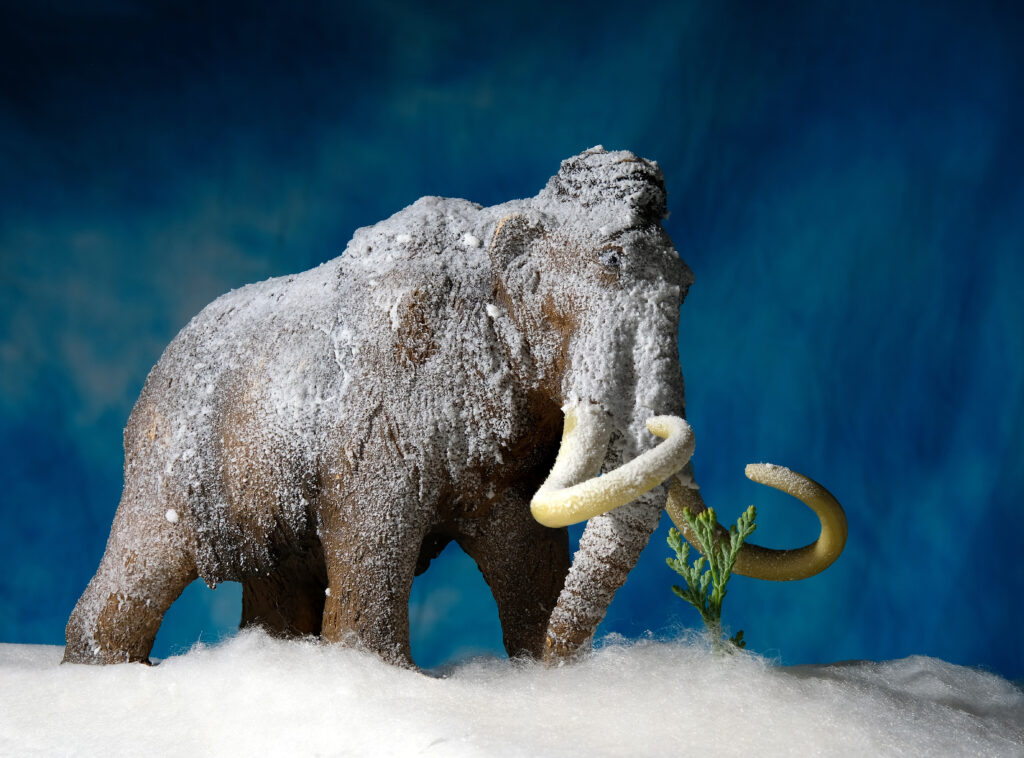
Ancient DNA has already helped scientists piece together mammoth genomes. Now scientists have done something wilder: they’ve pulled ancient RNA out of a ~39,000-year-old woolly mammoth and used it to see which genes were being expressed in its muscle tissue. In a new study, researchers showed that not only can woolly mammoth DNA survive tens of thousands of years in permafrost, but RNA, the fragile, quick-to-degrade “live feed” of the cell, can too.
Meet Yuka, The Time Capsule Mammoth
Yuka has been famous for a while as one of the best-preserved mammoth specimens ever discovered. The carcass still contains skin, hair and intact soft tissues, making it a gold mine for ancient DNA studies.
In the new study, scientists went a step further. They began by testing tiny tissue samples from 10 woolly mammoth specimens, and only a few yielded recoverable ancient RNA—Yuka produced the strongest results. They sampled Yuka’s preserved leg muscle, extracted whatever RNA might still be hanging on, and built sequencing libraries tailored for extremely short, damaged fragments. Given how fragile RNA is, they didn’t expect much, but modern sequencing and careful bioinformatics recovered a large number of ancient RNA fragments, many of which mapped back to mammoth genes. The team also cross-checked their RNA results against DNA data and other authenticity signals to help rule out modern contamination.
So, What Do You Actually Learn From 39,000-Year-Old Mammoth RNA?
Ancient DNA has already transformed how we picture extinct species. Ancient RNA opens a whole new door of possibilities.
This ancient RNA shows that scientists can:
- See not just what genes an animal had, but which ones were being expressed in a specific tissue.
- Capture a snapshot of a tissue’s biology, offering clues about metabolism, cellular stress and other physiological processes.
- Demonstrate that RNA can sometimes survive tens of thousands of years in exceptional conditions (permafrost), suggesting that other well-preserved ancient samples might also hold usable RNA.
In Yuka’s muscle, the team could infer broad features of what that tissue was doing. Many of the RNA sequences matched genes related to muscle structure and function, including genes associated with slow twitch muscle fibers, which in modern animals support posture and endurance.
They also detected expression patterns consistent with muscle stress responses and remodeling pathways. That could fit with hypotheses that have been proposed previously about Yuka experiencing major stress before death, but it is still an interpretation rather than a definitive replay of events.
The RNA sequences also helped settle a simpler question: Yuka is genetically male, overturning earlier guesses about sex based on external anatomy.
A New Way to Study Ancient Life
While the RNA fragments are short and degraded, they still provide powerful insights. This work shows that, under exceptional preservation conditions like deep permafrost, RNA can survive long enough to let scientists explore questions that DNA alone cannot answer:
- How did their tissues function?
- How did they respond to cold, stress or injury?
- How did they differ from modern elephants at the level of active gene programs?
For an animal like Manny, that might feel like giving him even more main-character energy—not by bringing him back to stomp around on screen, but by listening closely to the molecular traces left in his real-world counterparts.
I’m excited to see what other messages written in molecules have somehow survived the passing of time.
References
- Dunham, W. (2025, November 14). RNA recovered from Siberian mammoth that died 39,000 years ago. Reuters. https://www.reuters.com/science/rna-recovered-siberian-mammoth-that-died-39000-years-ago-2025-11-14/
- Kakade, J. (2025, December 4). Oldest RNA ever found in an ancient woolly mammoth leg. New Atlas. https://newatlas.com/biology/oldest-rna-woolly-mammoth-leg/
- Mármol-Sánchez, E., Fromm, B., Nikolay Oskolkov, Zoé Pochon, Dehasque, M., Morteza Aslanzadeh, Elif Bozlak, Brown, K., Tom, Kalogeropoulos, P., J. Camilo Chacón-Duque, Inna Biryukova, Heintzman, P. D., Furugård, C., Plotnikov, V., Protopopov, A., Andersson, B., Ersmark, E., Peterson, K. J., & Friedländer, M. R. (2025). Ancient RNA expression profiles from the extinct woolly mammoth. Cell. https://doi.org/10.1016/j.cell.2025.10.025

Latest posts by Shannon Sindermann (see all)
- The Parasite That Made Headlines This Summer: Cyclospora - September 29, 2026
- Why Antibiotic Resistance Is an Environmental Problem Too - July 28, 2026
- What Happens When You Delay an Ebola Vaccine Booster by 18 Months? - June 18, 2026