St. Patrick’s Day means different things depending on where you are in the world. In Ireland, it’s a national holiday steeped in culture and tradition: parades, traditional music sessions and, for many, a pint of Guinness accompanied by a hearty “Sláinte” are all part of the day. Here in the American Midwest, we tend to turn that same spirit into a full spectacle. Green everything as far as the eye can see, including somehow an entire river.
Whatever your version of the holiday looks like, there is a lot of fun science behind it. Here is a look at Midwest St. Patrick’s Day through a lab lens.
The Chicago River: Where Orange Becomes Green
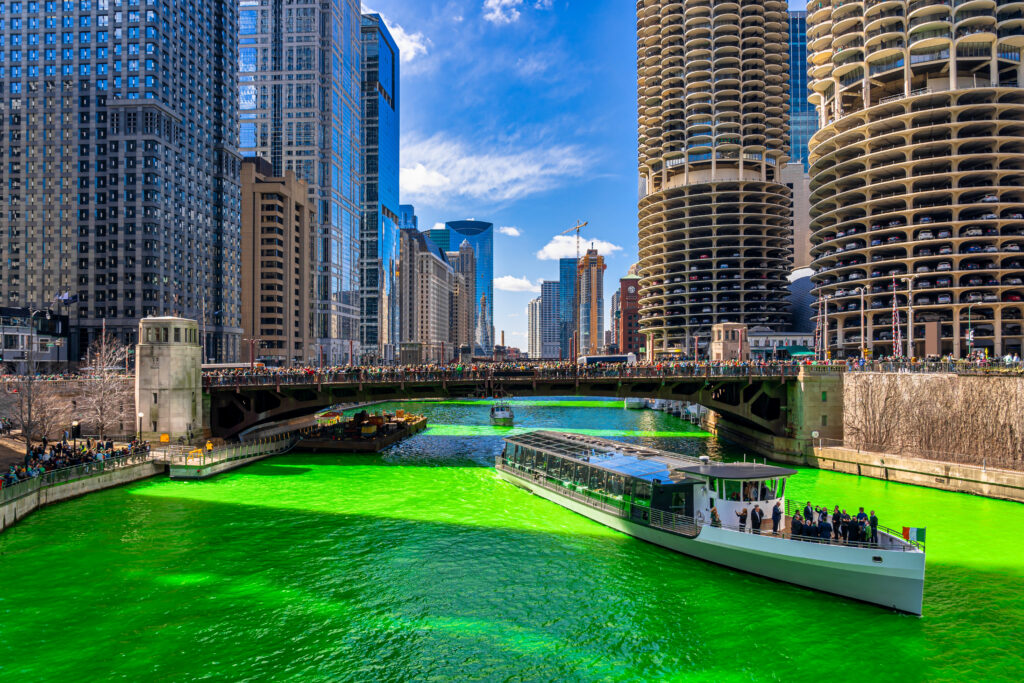
Every St. Patrick’s Day, the Chicago Journeymen Plumbers Local 130 heads out on the river and, in roughly 45 minutes, turns a stretch of the Chicago River a surreal emerald green (7, 11). The twist: the dye goes in orange.
The tradition dates to the early 1960s, rooted in a practical idea. Dye had been used to trace leaks and flow in the city’s waterways and someone realized the same concept could be repurposed into a public spectacle (7,11). The exact formula has been kept secret ever since, described only as environmentally friendly and designed to fade after a few hours (1,7,11).
So how does orange powder become a green river? One plausible explanation is a dye with behavior similar to fluorescein, a xanthene dye used in tracing applications (1,2). Fluorescein is reddish orange as a powder, but in alkaline solution it can appear yellow-green, making it a useful model for how an orange dye could produce a green-looking river (1,2).
Optics does the rest. Add in surface ripples, suspended particles that scatter light and the long path length of sunlight traveling through dyed water and you get that iconic neon emerald flow visible from the bridges. The recipe remains a secret, but the underlying chemistry and optics are familiar.
Green Beer: Same Idea, Smaller Scale
While we’re on the subject of things that probably shouldn’t be green but are, green beer follows the same basic principle, just in a pint glass.
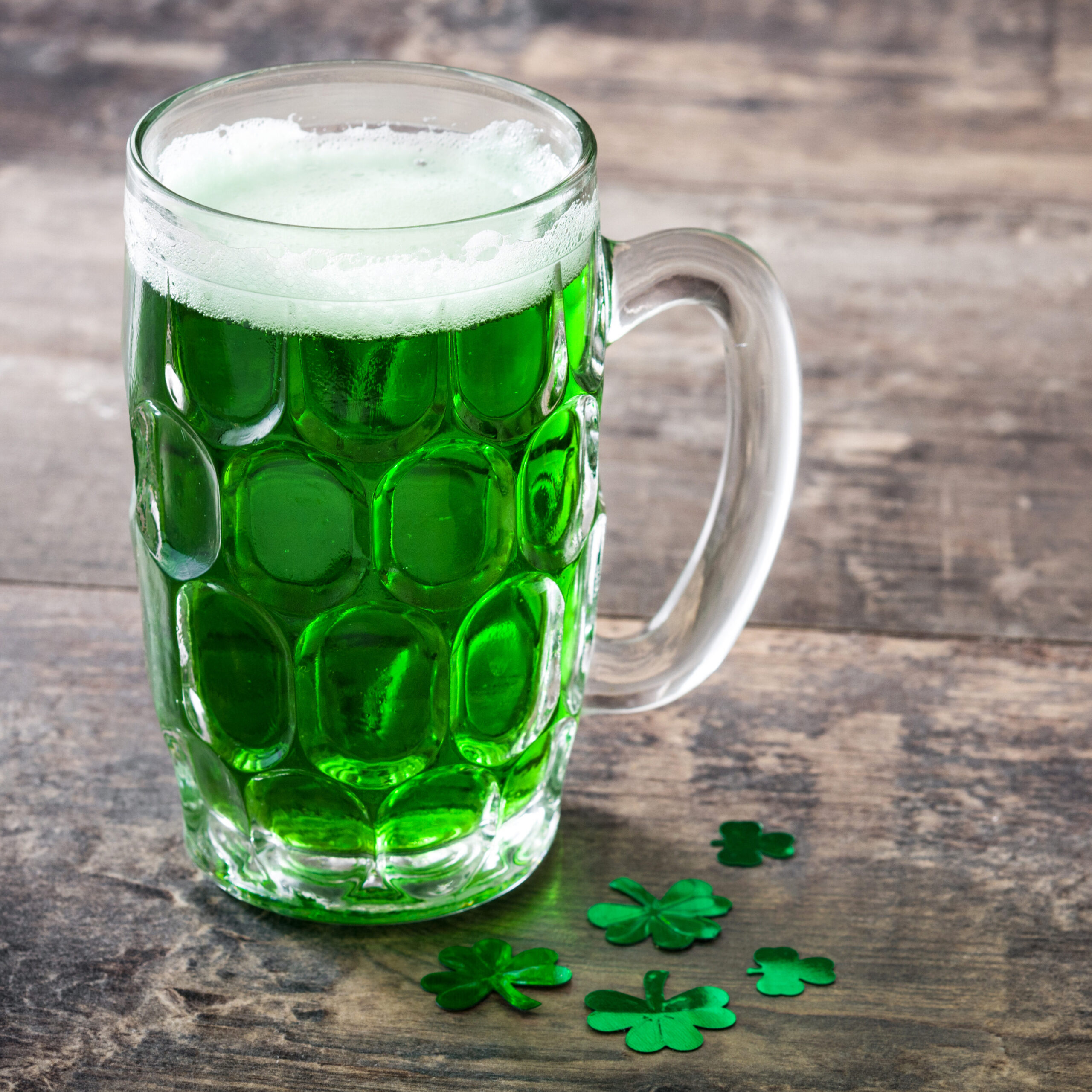
A few drops of blue or green food dye stirred into a light lager looks like a party trick, but what you are watching is a real-time demo of light absorption.
Beer often looks golden in part because Maillard reactions during malting and brewing create melanoidins and related brown-colored compounds that contribute to beer color (5,6). When you add food coloring, you reshape the beer’s absorbance spectrum, changing which wavelengths get “taken out” as light travels through the glass. According to the Beer–Lambert law, absorbance increases with both dye concentration and path length, so a tiny amount of dye in a pint glass can have a surprisingly big effect (3). The color you see is the light that makes it through, so when more red and yellow wavelengths are absorbed and more green light is transmitted, the beer looks green.
It’s not leprechaun magic, it’s wavelength filtering and a very human visual system doing its best.
The Shamrock: Small Plant, Big Survival Game

The four-leaf clover has been a symbol of good luck for centuries, reportedly tied to folklore suggesting each leaf represented something: faith, hope, love and luck. Some legends even trace it back to Eve carrying one out of the Garden of Eden as a keepsake of paradise (6), which is a lot of pressure for a lawn weed.
The science, as it turns out, is just as interesting as the legends. We pin shamrocks on lapels, stamp clovers on greeting cards, make questionable holiday accessories and credit them with bringing luck, but the shamrock and the four-leaf clover are not exactly the same thing. The shamrock is associated with three leaflets, while four-leaf clovers appear only occasionally due to a fluke of genetics and environmental factors (8). Clover’s low-growing, spread-out leaflets help it capture sunlight efficiently for photosynthesis, which is part of why it does so well in lawns and other crowded spaces. Clover also fixes its own nitrogen through bacterial partnerships in its roots, helping it grow without added nitrogen fertilizer (4). In other words, the familiar three-leaf form is already a highly effective design. A fourth leaflet is not an upgrade so much as an uncommon variation.
That rarity is part of the appeal. Four-leaf clovers are often estimated at roughly 1 in 5,000, though estimates vary by source (8,9). In white clover, the four-leaf trait is linked to genes affecting leaflet number, but the exact reason a fourth leaflet appears is still not fully understood because environmental conditions seem to matter too (9). In other words, even a lucky clover is a small example of how plant traits are shaped by both genes and environment.
Push that variation far enough, and you get extremes. The world record is 63 leaves on a single clover stem, discovered by Yoshiharu Watanabe in Nasushiobara, Japan, on August 2, 2023 (5). At that point it’s less lucky charm and more botanical overachiever.
Fun Fact: You’ll Never Reach the End of a Rainbow
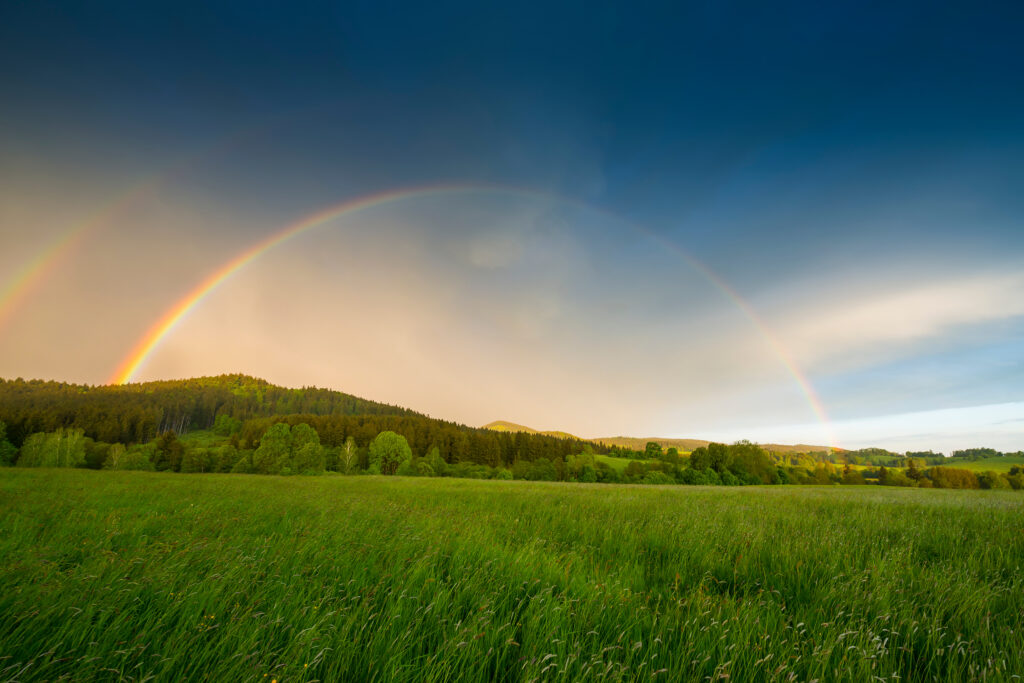
Rainbows have no fixed location; they are optical phenomena that exist only relative to you and the position of the sun. Each raindrop refracts and internally reflects light at specific angles, producing a primary rainbow at about 42° for red light and about 40° for blue/violet light from the antisolar point (10). As you move, the rainbow moves with you, so the “end” does not exist in a fixed place. That unfortunately means the pot of gold will never be within reach.
Happy St. Patrick’s Day—wherever you are in the world!
References
- American Chemical Society. (2012, May 21). Fluorescein. Molecule of the Week.
https://www.acs.org/molecule-of-the-week/archive/f/fluorescein.html - Boerner, L. K. (2025, March 14). It’s Saint Patrick’s Day. Let’s dye stuff: From green rivers to rainbow tubes, chemistry colors the holiday. Chemical & Engineering News.
https://cen.acs.org/environment/water/s-Saint-Patricks-Day-Lets/103/i7 - Clark, J. (n.d.). The Beer-Lambert law. Chemistry LibreTexts. https://chem.libretexts.org/Bookshelves/Physical_and_Theoretical_Chemistry_Textbook_Maps/Supplemental_Modules_%28Physical_and_Theoretical_Chemistry%29/Spectroscopy/Electronic_Spectroscopy/Electronic_Spectroscopy_Basics/The_Beer-Lambert_Law
- Jennings, J. (n.d.). Value of nitrogen fixation from clovers and other legumes (FSA-2160). University of Arkansas System Division of Agriculture. https://www.uaex.uada.edu/publications/pdf/FSA-2160.pdf
- Guinness World Records. (2023, August 2). Most leaves on a clover.
https://www.guinnessworldrecords.com/world-records/most-leaves-on-a-clover - Nannestad, C. (2026, March 10). Here’s why four-leaf clovers are considered lucky. Reader’s Digest.
https://www.rd.com/article/four-leaf-clover/ - Rascoe, A. (2022, March 16). Why the Chicago River is dyed green for St. Patrick’s Day. NPR.
https://www.npr.org/2022/03/16/1086988193/st-patricks-day-green-chicago-river - Penn State Extension. (2026, February 22). The botany behind the shamrock. https://extension.psu.edu/the-botany-behind-the-shamrock
- Tashiro, R. M., Han, Y., Monteros, M. J., Bouton, J. H., & Parrott, W. A. (2010). Leaf trait coloration in white clover and molecular mapping of the red midrib and leaflet number traits. Crop Science, 50(4), 1260–1268. https://doi.org/10.2135/cropsci2009.08.0457
- Tatum, J. (n.d.). 1.7: The rainbow. LibreTexts. https://phys.libretexts.org/Bookshelves/Optics/Physical_Optics_(Tatum)/01:_Reflection_and_Transmission_at_an_Interface/1.07:_The_Rainbow
- Wood, J. M. (2022, March 17). How do they dye the Chicago River green for St. Patrick’s Day? Mental Floss. https://www.mentalfloss.com/article/62220/what-do-they-use-dye-chicago-river-green-st-patricks-day

Latest posts by Shannon Sindermann (see all)
- Some St. Patrick’s Day Science: Green Rivers, Four-Leaf Clovers and Optics of a Good Pint - March 17, 2026
- Sequence to Substance: Making the mRNA Therapeutic - February 17, 2026
- The Science of Slipping… Blame the Molecules! - January 29, 2026
