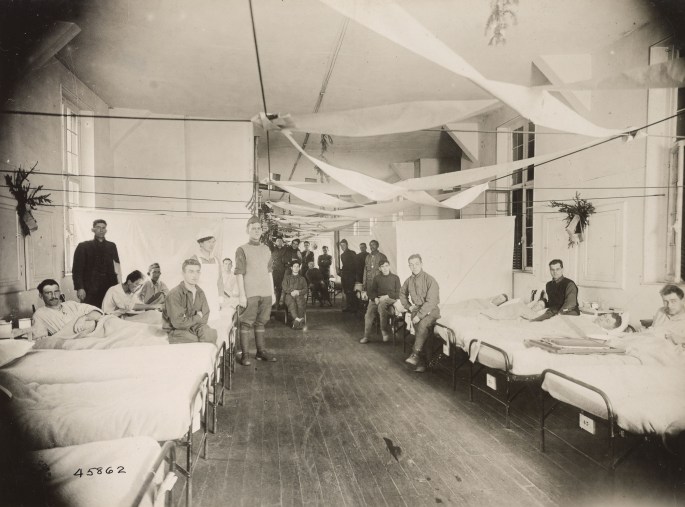
One hundred years ago, the world was taking its first deep breaths as it celebrated the end of World War I. The Armistice of Compiègne, was signed on November 11,1918, officially ending the four-year long conflict, which claimed the lives of more than 8 million soldiers (1). What the world didn’t yet realize was that they had been battling a far deadlier enemy in the hospitals and at home than any army the soldiers faced on the fields of war.
During the last year of the war, a deadly influenza virus rampaged around the globe leaving between 50 and 100 million dead in its wake.
Continue reading “Over 50 Million Died in the Pandemic of 1918-A Century Later We are still Searching for a Universal Flu Vaccine”
The boys were coming in with colds and a headache and they were dead within two or three days. Great big handsome fellows, healthy men, just came in and died. There was no rejoicing in Lille the night of the Armistice.
Sister Catherine Macfie from her post at casualty clearing station no. 11 at St André near Lille, France (2).


 Whether your first encounter was peering through the thick glass of an aquarium tank or peeking through your fingers in a darkened theater, there is something about sharks that captures our imagination. These fierce, and sometimes fearsome, creatures have existed in our oceans for over 400 million years, and survived multiple mass extinction events, including the one that killed the dinosaurs. They are not, however, the vicious, vengeful villain that some movies would have us believe. Sharks are apex predators, who play an important role in the world’s ocean ecosystem by regulating the population of prey species below them. Unfortunately, they are also part of one of the most threatened group of marine fish in the world. Of the more than 400 species of sharks that exist in our oceans today, approximately 15% are considered vulnerable, endangered or critically endangered.
  We can learn a lot about the past and its people from the written records of the time. What people write and how they write it can gives us glimpses into historical events, interpersonal relationships, social standing and even social and cultural norms. From paper to papyrus to clay tablets, the surface that holds the writing can tell us things that the words cannot.
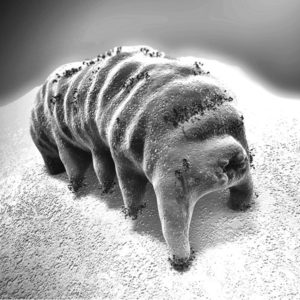 Everyone has their favorite microscopic creature—you all do have a favorite, right? Mine is unquestionably the tardigrade. Tardigrades, also called water bears or moss piglets, are microscopic invertebrates that are composed of five segments: one head segment and four body segments, each with a pair of legs. They are 0.1–1.2mm in length, making them easy to see under low magnification, and have a brain and well-developed nervous system. Tardigrades are found in just about every environment on earth. Termed “extremophiles”, they have adapted to survive in even extremely harsh environments. Your neighborhood pond? The Himalayas? Antarctica? Deep sea? Tardigrades live in all those places.
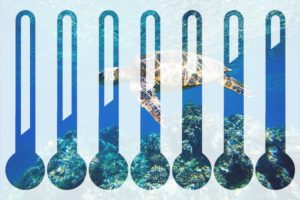 The earth’s climate has warmed and cooled before. Looking at ice-core and geological records, we know that the earth has been much warmer than it is now, and we know that it has been much colder. Climate is dynamic, there are always fluctuations in temperature and moisture from year to year and decade to decade. Some of these fluctuations become trends where the changes consistently track in one direction, and some are anomalies, with more extreme climate conditions and less predictable patterns. Plant and animal populations are unquestionably affected by both the year-to-year fluctuations and the long-term trends. In this blog I am going to talk about two rather dramatic examples of the effects climate change. One example looks at the impact of warming global temperatures over time on the breeding populations of green sea turtles. The other is an example of the devastating results of one warm, remarkably humid, spring on the calving aggregations of the saiga antelope.
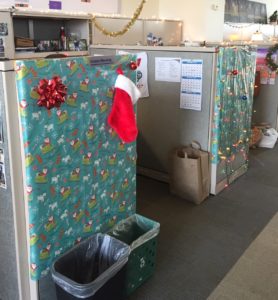
 Every year around the beginning of December, a magical transformation begins in Promega offices in Madison and around the world. In Madison, even as our own Promega cookie elf is busily baking the last of her Holiday treats, employees are donning their own elf hats and bedecking our halls and cubes with their own form of Holiday magic.