Titouan Bernicot founded Coral Gardeners, a nonprofit driving coral reef restoration, at just 18 years old. He was born on a pearl farm on a small atoll, a ring-shaped coral island, in French Polynesia. Instead of playing in the dirt with neighborhood friends after school, Bernicot, the only kid on the little atoll, spent his childhood in the water, immersed in the colorful and flourishing life around him (1). With no shops or markets, the community sustained themselves only with what the island had to offer, therefore relying on a thriving local ecosystem. “A really connected-to-nature way of living” says Bernicot (2). Largely disconnected from the rest of the human world but uniquely integrated with the natural one.
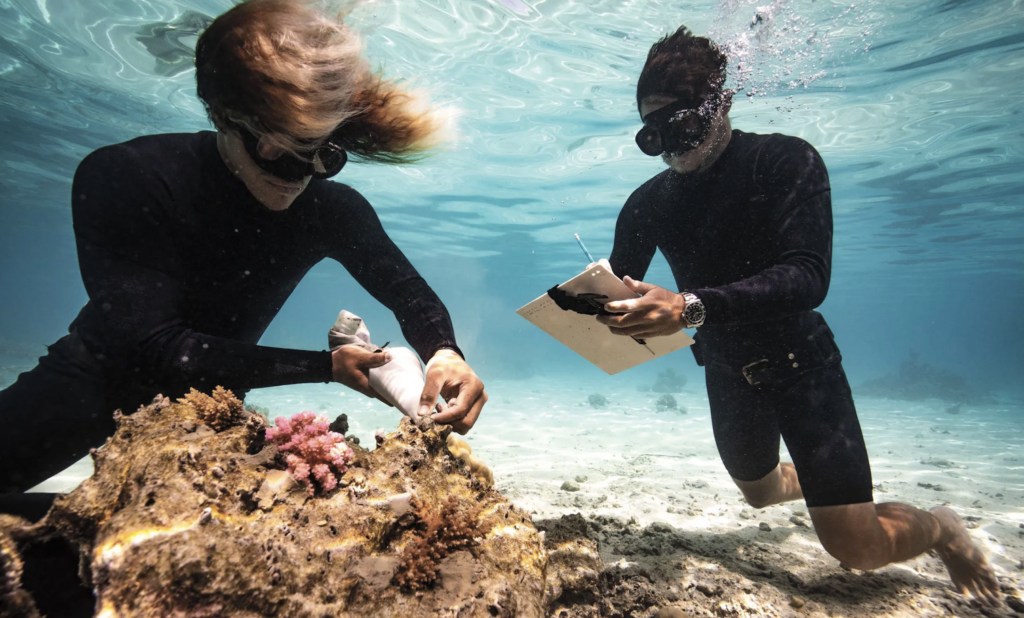
Photo Credit: Coral Gardeners
At age 16, Bernicot took a boat out with friends to new waters for a surf. He entered the water expecting to see the stunning colors of a thriving reef but was instead shocked when he beheld an expanse of bleached corals for the first time in his life. After returning, Bernicot began research to understand what was happening to his home.
Corals are not plants. They’re a collective colony of little marine invertebrates called polyps. Each polyp has a mouth and tiny stinging tentacles used to hunt plankton, but eating provides only about 10% of the energy it needs to survive. 90% comes from zooxanthellae algae living directly inside the polyp’s tissue, giving the otherwise translucent polyps their vibrant colors (3). This duo creates a highly effective symbiotic relationship: The polyp’s respiration system expels compounds that fuel the algae, while the algae use sunlight to photosynthesize, providing energy for the polyp. The polyps then pull calcium and carbonate ions out of the water and chemically bond them together to form the calcium carbonate skeleton (4). So, polyps are part of an elaborate architectural project that spans generations, some found to be over 4,000 years old (5). Their ancestors lived, built, and died on the same coral.
Coral reefs cover less than 1% of the ocean floor, yet support about a quarter of all marine life on the planet, harboring the highest biodiversity of any ecosystem globally. They also play a vital role in carbon dioxide absorption, coastline protection, and food security (6). Maintaining a healthy planet is greatly dependent on healthy reefs, but rising ocean temperatures are threatening the system. When temperatures rise, the algae produce compounds harmful to the polyp. As a survival response, the polyp expels the algae, leaving the coral bleached white — stripped of the energy source it depends on. A bleached coral is still alive, but can only survive for weeks to months (7). When corals die at scale, the entire reef ecosystem collapses with it.
This urgent understanding of the planet’s dependency on healthy reefs led Bernicot to take action. He assembled a team of local surfers and fishermen; the first of the Coral Gardeners. The initial methodology was simple: collect coral fragments, nurture them in underwater nurseries, and replant them on degraded reefs, with the goal to plant as many corals as possible. But quantity alone wasn’t building resilient reefs, so the methodology evolved. Guided by growing scientific collaboration and observations of the reef itself, Coral Gardeners shifted their focus from volume to resilience. Instead of collecting any available coral, they began seeking out heat-resilient corals showing minimal bleaching in warm pockets of water. These donor colonies became the corals worth propagating. The new approach was meaningful: as of 2025, Coral Gardeners has planted 221,212 corals across 12 active sites on 8 islands, restoring over 103 coral species with an average survival rate of over 80% (8).
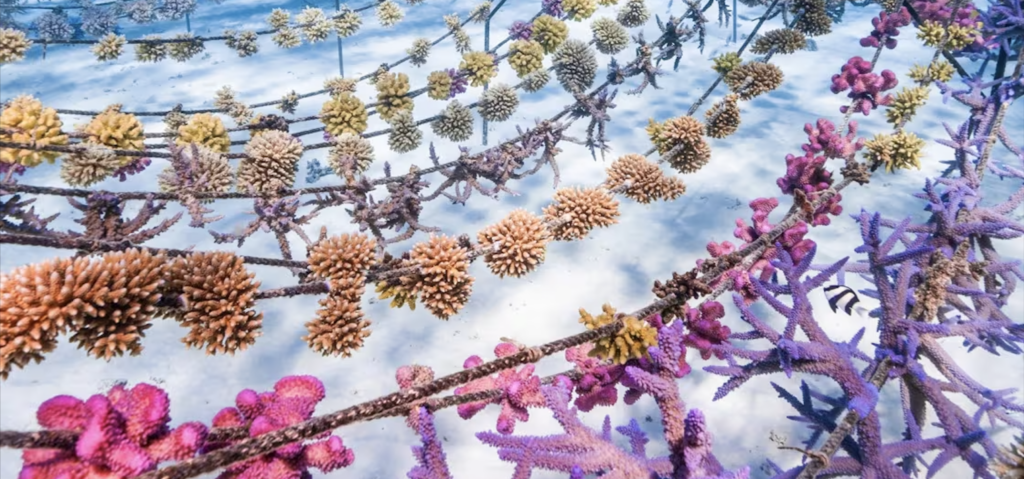
Photo Credit: Coral Gardeners
The Coral Gardeners’ in-house research center, CG Labs, has helped enhance the coral restoration process. They developed ReefOS, a suite of AI-powered monitoring tools including underwater cameras, a field data app, and a 3D reef mapping system (8). CG Labs is also pioneering the use of environmental DNA by filtering seawater to identify all species present at a restoration site from a single water sample (8). This technology does an excellent job observing and monitoring corals after they’ve been propagated and re-planted, but visual survival doesn’t show what’s happening at the cellular level. A coral can look fine but still be under cellular stress. Whether corals are just surviving or actively proliferating represents the next frontier in restoration research.
For coral restoration efforts, insight into what’s happening at the cellular level could change how scientists select and prioritize corals. Molecular research already has the tools to measure not just whether a cell is alive, but also whether it’s actively dividing or under stress. This insight could help identify which corals may have the highest odds of survival before outplanting, potentially revealing indicators of bleaching resilience that aren’t visible to the eye. Rather than waiting months to see which outplanted corals establish successfully, cellular data could inform selections earlier in the process and shift restoration from reactive monitoring to proactive decision-making.
Coral restoration is still a growing field, but Coral Gardeners has shown that resilience can be cultivated, that reefs can recover, and that a small crew of islanders with a big enough sense of urgency can build something the world needs. The questions relevant to enhancing their work are the same questions life sciences research has the tools to investigate. The gap between the reef and the lab is smaller than it seems and the more those worlds talk to each other, the better they may help one another.
No matter who you are, surfer, scientist, anyone, you can help the Coral Gardeners’ restore our reefs and keep our planet healthy, habitable, and beautiful.
Learn more about their work at coralgardeners.org, follow their Instagram, and spread the word.
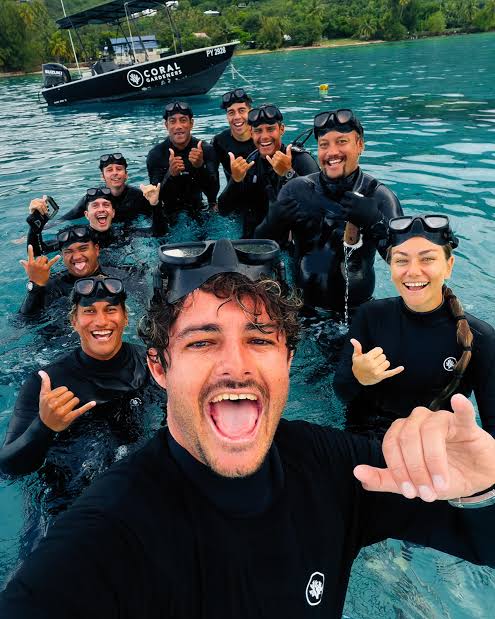
Photo Credit: Coral Gardeners
Citations:
- Bernicot, T. “Coral Gardener.” TOPIA Magazine, Gold Apple Studio.
https://goldapple.studio/topiamagazine/coral-gardener-titouan-bernicot/ - Bernicot, T. Why We Care, hosted by Tiphanie Marie, Spotify.
- NOAA. “What is Zooxanthellae?” oceanservice.noaa.gov/education/tutorial_corals/coral02_zooxanthellae.html
- NOAA. “How Do Corals Grow?” oceanservice.noaa.gov/education/tutorial_corals/coral03_growth.html
- Bower, B. “New Dating Finds Oldest Coral Yet.” Science News, March 2009.
https://www.sciencenews.org/article/new-dating-finds-oldest-coral-yet - United Nations Environment Programme. “Coral Reefs.” Blue Ecosystems, UNEP.
https://www.unep.org/topics/ocean-seas-and-coasts/blue-ecosystems/coral-reefs - NOAA. “What is Coral Bleaching?” oceanservice.noaa.gov/facts/coral_bleach.html
- Coral Gardeners Impact Report 2025. coralgardeners.org
Alena Nickolenko