Most cancer-related deaths from solid tumors aren’t caused by the primary tumor itself, but are the result of metastasis. Metastasis is the process by which cancer cells break away from the primary tumor, travel through the bloodstream and establish new tumors in distant tissues. This is a complex, multi-step process and cancer researchers have spent decades trying to understand and disrupt the metastatic cascade. What is known: platelets and calcium play important roles in metastasis. What is unknown: How do these two factors interact?
Here, we explore a recent study published in Scientific Reports by researchers at George Washington University1. They investigate how calcium levels influence platelet-cancer cell interactions and what happens when both factors converge.
Do Platelets Protect Cancer Cells?
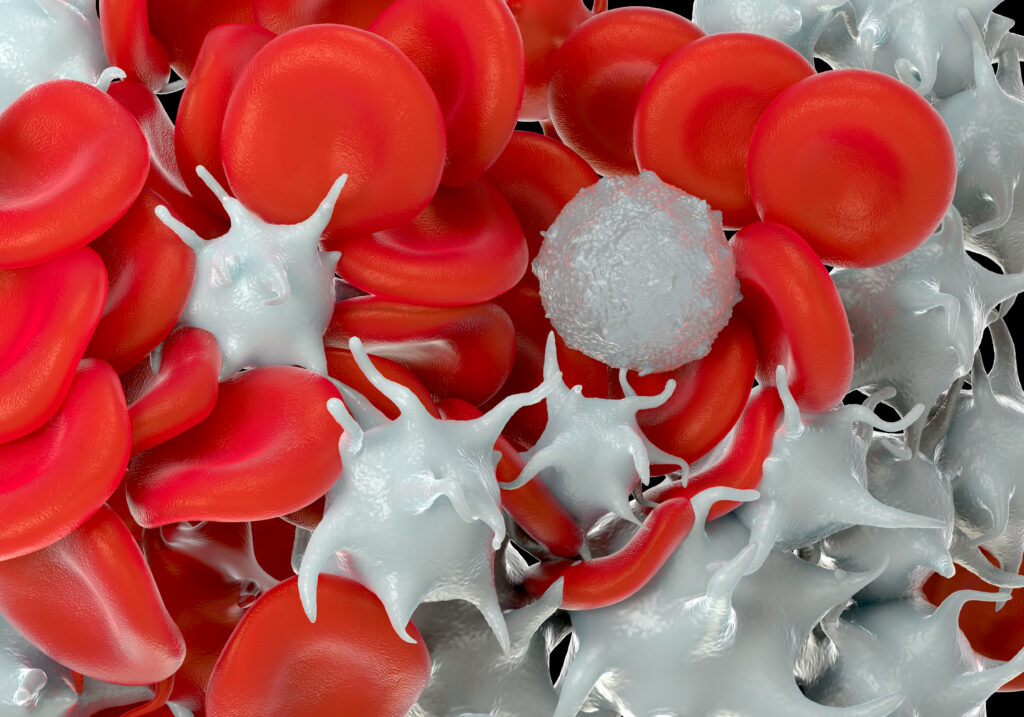
Platelets are best known for their role in stopping bleeding. In cancer biology, they are more like cellular shields. When tumor cells break free from a primary tumor and enter the bloodstream as circulating tumor cells (CTCs), platelets quickly surround them. This platelet cloak protects CTCs from immune surveillance and helps them latch onto blood vessel walls to invade new tissues. Studies in mice have shown that depleting platelets significantly reduces metastatic spread2.
The researchers began by examining the surface proteins that mediate the interaction between platelets and cancer cells, integrins. Integrins, including αIIbβ3 and αvβ3, are expressed on both platelets and some cancer cells, and they require divalent cations like calcium to maintain their structure and function.
This calcium dependency takes on added significance in cancer patients. 20–30% of advanced cancer patients develop hypercalcemia, or abnormally high levels of calcium in the blood. These patients consistently have worse prognoses, but the mechanisms connecting elevated calcium to poorer outcomes haven’t been fully understood.
The George Washington University research team set out to investigate this by systematically modulating calcium levels and measuring the effects on platelet function, platelet-cancer cell interactions and cancer cell invasion. They worked with two cancer cell lines: MDA-MB-231 (triple-negative breast cancer) and A549 (lung cancer), both of which express integrins involved in platelet interactions.
How Does Calcium Affect Platelet Behavior?
The researchers found that calcium levels have a direct and significant impact on platelet behavior. Depleting calcium with chelating agents like sodium citrate or EDTA collapsed the αIIb subunit of the key platelet integrin, inhibited platelet aggregation entirelyand reduced platelet adhesion to key blood vessel and clotting proteins.
While calcium depletion disrupted platelet function, hypercalcemia had a different and potentially more dangerous effect. High calcium levels increased the recruitment of αIIbβ3 integrins to the platelet surface. These receptors remained inactive at baseline, but when the researchers activated platelets with agonists, the response was significantly amplified compared to normal calcium conditions. In other words, high calcium doesn’t activate platelets on its own, but this research suggests calcium may prime platelets to overreact when triggered.
What Happens When Calcium and Platelets Combine?
When the researchers measured the ability of cancer cells to invade through a membrane barrier, the key finding was what happened when both calcium and platelets were present together.
They found that hypercalcemia alone did not significantly increase cancer cell invasion. Platelets alone promoted invasion, consistent with previous research. But when cancer cells were exposed to both platelets and hypercalcemic conditions, invasion increased significantly both MDA-MB-231 (breast cancer cells) and A549 (lung cancer cells). This synergistic effect suggests that hypercalcemia creates an environment in which platelets become more effective partners in the metastatic process. High calcium primes platelets for enhanced activation, which in turn amplifies their ability to support tumor cell invasion.
What Are the Implications for Cancer Research?
These findings offer a mechanistic explanation for a well-documented but poorly understood clinical observation: cancer patients with hypercalcemia tend to fare worse in treatment. The data suggest that elevated calcium may actively contribute to metastatic progression by enhancing platelet-mediated support of circulating tumor cells.
The study also raises intriguing questions about therapeutic potential. If calcium levels modulate the platelet-cancer cell interaction, could targeting that axis—whether through calcium management or disruption of integrin-mediated interactions—offer a way to slow metastatic spread? That remains an open question, but this research provides a clearer picture of the molecular dynamics at play.
Platelet adhesion to thrombogenic surfaces in this study was quantified using the LDH-Glo Cytotoxicity Assay. Learn more about the assay here.
References
- Morris, K., Masri, S., Schnoor, B. & Papa, A.-L. Calcium levels modulate platelet function, platelet-cancer cell interaction, and cancer cell invasion. Sci. Rep. 15, 7750 (2025). https://doi.org/10.1038/s41598-024-79280-8 ↩︎
- Camerer, E. et al. Platelets, protease-activated receptors, and fibrinogen in hematogenous metastasis. Blood 104(2), 397–401 (2004). https://doi.org/10.1182/blood-2004-02-0434 ↩︎

Anna Bennett
Latest posts by Anna Bennett (see all)
- The Tilcayo: A Tiny, Scrunch-Faced Cat With a Complicated Family Tree - September 24, 2026
- Midges on the Move: Tracking The Oropouche Virus Into New Territory - August 20, 2026
- The Calcium-Platelet Connection in Cancer Metastasis - July 14, 2026