
Since the COVID-19 pandemic swept the world in early 2020, many scientists in the viral research community have shifted their focus to study the SARS-CoV-2 coronavirus. Dr. Colleen Jonsson is one of them. She’s the Director of the Regional Biocontainment Laboratory, and Director of the Institute for the Study of Host-Pathogen Systems at the University of Tennessee Health Science Center (UTHSC) in Memphis.
Dr. Jonsson has been studying highly pathogenic human viruses for more than three decades. She has led several cross-institutional projects using high-throughput screens to discover small molecule antiviral compounds that could be used as therapeutics. And now, she’s using that experience to find an antiviral therapeutic against SARS-CoV-2.
Back in 2005, Dr. Jonsson set up her first high-throughput screen to discover small molecules against SARS-CoV-2’s close relative: SARS-CoV-1. SARS-CoV-1 originated from bats and emerged in humans as a severe respiratory disease in 2002, causing a global pandemic that was finally stopped in 2003. Her team spent 3–4 months optimizing the screen, testing different conditions and reagents to reach the optimal signal-to-noise and signal-to-background ratio. (They eventually landed on the CellTiter-Glo® Luminescent Cell Viability Assay, which gave them the best dynamic range.) Their efforts paid off, and they were able to identify several novel compounds that effectively inhibited the cytopathic effect of SARS-CoV-1. In the following years, they applied that knowledge to set up high-throughput screens for other viruses, such as the West Nile virus, Venezuelan equine encephalitis virus, and Mayaro virus.
For her high-throughput screens, Dr. Jonsson used a cell viability assay to determine whether the small molecules inhibit virus-induced cell death. But they were also successful in finding other viral pathways that were targeted. “There have been arguments that if you’re just measuring cell death, then you’re just going to find inhibitors that inhibit cell death. But we found a variety of small molecules that function at other levels,” she says. For example, in an influenza virus screen, they identified a small molecule that stopped the nucleocapsid from leaving the nucleus. In this way, her screens could help understand how the virus functions in cells.
When the pandemic hit the US in March of 2020, Dr. Jonsson’s lab immediately began to work on the SARS-CoV-2 virus. Her previous experience allowed them to develop a high-throughput screen for SARS-CoV-2 small molecule antiviral compounds within just two weeks! She also established collaborations with six other investigators at various institutions around the world to help them screen for small molecules. “It’s been a huge effort,” she says. “People have been incredibly dedicated towards making this happen. They all work very hard so we can make progress in discovering a small molecule. We’re going to keep going, to find as many molecules as we can.”
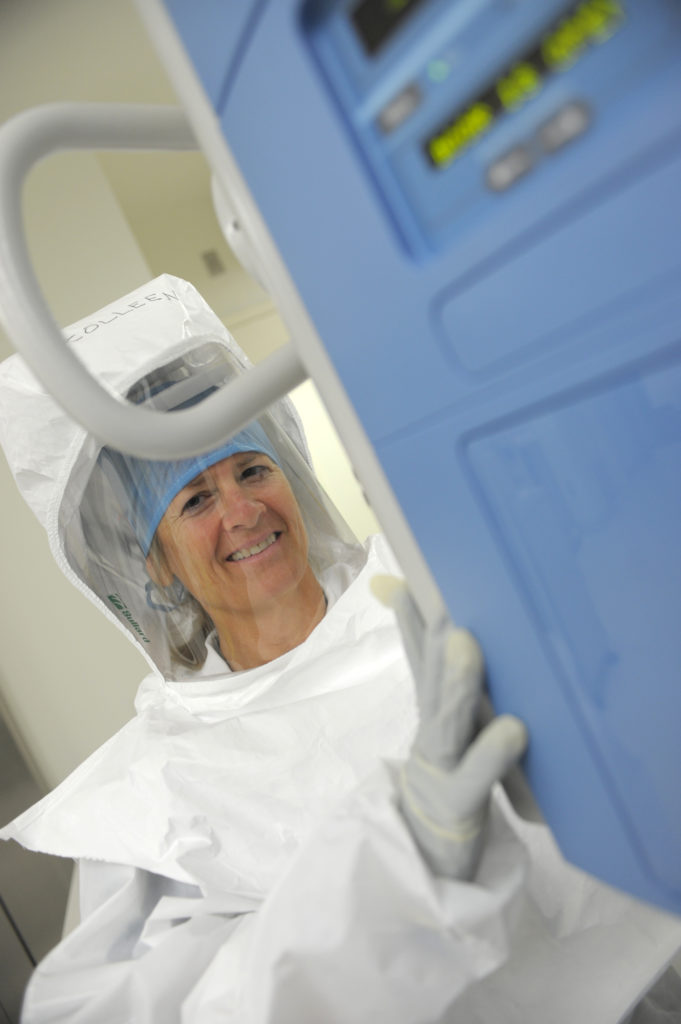
Will we ever find a small molecule antiviral that could cure COVID-19? According to Dr. Jonsson, it won’t be easy. This is because the disease is so different depending on the stage, and there are several classifications for the disease. Therefore, we may need to find a different drug for each stage. “It turns out that for each stage, some drugs are better than others,” she says, “It would be great to have a drug that worked across all of them, but I don’t know if that would be possible.” It doesn’t help that each individual has unique underlying conditions resulting in drastically different responses to the same virus, which further complicates treatment.
Although a large portion of Dr. Jonsson’s group is now dedicated to studying SARS-CoV-2, research on other viruses hasn’t stopped. They’ve recently completed a screen for the Mayaro virus, a virus transmitted by mosquitoes that is related to the Dengue and Zika virus. When people asked her why she’s working on this little-known virus with limited human exposure cases in Central and South America, she replied: “Because Mayaro could be the next Zika.” The Zika virus emerged in the Americas and rapidly spread to dozens of countries, affecting millions of people between 2013 and 2016. Dr. Jonsson’s vision is to use her screens to identify a collection of small molecule antiviral compounds that are ready to go even before an outbreak occurs. These molecules would be available for the scientific community to rapidly screen and understand how the virus functions. With this information, we may be better prepared for the next pandemic.
Despite the many challenges we’re facing in the post-COVID era, it’s amazing to see how scientists around the world have come together to fight this disease. Dr. Jonsson believes that the pandemic has stimulated many new collaborations and cross-disciplinary research that may not have existed before COVID. “It is all hands on deck. I think everyone would like to find a cure, cause that’s what we need,” she says. Seeing the dedication of these scientists, I am hopeful that they will succeed.
“The CellTiter-Glo Assay provides a very robust, easy to use reagent for high-throughput screening of small molecules for antiviral activity against viruses such as SARS CoV and SARS CoV-2 that cause a cytopathic effect in cell lines.”
– Dr. Colleen Jonsson, UTHSC
Featured Product: CellTiter-Glo® Luminescent Cell Viability Assay
Learn more about our products to support Viral Research, Vaccine and Therapeutic Development.
Related Posts

Latest posts by Johanna Lee (see all)
- A New Human Neuron Model for Tau-Targeted Drug Screening - August 27, 2026
- The Hidden Switch That Controls Lysosome Function - June 11, 2026
- Tiny Edits, Big Harvests: How a Massive Mutation Screen Could Transform Crop Engineering - May 21, 2026