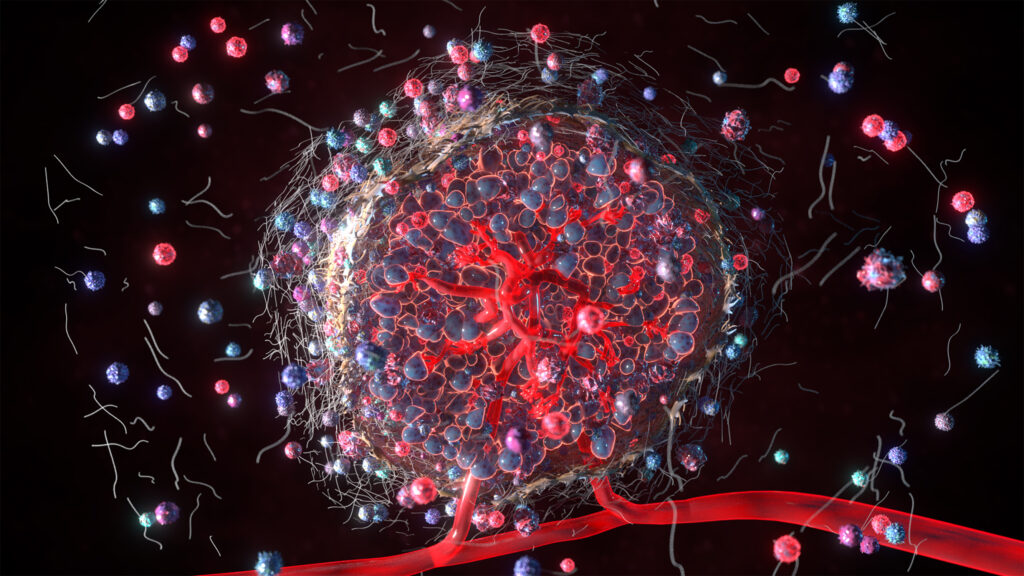
Estrogen receptor-positive (ER+) breast cancers are among the most common and treatable forms of the disease. Many patients respond well to a combination of endocrine therapy and CDK4/6 inhibitors—drugs like ribociclib that block the cell cycle and prevent tumor growth. But for up to half of these patients, treatment eventually fails. The tumor adapts and continues to grow, presenting a major barrier to developing more effective, long-term cancer therapies.
A new study published in Nature Communications by Griffiths et al. (2025) explores why some ER+ tumors resist CDK4/6 inhibitors and what we might do to reverse it. The answer, it turns out, may lie not only in the cancer cells themselves, but in the immune microenvironment that surrounds them.
Listening In on Tumor-Immune Conversations
The researchers collected serial biopsies from patients with stage II–III ER+ breast cancer undergoing treatment with letrozole, either alone or in combination with ribociclib. To better understand what was driving treatment response or resistance, they used single-cell RNA sequencing, a tool that reveals gene activity in individual cells across the tumor and its surrounding environment.
Single-cell analysis allows researchers to study the gene expression and signaling profiles of individual cells within the tumor environment, revealing how different populations —such as immune and cancer cells —interact. This added resolution helps clarify how those cellular relationships contribute to treatment response or resistance.
Their analysis showed that in tumors resistant to ribociclib, cancer cells were secreting signals that shifted nearby myeloid cells into a more immunosuppressive phenotype. This weakened the myeloid cells’ ability to activate CD8+ T cells, the immune cells that normally help target and eliminate tumors. In effect, the tumor had reshaped its microenvironment to suppress immune activity and avoid detection.
These results suggest that treatment resistance isn’t just about what’s happening inside the cancer cells themselves—it’s also about how they influence and are supported by the cells around them.
Turning the Tables with IL-15
Building on their earlier observations, the researchers conducted a series of co-culture experiments in the lab using cancer cells and T cells. They exposed the cultures to ribociclib to observe its effects in a controlled setting. As expected, the drug inhibited cancer cell growth, but it also reduced T-cell proliferation and viability, suggesting an unintended dampening of the immune response.
To address this, the team introduced IL-15, a cytokine known to support T-cell proliferation and survival. The impact was notable: T cells treated with IL-15 not only recovered, but also showed increased activation and cytokine production, enhancing their anti-tumor activity.
Throughout the experiments, cell viability was measured using the CellTiter-Glo® Luminescent Cell Viability Assay, which provided sensitive, real-time insights into how each treatment affected cell health.
While IL-15 is still in early clinical evaluation for other cancers, these findings point to its potential as a complementary therapy to CDK4/6 inhibitors in ER+ breast cancer, offering a new strategy to overcome immune suppression within the tumor microenvironment.
What This Means for Patients and the Future of Therapy
This study highlights key insights that could shape how breast cancer is treated moving forward:
- Targeting cancer cells alone may not be sufficient. The immune microenvironment plays an active role in therapeutic resistance, making it essential to consider both the tumor and the cells around it when designing treatment strategies.
- Single-cell sequencing helps uncover interactions bulk methods might miss. With the ability to isolate and analyze gene expression in individual cells, this approach reveals nuanced interactions that could inform more precise, effective therapies.
- Enhancing immune responses is an emerging strategy. Supporting T-cell function through agents like IL-15 may help overcome immune suppression and improve treatment outcomes in resistant tumors.
Together, these findings emphasize the need for integrated approaches that address both tumor-intrinsic and microenvironmental factors. They also reinforce the value of research tools that allow scientists to ask—and answer—more complex biological questions.
Reference:
Griffiths JI. et al. (2025) Cellular interactions within the immune microenvironment underpin resistance to cell cycle inhibition in breast cancers. Nat Commun. 16, 2132. https://doi.org/10.1038/s41467-025-56279-x

Sara Millevolte
