Earlier this fall, more than 90 researchers from academia and industry gathered at the Promega Madison campus for the 4th TPD & Induced Proximity Symposium. The event focused on the rapidly advancing field of targeted protein degradation (TPD) and the broader concept of induced proximity—therapeutic strategies that bring two or more proteins into proximity to trigger a specific biological effect.
This 4th year reflected of the symposium a maturing and diversifying field with chemoproteomics and proteomescale mapping redefining what it means to be “druggable,” while AI and high throughput biology are connecting molecular design to cellular function. Yet the mission remains unchanged—using molecular approaches that leverage the cellular machinery to make progress against targets once deemed “undruggable.”
Chemoproteomics: Decoding the Proteome to Expand What’s Druggable
Professor Daniel Nomura opened the symposium by highlighting how chemoproteomic technologies are reshaping how researchers identify new therapeutic entry points. His presentation, Reimagining Druggability Using Chemoproteomic Platforms, demonstrated how proteomewide ligandability mapping can uncover reactive and “glueable” sites on proteins that were once thought out of reach. Even complex and disordered targets such as the cMyc transcription factor are being reconsidered with advances in covalent chemistry and small molecule reactivity.
As Dr. Nomura explained:
“We’ve been trying to deploy an arsenal of strategies to go after transcription factors—whether it’s through directly targeting them, gluing them to E3 ligases to degrade them
,or developing completely new induced proximity approaches to tackle the unique challenges that transcription factors deploy.”
Throughout the symposium presentations highlighted the role of chemoproteomics in decoding how molecules engage the proteome, while induced proximity strategies work to reprogram those interactions for therapeutic or experimental outcomes. Together, they move the field forward in rationally guided degrader and glue design grounded in an understanding of real proteome reactivity and interaction networks.
The Expanding Induced Proximity Landscape
Beyond traditional E3based degradation, presenters explored new strategies to rewire cellular networks—using molecular glues that stabilize native protein–protein interactions, proximitydriven acetylation, or lysosomal targeting for extracellular proteins. These emerging concepts are expanding induced proximity from a mechanism of destruction to one of functional redirection and repurposing.
At the core of these developments is a deeper appreciation for the native interactome—the dynamic web of protein interactions that shape cell behavior. Rather than relying solely on trial and error, researchers now use proteomicsderived maps to identify which interfaces can be modulated and predict biological outcomes. Techniques like ubiquitin site mapping, affinity enrichment, and TurboID proximity labeling are helping scientists uncover these relationships, while advances in chemistry make it possible to finetune residence time, binding reversibility, and allosteric effects for greater selectivity and potency.
Integrating Mass Spectrometry, Proteomics, and AI: Closing the Loop
Building on these insights, other sessions explored how Mass Spec and AI expand our understanding of complex biological systems to accelerate datadriven design.
Dr. Martin Steger, Head of Degrader Biochemistry at NEOsphere Biotechnologies GmbH, shared insights on how mass spectrometry (LC–MS) supports every stage of TPD drug discovery—from identifying ligandable sites and confirming ternary complex formation to quantifying degradation outcomes. These approaches provide both discovery and validation data, forming a continuous feedback loop that connects chemical design with biological insight.

Participants emphasized that proteomics is no longer just for discovery—it’s becoming a decision-making tool for evaluating selectivity, mechanism, and off target effects. This shift allows researchers to move from asking “Is it working?” to “Why and how is it working?” with greater speed and clarity.
Meanwhile, discussion on computational and AIdriven modeling focused on bridging structural and functional insights. Predictive algorithms can model ternary complexes, estimate protein–protein interaction hot spots, and suggest which lysine residues are most likely to undergo ubiquitination. One intriguing idea raised during the meeting was whether conformational differences between mutant and wildtype proteins could be exploited to design mutantselective PROTACs—an area where AI could accelerate discovery.
During a panel discussion on AI Driven Drug Discovery the group discussed how AI tools can help to expand the scale: evaluate more molecules in the context of more targets leading to more therapeutic opportunities, with the most effective AI workflows integrating prediction and measurement, closing the loop between in silico design and real world validation.
A Connected Community Driving the Field Forward
Throughout the symposium, one theme stood out—the strength of the TPD and induced proximity community. Researchers, tool developers, and industry scientists share a unified vision to translate a deeper understanding of the proteome into new therapeutic opportunities.
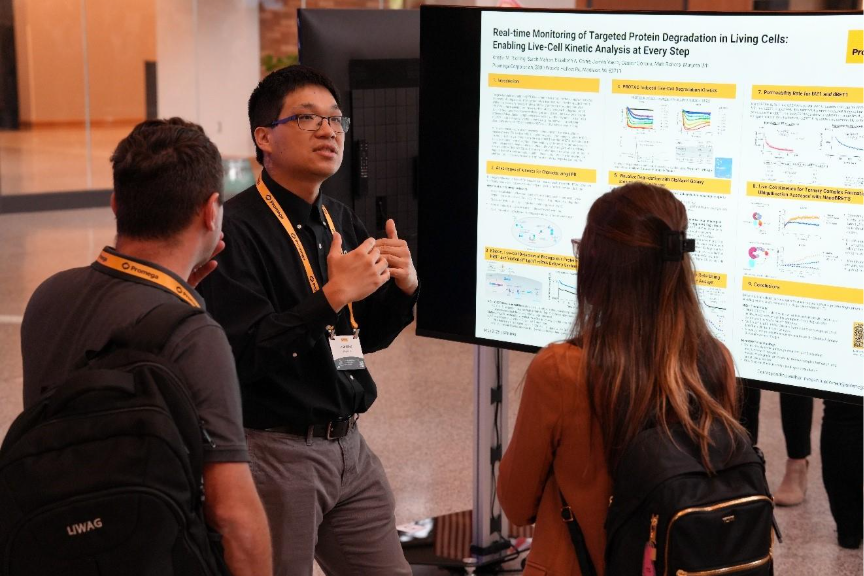
By combining chemoproteomic exploration with induced proximity engineering, the field is breaking past old boundaries—where proteomics defines the landscape and induced proximity modalities redraw it.
Promega Corporation’s role in hosting this event—and in developing technologies that range from proteomics sample preparation to live cell assay analysis—reflects our ongoing commitment to supporting this vibrant research community.
Extend the Learning—Watch OnDemand
The symposium may be over, but the learning continues. Select presentations are now available for OnDemand viewing, providing an opportunity for researchers worldwide to engage with the latest developments in TPD and induced proximity research.
Register to hear directly from experts and explore how these technologies are transforming drug discovery.

Amy Landreman