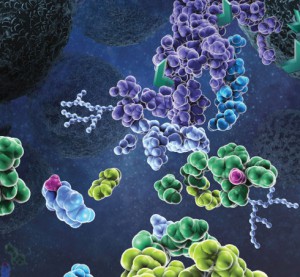
In his 2014 blog, “Why We Care About Glycosyltransferases” Michael Curtin, Promega Global Product Manager for Cell Signaling, wrote:
“Glycobiology is the study of carbohydrates and their role in biology. Glycans, defined as ‘compounds consisting of a large number of monosaccharides linked glycosidically’ are present in all living cells; They coat cell membranes and are integral components of cell walls. They play diverse roles, including critical functions in cell signaling, molecular recognition, immunity and inflammation. They are the cell-surface molecules that define the ABO blood groups and must be taken into consideration to ensure successful blood transfusions.
The process by which a sugar moiety is attached to a biological compound is referred to as glycosylation. Protein glycosylation is a form of post-translational modification, which is important for many biological processes and often serves as an analog switch that modulates protein activity. The class of enzymes responsible for transferring the sugar moiety onto proteins is called a glycosyltransferase (GT).”
Continue reading “Glycosyltransferases: What’s New in GT Assays?”
 Protein phosphorylation is a very important protein post-translational modification that controls many cellular processes including metabolism, transcriptional and translation regulation, degradation of proteins, cellular signaling and communication, proliferation, differentiation, and cell survival (1). Approximately 35% of human proteins are phosphorylated. Phosphoproteins are low in abundance, and, therefore, are challenging to detect and characterize by mass spectrometry. Different enrichment systems have been developed to isolate phosphopeptides. Among these techniques, immobilized metal affinity chromatography (IMAC) using Fe3+ and Ga3+ has been widely used for the enrichment of phosphopeptides.