What Counts as Evidence

This is the third post of three in a series leading up to the 16th annual International Forum on Consciousness, taking place in Madison this May. Hosted by the BTC Institute, Promega and Usona Institute, the forum gathers scientists, philosophers, and practitioners from dozens of different fields to investigate the nature of the mind. This year’s theme, “Unspoken Intelligence,” explores forms of perception and knowing that fall outside conventional cognition.
In 1845, mathematician Urbain Le Verrier calculated where an unseen planet had to be based on irregularities in Uranus’s orbit, wrote a letter to an observatory telling them where to point their telescope, and Neptune was there. He found a planet without ever looking up.

This is what third-person inquiry looks like at its best: observe from the outside, measure what anyone with the right instruments can measure, build a model precise enough to predict what no one has seen yet. Then look. The history of science is full of such moments, equations pointing to phenomena that hadn’t been detected, particles that hadn’t been observed, forces that hadn’t been measured. The method works because it is ruthlessly disciplined about what counts as evidence. The observer is removed, the conditions controlled, and the measurement trusted.

That discipline is not a limitation. It is the engine of over four centuries of extraordinary results. It gave us germ theory, the structure of DNA, and the sequenced human genome. Every time something seemed to resist physical explanation, the method eventually found the mechanism and the method held. The winning streak was long enough that the assumption underneath it stopped looking like an assumption. Outside-in, third-person, measurable evidence stopped looking like one way of knowing. It started looking like the definition of knowing itself.

The assumption felt safe because it had earned its confidence. Digestion, heredity, mental illness, each had seemed to resist physical explanation until it didn’t. The pattern was consistent enough that the method felt inevitable rather than chosen.

Then science turned toward consciousness, and the winning streak entered dangerous territory.


Here is the problem, what philosopher David Chalmers named the “hard problem” of consciousness in 1995.

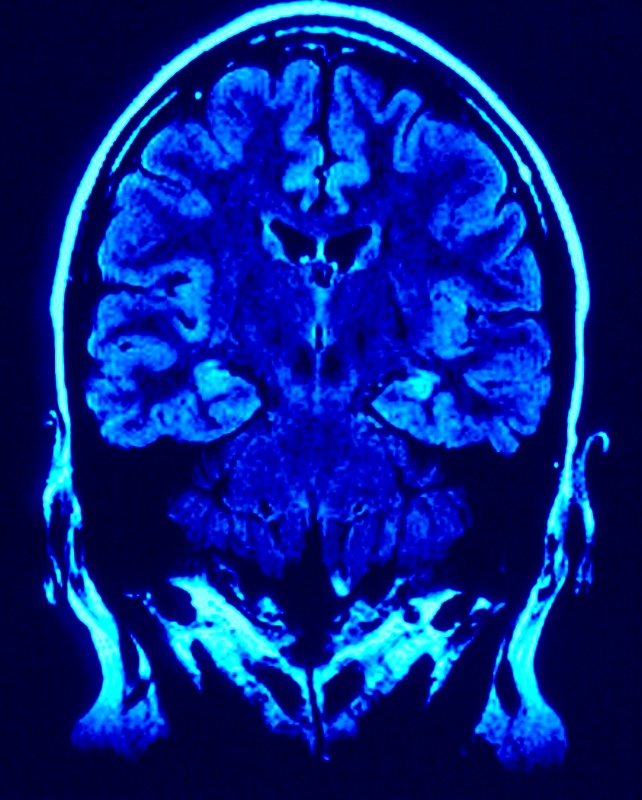
To understand what Chalmers meant, it helps to start with his own illustration. When you see red, something measurable happens. Light hits the retina. Signals travel along the optic nerve. Specific regions of the visual cortex activate in patterns that neuroscientists can map with increasing precision. All of that is, in principle, fully describable by the third-person, outside-in approach. Given enough time and instruments, you can trace the whole sequence.

What you cannot describe from the outside is what red looks like. The redness of red, that specific quality of experience that exists only in the moment of seeing it, is not in the neural map. No better scanner will find it there, because the felt quality of the experience isn’t a physical thing hiding in the data. It exists only from the inside. The outside measurement, however precise, cannot reach it.

Chalmers used “hard” deliberately, in contrast to what he called the “easy problems” of consciousness: how the brain integrates information, focuses attention, produces behavior. Those are genuinely difficult, but the outside-in approach knows how to go after them. The hard problem is different in kind. It’s the question that remains even after you’ve solved all of the “easy” ones: why does any of it feel like anything at all?

Think of it this way: everything the brain does could, in principle, happen without any felt experience attached. Processing, responding, behaving, all of it could run like a machine in the dark, with no one home. The question Chalmers is asking is why it doesn’t. Philosophers ask it this way: why is there something it’s like to be you, right now, reading this?

No amount of outside-in evidence, however precise, touches that question, not because the science is insufficient but because the method was specifically designed to exclude first-person data. That exclusion was the whole point. It’s what made the outside-in approach so powerful everywhere else.

With consciousness, the method’s central design decision runs into a question it wasn’t built to answer: how do you study first-person experience when your method was built to exclude first-person data?

Continue reading “What Counts as Evidence”

The Filter You Didn’t Choose

This is the second post in a series leading up to the 16th annual International Forum on Consciousness, taking place in Madison this May, hosted by the BTC Institute, Promega and Usona Institute. The Forum gathers scientists, philosophers, and practitioners from dozens of different fields to investigate the nature of the mind. This year’s theme, “Unspoken Intelligence,” explores forms of perception and knowing that fall outside conventional cognition.

When she thought about a dog, she saw a dog, more specifically, every dog she had ever encountered, cycling through her mind like a card catalog with pictures attached. She assumed everyone did this. When she discovered they didn’t, that most people access something more like an abstract concept hovering somewhere between language and image, she was genuinely surprised. Temple Grandin had always known her mind didn’t work the way people expected. What she didn’t know, until she was an adult, was the specific shape of the difference.

Most of us know this story, or one like it. We understand that some minds filter experience differently, but the science on this doesn’t stop where the conversation usually does.


For most of its history, the field that mapped minds like Grandin’s looked at those that didn’t fit the available systems and concluded the minds were broken. (It didn’t ask whether the systems were.) More recently, the conversation has been reframing those minds not as deficient but as different.

For many people, that reframing has been transformative, changing how educators teach, how clinicians diagnose, and how workplaces are designed. We are now more familiar with alternative cognitive profiles such as autistic pattern recognition (like that experienced by Grandin), ADHD-associated divergent thinking, and the hyper-focused depth of what researchers call monotropic attention. These are not broken versions of normal cognition. They are different architectures, each with genuine capabilities that other minds aren’t built to produce.

The terms most commonly used to describe these differences, neurotypical and neurdivergent, are useful shorthand but they describe a binary the underlying biology doesn’t support. Cognitive traits distribute across a population the way most biological traits do. “Neurotypical” minds are simply closer to the statistical center. What we call “neurodivergent” can be better understood as the part of that population that differs visibly enough from the statistical center to make the variation impossible to ignore.


Continue reading “The Filter You Didn’t Choose”

The Body Already Knows

This is the first post in a series leading up to the 16th annual International Forum on Consciousness, taking place in Madison this May, hosted by the BTC Institute, Promega and Usona Institute. The Forum gathers scientists, philosophers, and practitioners from dozens of different fields to investigate the nature of the mind. This year’s theme, “Unspoken Intelligence,” explores forms of perception and knowing that fall outside conventional cognition.

There’s a quote that travels well in some intellectual circles:

You don’t have a soul. You are a soul. You have a body.

There’s something genuinely relieving about that idea. It locates the real you somewhere above the fray, untouched by the body’s demands and indignities, the consciousness that thinks and persists while the body handles the inconvenient work of being hungry and tired and sick. The thinking part is what counts.

Plato thought something similar. So did Augustine. As did Descartes. Kant, too. The idea that the thinking self is separate from and superior to the body is Western civilization’s default setting.

It sounds like wisdom. It is also, I’ve come to think, exactly the wrong way to understand what we are.

Here’s a different text, one most millennials can recite from memory. In the opening verse of “Lose Yourself,” Eminem rattles off a visceral catalog of physical symptoms: sweaty palms, weak knees, heavy arms, vomiting. The body staging a complete revolt while the mind tries to execute a plan, until the moment on stage when the mouth opens and nothing comes out. The mind wanted to perform, but the body said no.

Nobody who has memorized those lyrics thinks of them as a description of embodied cognition. They file it under music, or nostalgia, or just a song they played too loud in a car they didn’t own. But the nervous system doesn’t care what you call it, because the body doesn’t catalogue in words.

This is the thing the soul-body quote gets wrong: the body isn’t a vehicle the self rides around in. It’s already thinking, already keeping score, already running a process the mind is only partially aware of. The question is what to do about that.

Continue reading “The Body Already Knows”

Awakening From Despair to Awe: 2021 International Forum on Consciousness

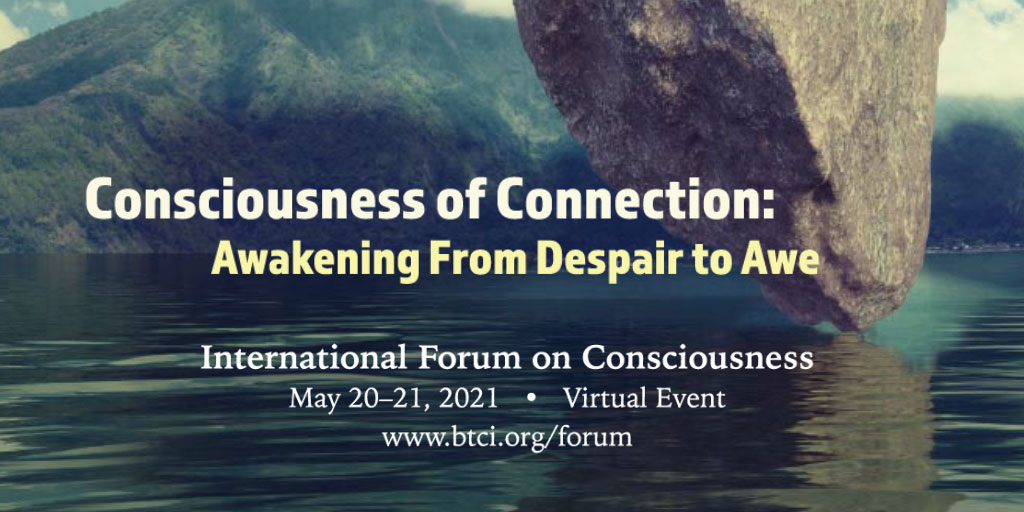
Banner for the International Forum on Consciousness 2021

Each year, the International Forum on Consciousness draws thought leaders from around the world to explore important, and often challenging, topics related to the exploration of consciousness. The theme for this year, Consciousness of Connection: Awakening from Despair to Awe, is an invitation to broaden curiosity about connection and take a closer look at the variety of connections that we forge in our lives.

Participants will examine the kinds of connections that transcend our individual selves and reach our inner desire to be part of an interconnected world, perhaps to transform our current sense of the individual, community, and society, from independent to interdependent. More specifically, the Forum will examine connection across the primary aspects of our lives with:

  • Self, and the many selves in our amazing neural networks
  • Others, and the multiple communities we intersect
  • Nature, and the breadth of life forms that surround us
Continue reading “Awakening From Despair to Awe: 2021 International Forum on Consciousness”

Wonders of the Conscious and Unconscious Mind—What I Learned from the International Forum on Consciousness

When Heather Berlin was 5 years old, she realized that, at some point in the future, she was going to die. This disturbed her so much that she couldn’t sleep all night. The next morning, she asked her father where she could store all her thoughts so they could live on after she died. There’s no way to do that, said her physician father. “What can I do to make this happen?” she asked. “Maybe become a psychiatrist?” said her dad. Decades later, she became an Assistant Professor of Psychiatry at Icahn School of Medicine at Mount Sinai. Her research focuses on interactions of the brain and mind, with the goal of treating and preventing psychiatric and neurological disorders.

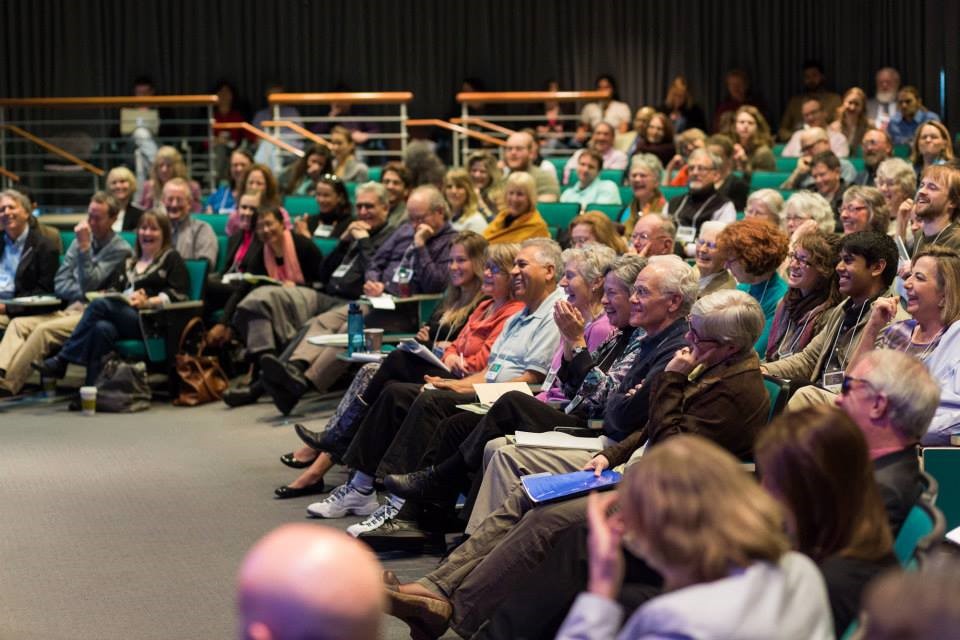
Dr. Heather Berlin told this story at the International Forum on Consciousness held at the BioPharmaceutical Technology Center Institute in Madison, Wisconsin last week. This annual forum gathers scientists from around the world, all interested in understanding how our conscious and unconscious minds work. This year, the forum focused on the newest research and technology for detecting and measuring consciousness. As someone with limited knowledge in this field, my mind was blown by how much researchers have learned so far about consciousness. (No, we can’t store our thoughts in a box…yet.) Here are a few takeaways:

Continue reading “Wonders of the Conscious and Unconscious Mind—What I Learned from the International Forum on Consciousness”

Back for More: Thoughts from 3 Regular Attendees on the International Forum on Consciousness

The International Forum on Consciousness offers a lively two days of information sharing and discussion regarding important—and often challenging—topics. Over the years, we have been guided through a range of topics, including creativity, near death, entheogens, intelligence in nature, business evolution and the effects of sensory inputs.  This year, we’re tackling Means and Metrics for Detecting and Measuring Consciousness.  You can find out more here: https://www.btci.org/events-symposia-2018/international-forum-on-consciousness/ .

As we work on the final details for this year and registrations flow in, I took a moment to pause and reflect on the fact that several of the registrants have joined us for many, if not all, of our past events. It’s gratifying to see that they are taking time out of their normal routines to make their way to the Promega campus again this spring.  So, I asked a few of them to share their thoughts for this post and this is what they had to say: Continue reading “Back for More: Thoughts from 3 Regular Attendees on the International Forum on Consciousness”