Updated February 2021.
In February 2018 we wrote about a resurrection effort to bring the then endangered black-footed ferret back from the brink of extinction in western U.S. This effort was undertaken by the U.S. Fish and Wildlife Service, with assistance from Revive & Restore and partners ViaGen Pets & Equine, San Diego Zoo Global and the Association of Zoos and Aquariums.
On February 18, the U.S. Fish and Wildlife Service announced announced the successful cloning of a black-footed ferret, introducing the world to a 38-day-old black-footed ferret kit “Elizabeth Ann” cloned from cells of a female ferret that died in 1988.
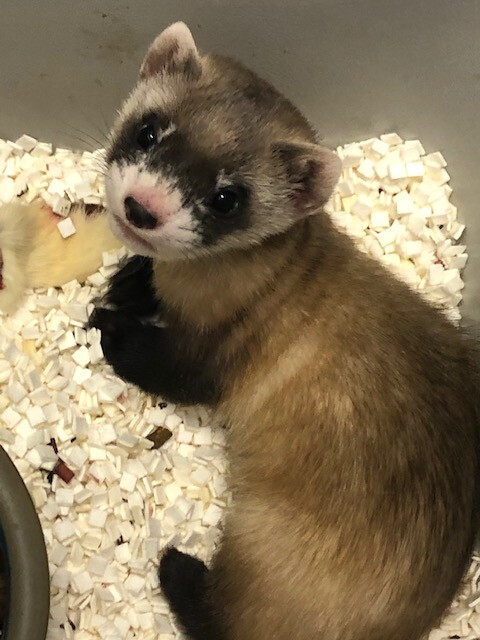
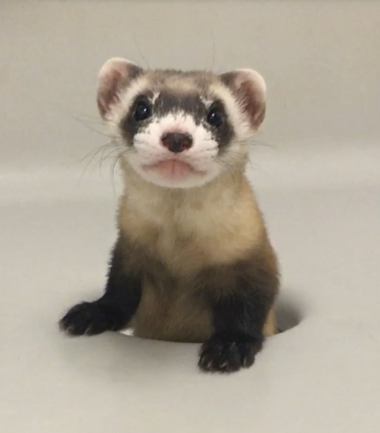
Cells from ferret, “Willa” were preserved by freezing, and when somatic cell nuclear transfer (SCNT) became a possibility, Willa’s cells were used to create Elizabeth Ann, the kit born just over one month ago.
Before Elizabeth Ann’s birth there were upwards of 1,000 black-footed ferrets alive in the western U.S., but they were all descendants of just 7 ferrets, and thus genetically very similar.
Analysis of Elizabeth Ann’s genome has revealed more than three times the genetic variants found in the existing wild U.S. ferrets. This means that if she is able to reproduce, her contribution to the genetic diversity of wild ferrets would be huge.
Interested in learning more about ferrets and the challenges they’ve faced in surviving and thriving in the wild? Below is our original 2018 blog with those details. Don’t miss the video clip of a young black-footed ferret doing the “weasel war dance” (below).
Continue reading “It’s a Girl! Welcoming Black-Footed Ferret Kit Elizabeth Ann!!”