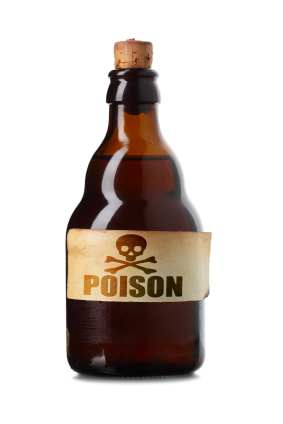
Poisoners and Scientists

If you eat enough silver, you will turn blue, but it probably won’t kill you.

In the 1920s, you could buy energy drinks and cosmetics containing radium. Because of its beneficial effects on tumors, it was believed to be healthy.

Arsenic was once known as “the inheritance powder”, because it was so commonly used to eliminate relatives who stayed alive too long.

In the 1930s the poison thallium was used in depilatory creams, because of its excellent ability to make hair fall out, but also because of its ability to lend a beautiful pale luster to the skin.

These are just a few of the fascinating facts and stories you can find in “The Poisoner’s Handbook”, by Deborah Blum

Continue reading “Poisoners and Scientists”

When the Writing Gets Tough, the Tough Write about Semicarbazide-Sensitive Amine Oxidases

These are the cranes I saw while walking and thinking about SSAOs.
When you hold a position as a scientific communication specialist at a biotech company, you never know what you are going to need to write. Most of the time I really like the fact that I have to master new subject matter on a daily basis. I’m using my degree and my brain, and articulating science in a way that connects with the reader is incredibly rewarding. It’s why I do what I do.

However, when I was asked to write about a new assay for semicarbazide-sensitive amine oxidases (SSAOs), my enthusiasm waned. This is a subject about which I know nothing, so I searched the literature to learn as much as I could. After reading several review articles I was able to write this scintillating paragraph: Continue reading “When the Writing Gets Tough, the Tough Write about Semicarbazide-Sensitive Amine Oxidases”

Use Parallel Structure to Guide the Reader

computer_keyboard

Parallel construction signals to the reader that two ideas are of equal importance. If two or more ideas or items are connected by a coordinating conjunction such as “and”, “but” or “or”, then those ideas should be expressed in parallel or equivalent grammatical constructs. Items and ideas of equal importance should be presented using equivalent grammatical structures. Items in a list should be parallel: all verbal phrases, all nouns, etc. Parallel construction guides your reader and helps your reader organize concepts on a first read of your text.

Continue reading “Use Parallel Structure to Guide the Reader”

Sloppy Technicians and the Progress of Science

Then, in 1953, a geneticist in Texas accidentally mixed the wrong liquid with HeLa and a few other cells, and it turned out to be a fortunate mistake. The chromosomes inside the cells swelled and spread out, and for the first time, scientists could see each of them clearly. —Rebecca Skloot, The Immortal Life of Henrietta Lacks

Okay, Ms. Skloot, no fair teasing a geneticist reader like that. Who was the scientist in Texas? What was the wrong liquid? How long did it take for the scientist to realize he had launched the entire field of cytogenetics with his mistake? This inquiring mind wants to know.

Continue reading “Sloppy Technicians and the Progress of Science”

Rescue the Verb!

Getting What You Want from Your Science Writing IV: Rescue the Verb!

computer_keyboard

When I wrote for my courses in college and in graduate school, my target audience was my professor, so I wrote to impress. To sound “smart” I nominalized verbs, used passive voice and as much jargon as possible. This is the kind of writing that complex scientific topics require. Right?

Continue reading “Rescue the Verb!”