FDA Regulation changes: The Problem is still Validation
In March 2026, the FDA published draft guidance that fundamentally changed how NAMs (New Approach Methodologies) are evaluated in drug development. If you’re designing NAMs, whether that be spheroids, organoids, or organs-on-a-chip, your model now must meet specific validation criteria set by regulators. This draft document, titled ‘General Considerations for the Use of New Approach Methodologies in Drug Development’ provides requirements on the use of NAMs, including in vitro, in silico and in chemico methods (FDA & CDER, 2026). This guidance is a big shift from aspirational recommendations towards clearer regulatory recommendations.
It comes on the coattails of consistent feedback and challenges the market has seen over the past few years as they attempt to transition and optimize away from animal models. Mainly being:
“How can I be sure the data I get from this non-animal model is reliable, trustworthy and relevant?”
This regulatory mandate from the FDA requires researchers to use models and assays that meet four validation criteria:
- Context of use
- Human biological relevance
- Technical characterization
- Fit-for-purpose
This guidance initially applies to antibody development, biologics, and will eventually be relevant for small molecules. The momentum in the market is sound and indicates that there is a real need for assays that meet these new requirements.
Progression from announcement to requirement
The drug development pipeline is a well-established, crucial process to provide solutions to many adverse health conditions and diseases. It is designed to thoroughly test molecules/treatments before transitioning to human trials. This pipeline has historically relied upon animal models for preclinical testing, as they offered complex physiology that was used to more closely resemble humans. The hope was using animals provided accurate responses for testing system-wide effects of potential drugs.
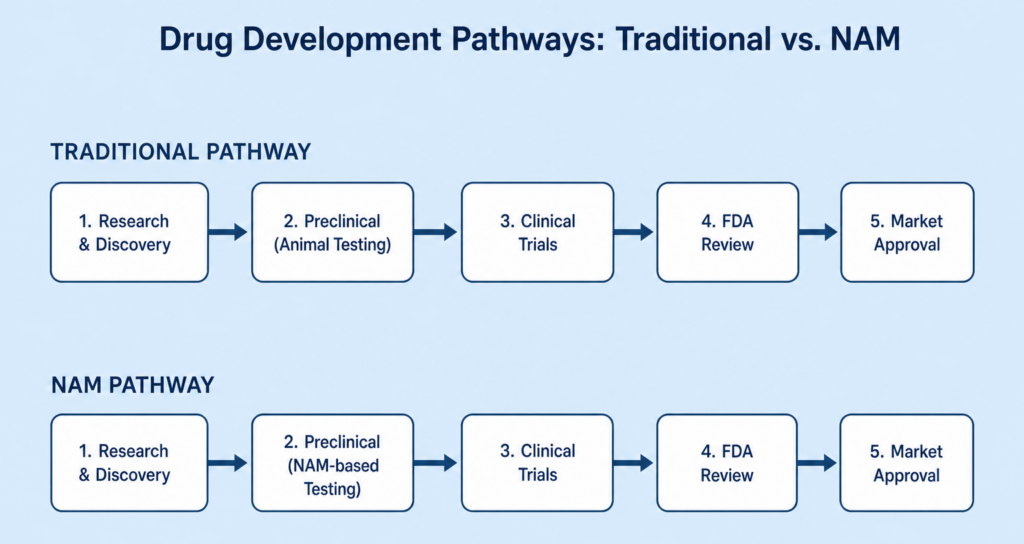
Figure 1: The Drug Development Pipeline before and after the introduction of NAMs. Image created with AI.
In April of 2025, the FDA announced a clear policy signal, that animal testing would be phased out of drug development. The initial policy shift was focused on antibodies as a pilot program. This announcement built upon the Food and Drug Omnibus Reform Act (FDORA) of 2022, which included the FDA modernization act 2.0 that specifically authorized the use of cell-based and computer models as an alternative to animal testing for drug development (FDA Modernization Act 2.0, 2022).
In March of 2026 the FDA published the ‘General Considerations for the Use of New Approach Methodologies in Drug Development’. This document outlined the key requirements for using NAMs, which includes more complex 3D models systems such as spheroids, organoids and organs-on-chips, and in silico models for computational modeling. The FDA outlines in the guidance document the four regulatory criteria that NAMs must meet to be a sufficient replacement of animal models. Beyond these four criteria, the document explicitly required lot-to-lot reproducibility, or “stable results across reagent resupply”.
What does this mean for drug development researchers? There is a real clock in this transition period and very firm expectations of what will be expected of both models and assay performance. Researchers have faced continual roadblocks in addressing these expectations.
The Credibility Killers of NAMs
Several challenges have plagued NAM adoption, hindering the full transition for many researchers.
Reproducibility: Multi-step workflows, including IPS reprogramming through direct differentiation to a mature organoid, have too many manual steps where human error compounds. If several researchers are working on separate 3D models during development, it is highly likely that mistakes won’t be caught until weeks down the road, costing researchers more money and time. Simply ensuring that structures are the same size can prove to be challenging within these workflows.
Endpoint Sacrifice and Longitudinal Tracking: Many assays require destroying samples to acquire a measurement. This can prove challenging for expensive organoid models that may take months to develop, costing thousands of dollars. With no means to track the sample over time, one measurement is a waste of the biological system.
Standardization Across Model Complexity: As spheroid, organoids and organs-on-chips become standard, assays optimized for 2D monolayers can fail in 3D structures. Signal doesn’t penetrate complex tissue architecture throughout or consistently. Similarly, there is not standardized approach to ensure reliable measurement irrespective of the model used.
Promega’s 20-year history on Biological Ground Truth: Solving Each Credibility Killer
We have been building platforms specifically to solve each credibility killer for the last 20 years.
Credibility Killer #1: Reproducibility
In 2001, we launched the CellTiter-Glo® Cell Viability Assay. This bioluminescent readout uses luciferase, an enzymatic signal inherently stable across reagent batches. Unlike fluorescence-based assays (which depend on fluorophore variability), bioluminescence is enzymatically driven, delivering the lot-to-lot consistency the FDA now requires explicitly. Due to the consistency of this assay minimizing compounded error, it became the gold standard cell viability assay and was incorporated into the NCI-60 Drug Screening Panel.
Credibility Killer #2: Endpoint Sacrifice & Longitudinal Tracking
Recognizing that many researchers want an alternative to sacrificing in vitro model samples using endpoint measurements, we developed the RealTime-Glo™ MT Cell Viability Assay. This non-lytic, real-time format enables researchers to measure the same sample repeatedly over days without destroying it. This assay has been incorporated into the Tox21 screening program to integrate the cytotoxicity of ~10,000 chemicals (Hsieh et al., 2017). Biomarkers released into the media serum, such as LDH or metabolites, can also be screened without lysing the cell using our LDH-Glo™ Cytotoxicity Assay and metabolic activity assays.
Credibility Killer #3: Standardization Across Model Complexity
A decade after the launch of the original CellTiter-Glo® Assay, as interest in spheroids and organoids increased, we reformulated the assay for 3D environments. The CellTiter-Glo® 3D Cell Viability Assay uses stronger lytic detergents and optimized incubation protocols to ensure consistent signal penetration through complex 3D structures. The result is the same reliable bioluminescent principle whether cells are in a 2D dish, a spheroid, or an organ-on-chip. Functional assessment of mechanistic toxicity can be added with the non-lytic P450-Glo™ CYP3A4 Assay and Screening System, which can supplement CellTiter-Glo® 3D workflows.
Why does Promega care about NAMs?
We have been solving this problem long before it was called NAMs. Tox21 was launched in 2007 by the NIH/EPA/FDA and screened over 10,000 chemicals using in vitro assays to replace animal testing. The FDA selected the RealTime-Glo™ MT Cell Viability Assay and the CellTox™ Green Cytotoxicity Assay during this testing. The resulting dataset was thousands of chemicals linked to toxicity outcomes. This eventually trained the AI/Machine learning models that the FDA now holds as the standard for validating NAMs.
Additionally, Promega scientists authored key chapters in the NIH assay guidance manual, including the chapter titled ‘In Vitro Cell Based Assays’, and ‘Pharmacokinetics and Drug Metabolism’. These chapters offer substantial guidance on approaching advanced in vitro models within NAM research. The ‘Cell Viability Assays’ chapter has been cited over 3000 times since its publication in 2016. This means anyone using our assays is using assays designed by those to set the standard in cell-based assay.
If NAMs continue to move towards more mechanism-of-action specific validation, demand will likely continue towards more curated bioluminescent reporter technologies. Our 20+ year bioluminescence toolbox of solutions extends from viability, cytotoxicity and metabolic activity assays into luminescent reporters for more complex protein detection capabilities. More information on all the tools we offer for detecting biologically relevant protein activity can be found here.
Looking forward
For 20 years, we’ve built assays specifically to solve the credibility problems NAMs researchers face. Now that the FDA has made those requirements explicit, companies are moving fast to design workflows that meet them. Don’t wait. Talk to us about incorporating our assays into the validation stages of your NAM workflows and addressing the credibility killers. Our assays solve the measurement credibility problem: consistent readouts that regulators trust, enabling your human-relevant models to generate regulatory-grade data. In other words: biological ground truth.
Citations
- FDA, & CDER. (2026). General Considerations for the Use of New Approach Methodologies in Drug Development Guidance for Industry DRAFT GUIDANCE. https://www.fda.gov/drugs/guidance-compliance-regulatory-information/guidances-drugs
- FDA Modernization Act 2.0. (2022). S. 5002, 117th Congress. Retrieved from https://www.govinfo.gov/app/details/BILLS-117s5002cps
- Hsieh, J. H., Huang, R., Lin, J. A., Sedykh, A., Zhao, J., Tice, R. R., Paules, R. S., Xia, M., & Auerbach, S. S. (2017). Real-Time cell toxicity profiling of Tox21 10K compounds reveals cytotoxicity dependent toxicity pathway linkage. PLoS ONE, 12(5). https://doi.org/10.1371/journal.pone.0177902